📌 QUICK ANSWER
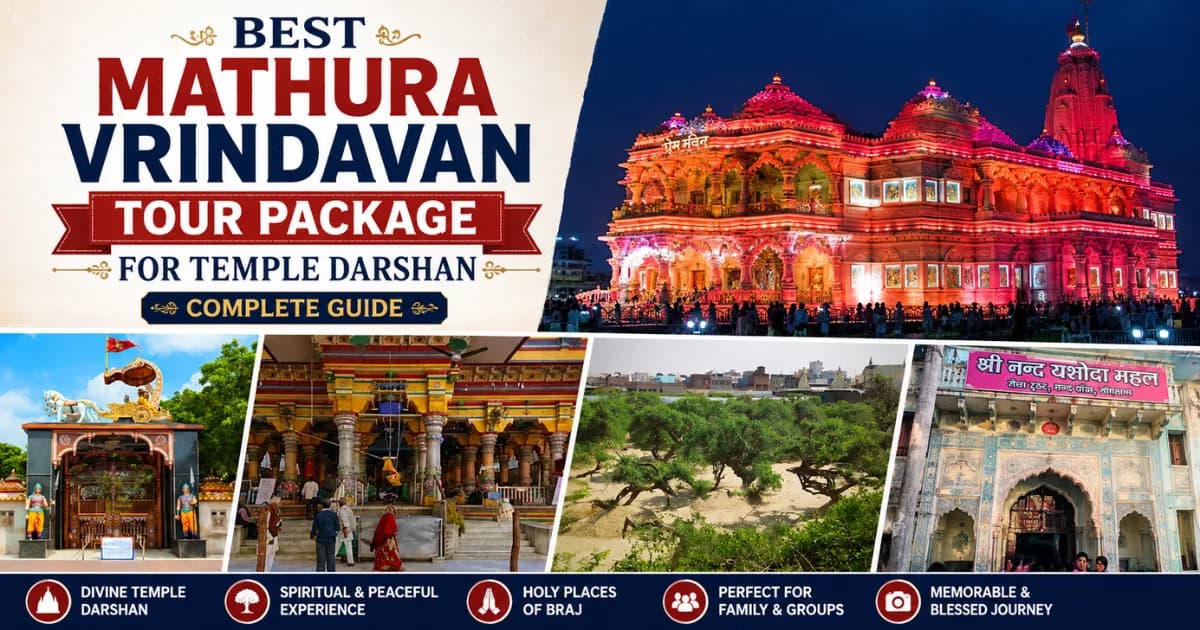
A Mathura Vrindavan tour covers 10 essential sacred sites: in Mathura — Shri Krishna Janmabhoomi, Dwarkadhish Temple, Vishram Ghat, Gita Mandir, and Kans Quila; in Vrindavan — Banke Bihari Temple, Prem Mandir, ISKCON Temple, Radha Raman Temple, and Seva Kunj and Nidhivan. All 10 can be covered in 1 full day. Mathura in the morning, Vrindavan in the afternoon and evening. Experience My India has guided pilgrims through this exact circuit since 2018. Guided tours from ₹2,999 per person. WhatsApp +91-7302265809, 7300620809. Jai Shri Krishna 🙏
Why Mathura and Vrindavan Are One Pilgrimage, Not Two
Mathura and Vrindavan sit 12 km apart on the western bank of the Yamuna River in Uttar Pradesh, and in the theology of Vaishnavism they are inseparable. Mathura is where Lord Krishna was born at midnight in a prison cell, under the watch of his tyrant uncle Kansa. Vrindavan is the forest land where he grew up, performed his childhood leelas, and danced the Ras Leela with Radharani. To visit one without the other is to read only half a book.
Together, the twin cities contain over 5,000 temples within a combined area of roughly 15 square kilometres. The 10 sites in this guide — 5 in Mathura and 5 in Vrindavan — are the ones that every first-time pilgrim must see, selected for their scriptural significance, their architectural distinction, and the quality of darshan experience each one provides. They can all be visited in a single well-planned day, or spread across two days at a more meditative pace.
I am Gurudutt, founder of Experience My India, born and raised in Braj Bhoomi. Since 2018 I have personally guided over 50,000+ pilgrims through this exact circuit — from the pre-dawn security queue at Krishna Janmabhoomi to the evening Vishram Ghat Aarti as lamps float on the Yamuna. I know which session avoids the 90-minute Dwarkadhish queue, which approach to Janmabhoomi gets turned back, and why arriving at Nidhivan after 8:00 PM means standing outside a locked gate. This guide delivers that on-ground knowledge. Call +91-7302265809, 7300620809 to plan your tour with Experience My India.
Mathura — The 5 Essential Places to Visit on Your Tour
1. Shri Krishna Janmabhoomi Temple
Krishna Janmabhoomi is the most sacred site in all of Braj — the garbha griha (inner sanctum) built directly over the prison cell where, according to the Bhagavata Purana, Lord Krishna's parents Devaki and Vasudeva were imprisoned by Kansa and where Krishna was born at midnight during the Ashtami of Bhadrapada month. No temple in India carries the weight of this exact square of earth.
The complex contains two main structures: the Keshavdeo Temple, a modern structure built over the original ruins, and the Garbha Griha shrine — a small, dimly lit cell that is the most intensely moving space on this entire circuit. Security is extensive: mobile phones, cameras, bags, and all electronic devices are prohibited past the main security gate. There is no cloak room or storage facility on-site. Visitors who arrive with devices are turned back from the queue, not from the gate.
Detail | Information |
Morning session | 5:00 AM – 12:00 PM |
Evening session | 4:00 PM – 9:30 PM |
Entry fee | Free |
Devices allowed | None — phones, cameras, bags prohibited past main gate |
Best time | Before 6:30 AM — morning abhishek ritual, minimal crowd |
Distance from Dwarkadhish | 600 metres — 7-minute walk |
Leave all devices and bags in your vehicle before joining the queue. Experience My India guides carry a standard briefing card for every pilgrim before Janmabhoomi entry — WhatsApp +91-7302265809, 7300620809.
2. Dwarkadhish Temple
Built in 1814 by Seth Gokuldas Parikh, treasurer of the Gwalior state, the Dwarkadhish Temple is Mathura's most architecturally celebrated temple. The presiding deity — Lord Dwarkadhish, a form of Lord Krishna as the Lord of Dwarka — is carved of black stone and dressed in seasonal clothing that changes with each festival. The temple's facade is a masterwork of Rajasthani haveli architecture: carved sandstone screens, painted arches, and tiered chhatris stacked in saffron and yellow.
What makes Dwarkadhish unusual is its three-session daily schedule. Most pilgrims and travel websites know only the morning and evening sessions. The mid-morning session from 11:30 AM to 1:00 PM is the least crowded of the three — a crowd-free backup if your Janmabhoomi visit runs longer than planned.
Detail | Information |
Morning session | 6:30 AM – 10:30 AM |
Mid-morning session | 11:30 AM – 1:00 PM — least crowded |
Evening session | 5:00 PM – 9:30 PM |
Entry fee | Free |
Weekday queue | 20–30 minutes (morning) |
Weekend/festival queue | 90–120 minutes (morning) |
Best day | Tuesday or Wednesday 7:00–8:30 AM |
Distance from Vishram Ghat | 600 metres |
3. Vishram Ghat
Vishram Ghat is the most sacred bathing ghat in Mathura — the point on the Yamuna River where Lord Krishna is said to have rested (vishram) after defeating Kansa. The ghat consists of a broad stone staircase descending to the Yamuna, flanked by 25 smaller subsidiary ghats. The evening Yamuna Aarti is the spiritual centrepiece of any Mathura tour — conducted daily by multiple priests simultaneously with large oil lamps, conch shells, and bells in a ceremony lasting 30–40 minutes.
The Aarti's reflection in the Yamuna's surface — oil lamps cycling across the water as conch shells echo from the far bank — is the single most visually striking moment on this entire Mathura Vrindavan circuit.
Detail | Information |
Ghat timings | Open 24 hours |
Summer Aarti (April–Oct) | 7:00 PM |
Winter Aarti (Nov–March) | 6:00 PM |
Best arrival time | 30 minutes before Aarti — upper terrace seating |
Yamuna boat ride | ₹30–₹100 per person — 20 minutes |
Entry fee | Free |
Distance from Janmabhoomi | 1 km — 12-minute walk |
4. Gita Mandir
Gita Mandir is one of Mathura's most distinctive temples — built in red sandstone by industrialist Jugal Kishore Birla in 1965 with a design that intentionally references South Indian temple architecture in the middle of North India's Braj landscape. The temple's defining feature is its interior: every one of the 700 shlokas of all 18 chapters of the Bhagavad Gita is inscribed on the red sandstone walls in both Sanskrit and Hindi script. This makes Gita Mandir a working scripture that pilgrims walk through, not simply a place of worship.
A 35-foot stone column in the courtyard bears the Gita Mahatmya — the glorification of the Bhagavad Gita. The presiding deity is Lord Lakshmi Narayan.
Detail | Information |
Morning session | 5:00 AM – 12:00 PM |
Evening session | 3:30 PM – 9:00 PM |
Entry fee | Free |
Minimum time needed | 45 minutes — the inscribed walls are the point |
Distance from Janmabhoomi | 3 km — 10 minutes by auto-rickshaw |
Best for | Bhagavad Gita students, architecture pilgrims |
5. Kans Quila
Kans Quila is the most historically layered site in Mathura — a fort complex built by Mughal Emperor Akbar in the 16th century on the ground that local tradition identifies as the fortress of Kansa, the tyrant king who imprisoned Lord Krishna's parents and was ultimately defeated by Krishna himself. The fort sits directly on the Yamuna's western bank and offers the most expansive river view available from any site in Mathura.
The structure is maintained by the Archaeological Survey of India and blends Mughal and Hindu architectural elements across centuries of layered history. The terrace provides a 180-degree panoramic view of the Yamuna and Mathura's ghats — the best elevated river perspective in the city.
Detail | Information |
Timings | 6:00 AM – 6:00 PM |
Entry fee | ₹25 (Indian nationals) / ₹300 (foreign nationals) |
Best time for view | 5:00–6:00 PM — evening light over the Yamuna |
Distance from Vishram Ghat | 800 metres |
Visit duration | 30–45 minutes |
Best for | History, river views, photography |
Covering All 5 Mathura Sites Without Missing a Session or Queuing at the Wrong Time? Experience My India coordinates the Janmabhoomi security briefing, the mid-morning Dwarkadhish slot, and Vishram Ghat Aarti terrace seating — all in one guided morning. From ₹2,999 per person · Private AC cab, local guide, all sessions timed Same Mathura Vrindavan Tour Package
Vrindavan — The 5 Essential Places to Visit on Your Tour
6. Banke Bihari Temple
Banke Bihari Temple is the most visited and most emotionally intense pilgrimage space in Vrindavan. The presiding deity — Lord Krishna in the Tribhanga (three-curved) posture, bent at the neck, waist, and knee — is separated from devotees by a curtain drawn at intervals by the priests. The tradition holds that the deity's gaze is so absorbing that sustained eye contact would cause the devotee to lose awareness of the world. The curtain opens and closes every 2–3 minutes throughout the entire darshan session.
Two features distinguish Banke Bihari from every other temple in North India: no bells, no conch shells, and no Aarti lamps are ever used — because the tradition holds the deity is perpetually in divine rest. The curtain interaction is the darshan itself. The temple was established in 1864 by the Goswami lineage of Swami Haridas.
Detail | Information |
Summer morning | 7:45 AM – 12:00 PM |
Summer evening | 5:30 PM – 9:30 PM |
Winter morning | 8:45 AM – 1:00 PM |
Winter evening | 4:30 PM – 8:30 PM |
Entry fee | Free |
Photography | Strictly prohibited inside |
Best time | Weekday 8:00–9:00 AM — quietest slot |
Distance from Keshi Ghat | 800 metres |
7. Prem Mandir
Prem Mandir is Vrindavan's most visually striking modern structure — a 125-foot-tall temple built of Italian and Rajasthani white marble over 11 years, inaugurated in 2012 at a construction cost of ₹150 crore. Every surface of the exterior is carved with relief panels depicting the Ramayana and Radha-Krishna leelas. The 54-acre compound includes musical fountains illuminated in coloured lights each evening.
After sunset the marble surfaces come alive under coloured spotlights as the fountain display choreographs water patterns to devotional music. This is the single largest free public event in Vrindavan every evening of the year.
Detail | Information |
Temple timings | 8:30 AM – 12:00 PM and 4:30 PM – 8:30 PM |
Fountain show (winter) | 7:30 PM — 20 minutes |
Fountain show (summer) | 8:00 PM — 20 minutes |
Entry fee | Free — show is free from gardens |
Best position | Near main fountain facing the temple |
Distance from Banke Bihari | 2 km — 12 minutes by e-rickshaw |
8. ISKCON Temple — Sri Krishna-Balaram Mandir
The ISKCON Temple was inaugurated in 1975 by ISKCON founder Srila Prabhupada, whose samadhi shrine is within the compound. The main temple houses three deity pairs: Krishna-Balaram in white marble, Radha-Shyamasundar, and Gaur-Nitai. The campus includes wide garden pathways, a guesthouse from ₹800 per night, a Vaishnava vegetarian restaurant, and a multilingual information counter.
ISKCON is the most accessible major temple in Vrindavan for first-time visitors, families with children, and senior citizens. The Mangala Aarti at 4:30 AM — pre-dawn devotional chanting in the marble hall — is the most spiritually immersive experience available at any temple on this circuit for early-rising pilgrims.
Detail | Information |
Timings | 4:30 AM – 1:00 PM and 4:30 PM – 8:45 PM |
Mangala Aarti | 4:30 AM |
Sandhya Aarti | 7:00 PM |
Prasadam | Free — before 9:30 AM |
Entry fee | Free |
Guesthouse | From ₹800 per night |
Best for | First-time visitors, families, seniors |
9. Radha Raman Temple
Radha Raman Temple holds a distinction shared by no other shrine in Vrindavan: the original self-manifested deity installed here in 1542 by Gopala Bhatta Goswami has never been moved. During Aurangzeb's 17th-century campaign, the original deities of Govindadeva, Gopinath, and Madan Mohan were relocated to Jaipur for safety. The Radha Raman deity remained — 484 years of continuous worship at exactly this spot.
The deity emerged spontaneously from a Shaligram stone — not carved by human hands. The Shringar Darshan between 8:00 AM and 9:00 AM, when priests dress the deity in fresh clothing while devotees watch from within 5 metres, is one of the most intimate ritual moments available to the public in all of Vrindavan.
Detail | Information |
Timings | 7:00 AM – 12:00 PM and 6:00 PM – 9:30 PM |
Founded | 1542 — 484 years continuous worship |
Deity | Self-manifested Shaligram — never relocated |
Best darshan | Shringar Darshan 8:00–9:00 AM |
Entry fee | Free |
Best for | Vaishnav devotees, pilgrimage depth |
10. Seva Kunj and Nidhivan
Seva Kunj and Nidhivan are two adjacent sacred groves in Old Vrindavan — less than 100 metres apart — best visited as a single 60-minute circuit. They represent the most mythologically charged natural spaces in all of Braj.
Nidhivan is a dense grove of intertwined tulsi trees whose trunks and branches appear locked in permanent embrace. This grove is believed to be where Lord Krishna performs the Ras Leela with Radharani and the Gopis every night after the gates are sealed. The forest is locked at 8:00 PM without exception — no human, animal, or bird remains inside. The Rang Mahal within the complex is the pavilion where priests place nightly offerings that are found consumed by morning.
Seva Kunj, directly adjacent, is the bower where Lord Krishna performed personal service (seva) for Radharani — decorating her hair and adorning her with flowers. It is managed by the Radha Raman Temple trust and is consistently quieter than Nidhivan.
Detail | Information |
Nidhivan timings | 5:00 AM – 12:00 PM and 4:00 PM – 8:00 PM |
Seva Kunj timings | 8:00 AM – 12:00 PM and 4:00 PM – 8:00 PM |
Evening closure | Strictly 8:00 PM — no grace period |
Best entry time | By 7:15 PM for evening visit |
Entry fee | Both free |
Location | 100 metres west of Banke Bihari Temple |
Complete Timings Table — All 10 Sites at a Glance
All timings verified by Experience My India's local team — May 2026. Planning the Mathura morning block and Vrindavan evening block around these windows is the single most important factor in a successful 1-day circuit.
Site | City | Morning Session | Evening Session | Entry Fee |
Krishna Janmabhoomi | Mathura | 5:00 AM – 12:00 PM | 4:00 PM – 9:30 PM | Free |
Dwarkadhish Temple | Mathura | 6:30 AM – 10:30 AM + 11:30 AM–1:00 PM | 5:00 PM – 9:30 PM | Free |
Vishram Ghat | Mathura | 24 hours | Aarti 6:00/7:00 PM | Free |
Gita Mandir | Mathura | 5:00 AM – 12:00 PM | 3:30 PM – 9:00 PM | Free |
Kans Quila | Mathura | 6:00 AM – 6:00 PM | Closes at 6:00 PM | ₹25 |
Banke Bihari Temple | Vrindavan | S: 7:45 AM–12 PM / W: 8:45 AM–1 PM | S: 5:30–9:30 PM / W: 4:30–8:30 PM | Free |
Prem Mandir | Vrindavan | 8:30 AM – 12:00 PM | 4:30 PM – 8:30 PM | Free |
ISKCON Temple | Vrindavan | 4:30 AM – 1:00 PM | 4:30 PM – 8:45 PM | Free |
Radha Raman Temple | Vrindavan | 7:00 AM – 12:00 PM | 6:00 PM – 9:30 PM | Free |
Seva Kunj and Nidhivan | Vrindavan | 5:00 AM – 12:00 PM | 4:00 PM – 8:00 PM | Free |
S = Summer (April–October) | W = Winter (November–March). Timings shift on Ekadashi, Janmashtami, Holi, and major festivals. Call +91-7302265809, 7300620809 on the morning of your visit — Experience My India guides carry real-time updates.
Best 1-Day Mathura Vrindavan Tour Itinerary
This is the exact sequence Experience My India follows on every guided 1-day Mathura Vrindavan tour. Built around session windows, traffic patterns, and crowd timing — not geographic convenience.
Time | Site | City | Notes |
5:30 AM | Krishna Janmabhoomi — morning abhishek | Mathura | Arrive by 5:15 AM; all devices left in vehicle |
7:30 AM | Dwarkadhish Temple — morning session | Mathura | Before 8:00 AM for shortest queue; 20–30 min |
9:00 AM | Gita Mandir | Mathura | Allow 45 minutes; walk all inscribed walls |
10:00 AM | Kans Quila — river view terrace | Mathura | 30-minute visit; best panoramic Yamuna view |
11:00 AM | Drive to Vrindavan | — | 12 km — 20–45 min depending on traffic |
11:30 AM | ISKCON Temple — orientation + kirtan | Vrindavan | Wide paths; good for families and seniors |
12:30 PM | Radha Raman Temple | Vrindavan | Morning session only — evening opens 6:00 PM |
1:30 PM | Lunch | Vrindavan | ISKCON restaurant ₹80–₹150 or local dhaba |
2:30 PM | Rest — afternoon closure window | — | Most temples closed 12:00–4:00 PM |
4:30 PM | Banke Bihari Temple — evening session | Vrindavan | Arrive before 5:00 PM |
5:30 PM | Nidhivan and Seva Kunj | Vrindavan | Enter by 7:15 PM — gates close 8:00 PM |
7:00 PM | Drive back to Mathura — Vishram Ghat | Mathura | 30 min drive; Aarti at 7:00 PM (summer) / 6:00 PM (winter) — time accordingly |
After Aarti | Prem Mandir fountain show (optional) | Vrindavan | Only if staying overnight — 7:30 PM (winter) / 8:00 PM (summer) |
2-Day addition: If staying overnight in Vrindavan, Day 2 adds Keshi Ghat sunrise (5:30 AM), Madan Mohan Temple (6:30 AM), Shahji Temple (8:00 AM), Gopeshwar Mahadev (9:30 AM), and the full Prem Mandir evening show (7:30 PM) — at a relaxed pace. Experience My India's 2-day Mathura Vrindavan package starts from ₹4,999 per person. Call +91-7302265809, 7300620809. Book Your Mathura Vrindavan Tour Package
Festival-Wise Planning for a Mathura Vrindavan Tour 2026
The festival you choose to visit around — or to deliberately avoid — determines everything about your trip: crowd levels, hotel availability, and the specific experience you have.
Festival | 2026 Dates | Primary Site | Visitor Volume | Book How Far Ahead |
Holi — Lathmar Holi | March 1–3 (Barsana); March 2–4 (Mathura/Vrindavan) | Dwarkadhish, Banke Bihari | 500,000+ over 3 days | 90 days minimum |
Ram Navami | April 6, 2026 | Krishna Janmabhoomi | 200,000+ | 45 days |
Janmashtami | August 16, 2026 | Janmabhoomi, Dwarkadhish | 1,000,000+ over 2 days | 120 days minimum |
Radha Ashtami | September 5, 2026 | Banke Bihari, Radha Raman | 150,000+ | 30 days |
Sharad Purnima | October 18, 2026 | Vishram Ghat, Nidhivan | 100,000+ | 30 days |
Kartik Month | Oct 17 – Nov 15, 2026 | All Vrindavan temples | Peak season — steady high footfall | 60 days |
Govardhan Puja | October 23, 2026 | Govardhan Hill (25 km) | 500,000+ | 60 days |
Janmashtami note: Janmashtami in Mathura is the largest Krishna festival in the world. Hotels within 2 km of Krishna Janmabhoomi fill completely 4 months in advance. Rates triple. Experience My India secures accommodation and manages queue logistics for all major festivals — call +91-7302265809, 7300620809 as early as possible.
Best Time to Visit Mathura Vrindavan
Season | Months | Temperature | Crowd Level | Verdict |
Peak — Ideal | October – February | 8°C – 25°C | Moderate weekdays | Best season — all 10 sites comfortable, Kartik month most sacred |
Holi Season | March | 20°C – 32°C | Very high | Go for Holi — the grandest in India; book 90 days ahead |
Summer | April – June | 38°C – 47°C | Low | Only if unavoidable — all outdoor sites before 9:00 AM and after 5:30 PM |
Monsoon | July – September | 28°C – 38°C | Moderate | Janmashtami only (Aug 16) — book 4 months ahead for this |
Janmashtami | August 16, 2026 | 30°C – 36°C | Extreme | Once-in-a-lifetime experience — 1 million+ pilgrims; full advance planning required |
Experience My India operates year-round. For Holi 2027, call by December 2026. For Janmashtami 2026, call +91-7302265809, 7300620809 now — packages for August 16 fill by May.
Mathura Vrindavan for Senior Citizens — Honest Accessibility Guide
Both Mathura and Vrindavan are navigable for elderly and mobility-limited pilgrims — with site-by-site planning. Here is the reality at each location.
Location | Accessibility Reality | Experience My India Approach |
Krishna Janmabhoomi | Flat approach after security. Long queue without early arrival. No bags or devices — leave everything in the vehicle. | Arrive before 6:30 AM to avoid the queue. The guide manages the security briefing for the group. |
Dwarkadhish Temple | Moderate steps at entrance. Flat interior. Long weekend queues. | Tuesday/Wednesday morning visit — 20-minute queue vs 90-minute weekend wait. Mid-morning 11:30 AM session is back up. |
Vishram Ghat | Stone steps to water level. The upper terrace platform gives a full Aarti view without descent. | All senior groups positioned on the upper terrace — no ghat descent required. |
Gita Mandir | Flat, wide approach. Spacious interior. No crowd pressure. | Always included in senior packages — most accessible major temple in Mathura. |
Kans Quila | Moderate ramp and steps to terrace. ASI maintained. Manageable for most elderly. | Morning visit before heat; cab waits at entrance. |
ISKCON Vrindavan | Most accessible in Vrindavan — wide marble paths, seating throughout, no narrow lanes. | First stop in all senior Vrindavan itineraries. |
Banke Bihari | Narrow lane approach. Flat interior. Intense crowd on weekends. | Weekday before 8:30 AM — dramatically easier. The guide manages crowd movement. |
Nidhivan | Uneven ground inside the grove. Manageable for most elderly in the morning. | Morning timing only. AC cab waits at entrance. |
Prem Mandir | Most wheelchair-friendly — wide paths, level ground, benches every 30 metres. | Evening fountain show included; seating secured before arrival. |
WhatsApp +91-7302265809, 7300620809 with your family member's specific mobility requirements before booking. Experience My India adjusts the full itinerary — not just one section.
Mathura Vrindavan Trip Cost 2026 — Complete Budget Guide
All costs verified by Experience My India's local team — May 2026.
Expense | Budget Option | Mid-Range | In Tour Package |
Auto/e-rickshaw (full day) | ₹300–₹500 | ₹600–₹900 | Included — AC cab |
Yamuna boat ride | ₹30–₹100 per person | — | Included |
Food — all meals | ₹200–₹400 | ₹400–₹800 | — |
Hotel per night (Vrindavan) | ₹800–₹1,500 | ₹2,000–₹4,000 | Included |
Kans Quila entry | ₹25 | ₹25 | ₹25 |
All other temple entry | Free | Free | Free |
Guide (full day) | ₹500–₹800 | ₹800–₹1,200 | Included |
Prem Mandir show | Free | Free | Free |
1-day self-guided Mathura Vrindavan trip for 2 people: ₹1,500–₹4,000 all-in, excluding travel from home city. All 9 of the 10 sites are free (only Kans Quila charges ₹25).
An Experience My India 1-day guided package starts from ₹2,999 per person — private AC cab, local guide, all session timings managed, and Vishram Ghat Aarti terrace coordination included. For 2-day packages including hotel, from ₹4,999 per person. WhatsApp +91-7302265809, 7300620809 for a personalised quote.
Ground Truth — What Nobody Tells You About This Tour
Krishna Janmabhoomi has no cloak room or luggage storage. Every travel website mentions that phones and cameras are not permitted inside. Almost none mention that there is no storage facility at the gate. Visitors who arrive with devices are turned back from the security queue — not from the entrance — after waiting 20–30 minutes. Leave every device and bag in your vehicle or at your hotel before joining the line. Experience My India briefs every pilgrim on this before they exit the car.
The Mathura–Vrindavan drive takes 20–45 minutes, not 15. Google Maps shows 12 km and 20 minutes. In practice, morning traffic (8:00–10:00 AM) and evening traffic (5:00–7:30 PM) on the Mathura–Vrindavan Road pushes this to 45–60 minutes. Plan your city crossover between 10:30 AM and 12:00 PM to avoid both traffic peaks. Experience My India drivers know the three alternate routes.
Dwarkadhish has a third session that most pilgrims never find. The mid-morning session from 11:30 AM to 1:00 PM is not listed on most travel sites and is the least crowded session of the three. If your Janmabhoomi visit runs longer than expected, the 11:30 AM slot at Dwarkadhish is your queue-free backup — 10 minutes wait vs 90 minutes in the morning peak.
Nidhivan locks its gates at exactly 8:00 PM — no grace period. Multiple visitors on every tour week arrive at 8:01 PM and stand outside a locked gate. The closing is enforced by temple authorities without exception and has been for as long as anyone in Vrindavan can remember. Plan your Nidhivan visit for 5:00–6:30 PM on a Vrindavan evening — never as a last rushed stop after 7:30 PM.
The Vishram Ghat Aarti and Keshi Ghat Aarti happen at the same time. Both Aartis run at 6:00 PM in winter and 7:00 PM in summer — simultaneously. On a 1-day tour you must choose one. Vishram Ghat's Aarti in Mathura is larger, with more priests. Keshi Ghat's Aarti in Vrindavan is more intimate, with older riverside architecture as backdrop. Experience My India recommends Vishram Ghat for first-time visitors; Keshi Ghat for those returning for a second circuit.
Mathura Vrindavan Experience Summary — Quick Reference
Experience | Best Timing | Time Needed | Ideal For | Cost |
Janmabhoomi morning abhishek | 5:30–6:30 AM | 45 mins | All pilgrims — first priority | Free |
Dwarkadhish darshan | 7:00–8:00 AM weekdays | 30–45 mins | Architecture + devotion | Free |
Vishram Ghat Aarti | 6:00 PM (W) / 7:00 PM (S) — arrive 30 min early | 45 mins | All visitors — spiritual centrepiece of Mathura | Free |
Gita Mandir inscribed walls | 9:00–10:00 AM | 45 mins | Bhagavad Gita devotees | Free |
Kans Quila river view | 5:00–6:00 PM | 30–45 mins | History, photography, river views | ₹25 |
Yamuna boat ride — Vishram Ghat | Morning 7–9 AM or pre-Aarti | 20 mins | Families, couples | ₹30–₹100 |
ISKCON Mangala Aarti | 4:30 AM | 1 hour | Devotional immersion | Free |
Banke Bihari darshan | Weekday 8:00–9:00 AM | 45 mins | All pilgrims — most intense darshan | Free |
Radha Raman — Shringar | 8:00–9:00 AM | 30 mins | Vaishnav devotees, pilgrimage depth | Free |
Nidhivan and Seva Kunj | 5:00–7:00 PM (evening) or 8:00–11:00 AM | 60 mins for both | First-time visitors, mystical experience | Free |
Prem Mandir fountain show | 7:00 PM arrival (W) / 7:30 PM (S) | 1.5 hours | All visitors, families, children | Free |
Dwarkadhish mid-morning session | 11:30 AM – 1:00 PM | 20 mins | Crowd avoiders, late risers | Free |
Know Before You Plan Your Mathura Vrindavan Tour
● Leave all phones, cameras, and bags in your vehicle before joining the Krishna Janmabhoomi security queue — there is no cloak room and no exceptions; arriving with devices means rejoining the queue from the start
● Plan the Mathura–Vrindavan road crossing between 10:30 AM and 12:00 PM — morning and evening traffic can add 30–45 minutes to the 12 km distance
● Dwarkadhish Temple has three sessions — the 11:30 AM–1:00 PM mid-morning session is the least crowded and is the best backup if your morning Janmabhoomi visit runs long
● Nidhivan closes at exactly 8:00 PM with no grace period — plan your entry before 7:15 PM for a complete visit including the Rang Mahal
● The Vishram Ghat Aarti and Keshi Ghat Aarti happen simultaneously — choose one per day; Vishram Ghat for first visit, Keshi Ghat for second
● Banke Bihari Temple on weekday mornings before 8:30 AM is a completely different experience from weekend afternoons — crowd difference is not gradual, it is categorical
● All 9 of the 10 sites in this guide are free — only Kans Quila charges ₹25 for Indian nationals
● Do not carry open food near Banke Bihari or Nidhivan — monkey presence near both sites is active; zipped bags and no visible food
● Radha Raman Temple's evening session opens at 6:00 PM — the latest evening opening of any temple on this circuit; plan Vrindavan evening sequence accordingly
● During Janmashtami (August 16, 2026) and Holi (March 2027), hotel availability within 2 km of Janmabhoomi becomes critical — booking 3–4 months ahead is not early, it is the minimum
Experience My India builds all Mathura Vrindavan tours around these exact realities. WhatsApp +91-7302265809, 7300620809 — personalised itinerary sent within 30 minutes of your enquiry.
Ready to Plan Your Mathura Vrindavan Yatra with Experience My India?
WhatsApp us and receive your personalised Mathura Vrindavan itinerary within 30 minutes — all 10 session timings, Vishram Ghat Aarti seating, Janmabhoomi security briefing, AC cab, and local Braj guide planned and confirmed. Packages from ₹2,999 per person.
WhatsApp +91-7302265809, 7300620809 — Book Now
Jai Shri Krishna 🙏
Gurudutt — Born & Raised in Braj Bhoomi
Guiding pilgrims through Mathura & Vrindavan since 2018 · 50,000+ pilgrims served