📌 QUICK ANSWER
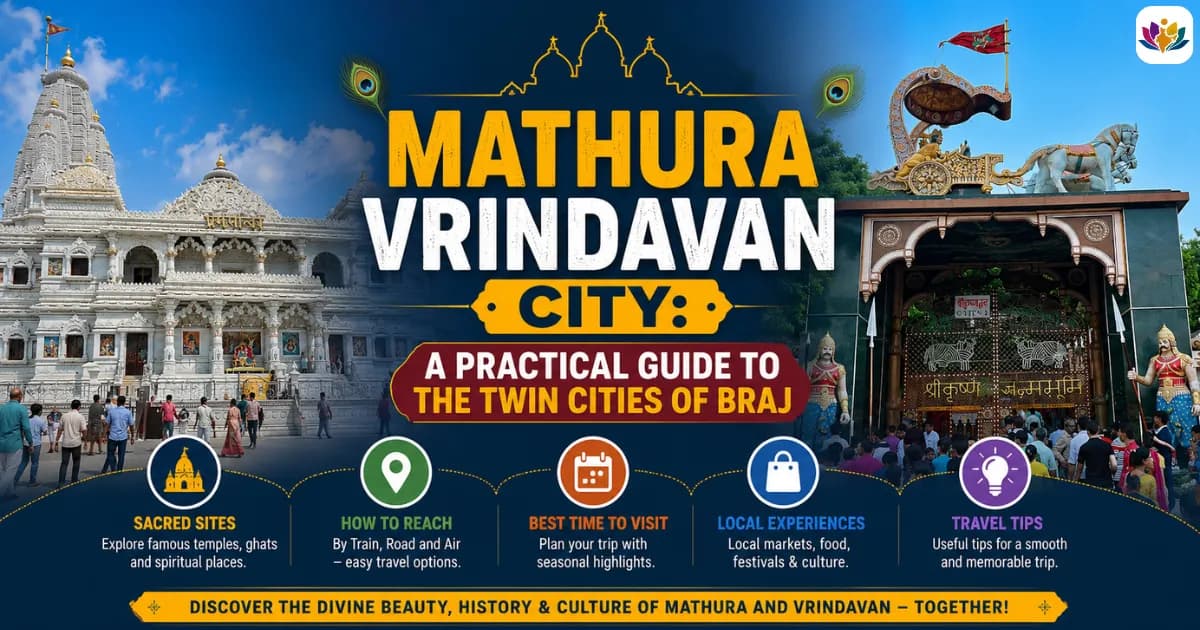
Mathura and Vrindavan are twin cities of the Braj region in Uttar Pradesh, about 12 to 15 kilometres apart and usually spoken of together as one destination. Mathura is the larger administrative city and the birthplace of Krishna; Vrindavan is the temple town where he spent his youth, said to hold thousands of shrines. Get around by e-rickshaw or a private car, stay in Vrindavan, carry cash, and dress modestly. Darshan is free everywhere. To visit both with a Braj-born guide, call or WhatsApp +91 7302265809.
Key takeaways
Mathura and Vrindavan are two towns, about 12 to 15 km apart.
Mathura is the working city; Vrindavan is the temple town.
Stay in Vrindavan, which is central and richest in atmosphere.
E-rickshaws are the everyday form of transport; a private car saves hours.
Carry cash, dress modestly, and expect to remove your shoes often.
Darshan is free everywhere, and no official VIP pass exists.
I am Gurudutt, born in Gokul in the Mathura district, guiding pilgrims through Braj since 2018: more than 50,000 of them. Most guides to this region tell you which temples to see. Very few tell you what the place is actually like to be in: how to get across town, where a car can stop, whether the ATMs work, what to do about the monkeys, and why the two cities feel so different from each other. That is what this page is for. It is the practical brief I give friends before they arrive. To have the whole visit arranged, plan your visit with our Mathura Vrindavan Tour Package. message us on WhatsApp at +91 7302265809, any day from 8 AM to 9 PM.
One name, two very different cities
People say Mathura Vrindavan as though it were a single city. It is not: it is two towns with two characters, and knowing the difference changes how you plan. The table sets them side by side.
Mathura and Vrindavan compared. They are 12 to 15 km apart and feel quite different.
| Mathura | Vrindavan |
What it is | A working city and district headquarters | A temple town, smaller and denser |
The story | Krishna’s birthplace | Where he spent his boyhood and youth |
Feel | Busier, more commercial, more traffic | More devotional, narrow lanes, constant kirtan |
Main draw | Krishna Janmabhoomi, Dwarkadhish, Vishram Ghat | Banke Bihari, Prem Mandir, ISKCON, Nidhivan |
Transport | Railway junction, wider roads | Lanes too narrow for cars in the old quarter |
Where to stay | Practical if you arrive late by train | Better for atmosphere and early darshan |
Time needed | Half a day to a day | A full day, ideally two |
Getting around the two cities
This is where most visitors lose time, so it is worth understanding before you arrive.
E-rickshaws are the everyday transport of both towns, cheap and able to thread the narrow lanes. There is no meter, so agree the fare before you sit; drivers quote high to visitors and it is entirely normal to negotiate politely.
Auto rickshaws cover the longer hops, including between Mathura and Vrindavan, and are a little quicker on the wider roads.
Shared transport runs frequently between Mathura and Vrindavan through the day, and is the cheapest way to make that hop; ask locally for the current pickup points.
A private car is what I recommend for a family or anyone with limited days. It waits at each temple, carries your bags and your phones, and removes the constant negotiating. Our Mathura Vrindavan taxi service covers both towns and the outer Braj villages.
On foot is genuinely the best way to see old Vrindavan. Banke Bihari, Radha Raman, Radha Damodar and the Loi Bazaar lanes are all within a few minutes of one another, and no vehicle can follow you there anyway.
One practical warning: cars cannot reach the Banke Bihari temple itself. Your driver will stop several hundred metres away and you walk the last stretch through the lanes. Plan for that, particularly with elderly travellers.
Where to stay
Stay in Vrindavan unless you have a specific reason not to. It is central to everything, it puts you within reach of the morning darshan before the day trippers arrive from Delhi, and the evening atmosphere is the whole point of being here. Mathura makes sense only if you are arriving very late by train or leaving very early from the junction.
The range runs from simple ashram and dharamshala rooms through mid range hotels to a few genuinely comfortable properties on the edge of town. Rooms near the temples are convenient but noisy from the early hours, since the lanes wake before dawn, and light sleepers may prefer something slightly out. Book well ahead for festival periods, when the whole region fills. Our Mathura Vrindavan hotels page has vetted options, and our Vrindavan trip cost guide sets out what a fair total looks like.
What to eat
The whole of Braj is pure vegetarian, and no meat, fish or eggs are sold in the holy areas; a good many places do not serve onion or garlic either, since the food is cooked as an offering first. The famous things are worth trying:
Mathura peda, the milk sweet the city is known for across India, sold everywhere and best from an established shop rather than a stall at a temple gate.
Kachori with aloo sabzi, the standard Braj breakfast, spicy and heavy and excellent.
Lassi in an earthen cup, thick enough to stand a spoon in.
Rabri and jalebi, for anyone with a serious appetite for sweets.
Temple prasad, particularly at ISKCON, which serves simple sattvic meals.
Eat where the local families are eating, drink bottled or filtered water, and be a little careful with street food in the hot months if you are not used to it.
Money, connectivity and practicalities
Carry cash. Small vendors, e-rickshaws and offerings are cash affairs, and while digital payment is now common in shops, the lanes still run on notes. ATMs exist in both towns but queues and outages happen, so do not arrive with nothing.
Phones. Network coverage is fine in both towns. What matters more is that several major temples do not allow phones inside at all, so the simplest habit is to leave yours in the car.
Shoes. You will remove them many times a day. Wear something you can slip on and off in seconds, and do not bring your best pair; temple shoe stands are safe enough but not immaculate.
Language. Hindi and Braj Bhasha are the local languages. English is understood at hotels and by guides, less so in the lanes, and a guide bridges that gap comfortably.
The monkeys. This is not a joke in Vrindavan. They take spectacles, phones and prasad with real skill, particularly near the ghats and the old temples. Hold everything, and do not try to bargain with a monkey holding your glasses; a local will help for a small tip.
Temple etiquette in a nutshell
Dress modestly, with shoulders and knees covered, for men as well as women. Remove your shoes before entering. Do not photograph the deities where it is forbidden, which includes Banke Bihari and the Krishna Janmabhoomi. Keep quiet during aarti. Give way to the elderly in the crush, which there will be. Accept the prasad with your right hand. And if a priest presses a tilak or a thread on you and then names a figure, a polite, firm no is perfectly acceptable and no offence is taken.
Safety and solo travel
Both towns are safe by ordinary Indian standards, including for solo women travellers, and pilgrims are generally treated with courtesy. The real risks are pickpocketing in the festival crush, the monkeys, and being overcharged rather than anything more serious. Sensible precautions apply: avoid empty lanes late at night, keep valuables close in crowds, use a hotel or a known driver rather than an unknown vehicle after dark, and be firm with anyone who attaches themselves to you as an unofficial guide.
When the cities are at their best
October to March is the comfortable season. Within any day, the two best hours are the early morning, when the temples open and the lanes are still quiet, and the evening, when the aarti bells start and Prem Mandir lights up. The middle of the day is the worst time in every sense: hot, and most temples closed for their long midday break. Plan your rest for them rather than fighting it. Festivals, above all Holi and Janmashtami, transform both cities and fill them beyond capacity; see our festivals of Braj page for the calendar and our best time to visit Mathura Vrindavan guide for the seasons.
How long to give the two cities
One day covers the essentials in a rush. Two days is the sensible minimum: Vrindavan on one, Mathura and Gokul on the other. Three days adds Govardhan and the villages of Barsana and Nandgaon, or simply lets you slow down, which in Braj is not wasted time. A ready plan takes the guesswork out: a Same Day Mathura Vrindavan Tour, a 2 Days Gokul Mathura Vrindavan Tour or a 3 Days Mathura Vrindavan Pilgrimage Tour. Our places to visit in Vrindavan and top places to visit in Mathura guides cover the sights, and the temples of Mathura and Vrindavan hub have a guide for each one.
The honest bit
Some plain words about these two cities, because a great deal of what is published about them is not true. Darshan is free at every temple in Mathura and Vrindavan. There is no official VIP darshan pass at Banke Bihari or anywhere else in Braj, and any website selling one is selling you nothing; foreign visitors and first timers are targeted most. Banke Bihari has no daily Mangala Aarti, only rare festival days, while ISKCON, Rangji and Radha Vallabh genuinely hold one. Nidhivan's nightly raas is a cherished living belief rather than a documented fact. The Yamuna, which both cities are built on, is revered and honestly polluted, so take the aarti and do not bathe carelessly. And treat any page announcing brand new attractions, shuttle services or festivals with caution; a good deal of that is invented to fill a webpage, and I would rather tell you what is genuinely here.
Our VIP darshan in Vrindavan guide sets out the fake pass trade in full.
Why Experience My India is the right choice
I was born in Gokul Mahaban Bangar, inside this district, and these are the streets I grew up in rather than a destination I researched. Guiding since 2018, more than 50,000 pilgrims, 4.5 stars across 204 Google reviews, WhatsApp first, 8 AM to 9 PM daily. What we give is the practical local knowledge this page is made of: where a car can actually stop, which lane is quickest on foot, when each temple is calm, which sweet shop the local families use, and a firm no to anyone selling passes for something that is free. One clear fare, and never a charge for darshan.
Tip from Gurudutt: spend one evening doing nothing at all. Sit on the steps at a ghat as the light goes and the aarti lamps come out, with your phone in the car. Every visitor plans temples and nobody plans this, and it is the hour people write to me about months later.
Related guides
Plan your visit
Tell me your dates and your group, and I will plan your time in both cities, the order, the stay, the transport and the darshan, for one clear price. WhatsApp +91 7302265809, any day 8 AM to 9 PM. Packages from Rs 5,999 per person, 4.5 stars from 204 Google reviews. Born in Gokul, Mathura.
Book Your Mathura - Vrindavan Trip Today 📞 +91-7302265809 💬 WhatsApp: +91-7302265809 Packages start from ₹1,999/ person | Rated 4.5★ / 204+ Reviews Explore all: Mathura Vrindavan Tour Packages Jai Shri Krishna 🙏 |
Gurudutt — Born & Raised in Braj Bhoomi
Guiding pilgrims through Mathura & Vrindavan since 2018 · 50,000+ pilgrims served