📌 QUICK ANSWER
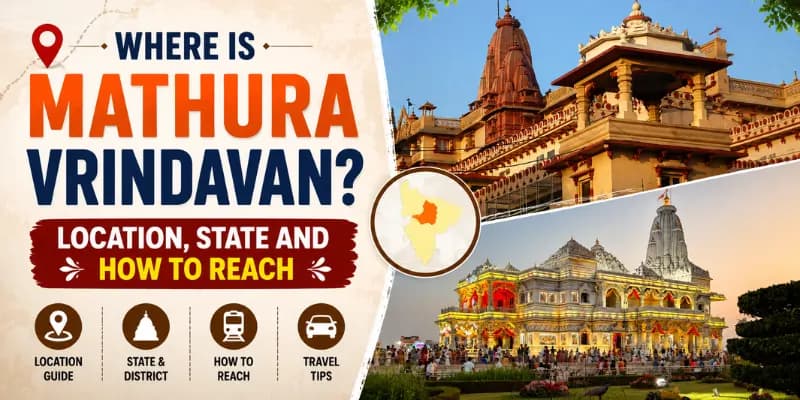
Mathura and Vrindavan are two neighbouring holy towns in the state of Uttar Pradesh, in northern India, in the Braj region of the Mathura district, on the banks of the Yamuna river. They lie about 150 kilometres south of Delhi and about 55 to 65 kilometres north of Agra, with Vrindavan about twelve to fifteen kilometres from Mathura city. Both are easily reached by road on the Yamuna Expressway or by train to Mathura Junction. Mathura is the birthplace of Krishna and Vrindavan the town of his childhood and together they form the heart of the Braj pilgrimage. To visit them with a local guide, call or WhatsApp +91 7302265809.
Key takeaways
Mathura and Vrindavan are in Uttar Pradesh, in northern India.
They lie in the Braj region of the Mathura district, on the Yamuna river.
About 150 kilometres south of Delhi and 55 to 65 kilometres north of Agra.
Vrindavan is about twelve to fifteen kilometres from Mathura city.
Reach them by road on the Yamuna Expressway or by train to Mathura Junction.
Mathura is Krishna's birthplace; Vrindavan the town of his childhood.
I am Gurudutt, born in Gokul, in the heart of this very land and I have guided pilgrims across Braj since 2018: more than 50,000 of them. People ask where Mathura and Vrindavan are because the two names are almost always spoken together, yet many are unsure which state they are in or how far apart they lie. The answer is simple and this guide gives it clearly: where they are, how close they sit and how to reach them from wherever you are starting. To have the whole journey arranged, plan your visit with our Mathura Vrindavan Tour Package, arranged around the temple hours. message us on WhatsApp at +91 7302265809, any day from 8 AM to 9 PM.
Where exactly are Mathura and Vrindavan
Both towns sit in the state of Uttar Pradesh, in the north of India, within the Mathura district, in the sacred region known as Braj or Brij, the land of Krishna's life. They stand on the banks of the Yamuna river. Mathura is the district's main city and the birthplace of Krishna; Vrindavan is a smaller temple town about twelve to fifteen kilometres away, where Krishna spent his childhood. They are close enough to be visited together in a single trip and almost always are.
Location at a glance
Where Mathura and Vrindavan are: location details at a glance.
Detail | Mathura | Vrindavan |
State | Uttar Pradesh | Uttar Pradesh |
Region | Braj | Braj |
District | Mathura | Mathura |
River | Yamuna | Yamuna |
Pin code | 281001 | 281121 |
Distance from Delhi | About 150 km | About 150 km |
Distance from Agra | About 55 km | About 65 km |
Nearest railway station | Mathura Junction | Mathura Junction, about 12 km |
Nearest airport | Agra or Delhi | Agra or Delhi |
How far is Mathura Vrindavan from major cities
The two towns are well placed for a trip from Delhi, Agra and much of north India. From Delhi it is about 150 kilometres, roughly two and a half to three and a half hours by road. From Agra it is about 55 to 65 kilometres, a little over an hour. From Jaipur it is about 230 kilometres and from Noida about 130. Mathura also sits on the golden triangle route between Delhi, Agra and Jaipur, which is why so many pilgrims fold it into a wider tour. Our Delhi to Mathura Vrindavan distance and travel options guide covers the drive in full.
How to reach Mathura and Vrindavan
Reaching the two towns is easy. By road, the Yamuna Expressway from Delhi is the fastest and smoothest route, exiting at Mathura, with Vrindavan a short hop on. By train, Mathura Junction is a major railhead with frequent trains from Delhi, Agra and across India and Vrindavan is about twelve to fifteen kilometres on by auto or cab. There is no airport in Mathura or Vrindavan, so the nearest are Agra and Delhi, from which you travel on by road. Our Mathura Vrindavan taxi service covers the drive and the local travel.
The Braj region: the wider setting
Mathura and Vrindavan do not sit alone; they are the two best known towns of Braj, the wider sacred region of Krishna's life. Around them lie Gokul, where he was raised, Govardhan with its holy hill, Barsana, the town of Radha and Nandgaon, the town of Nanda, all within a short drive. To ask where Mathura and Vrindavan are is really to ask where Braj is and the answer is this gentle stretch of Uttar Pradesh along the Yamuna, south of Delhi. Our guide to whether Mathura and Vrindavan are the same explains how the two towns relate.
The honest bit
Wherever you are coming from, one honest note helps. Once you arrive, darshan at every temple in Mathura and Vrindavan is free; there is no official VIP darshan pass and no one should charge you to enter or for a special view. The towns are easy to reach and free to worship in; the only real costs are your travel, a simple stay and food. Met plainly, Braj asks nothing of you but the journey and an open heart.
Why Experience My India is the right choice
I was born in Gokul Mahaban Bangar, in this very region and I have guided Braj since 2018: more than 50,000 pilgrims, 4.5 stars across 204 Google reviews. We WhatsApp first, 8 AM to 9 PM daily. Knowing where Mathura and Vrindavan are is the easy part; knowing how to move between the towns, at the right hours, past the crowds and the touts, is where a local guide earns their place. From your start city to the door of the temples, we make the whole journey simple, because this is our home.
Tip from Gurudutt: because the two towns are so close, base yourself in one, usually Vrindavan for its temple atmosphere and travel out to the other and to Gokul. The short distances mean you lose almost no time and you keep the calm of a single base.
Related guides
Ready to visit Mathura Vrindavan?
Tell me your start city and your dates and I will arrange the travel and the temples into one easy journey. WhatsApp +91 7302265809, any day 8 AM to 9 PM. Packages from Rs 5,999 per person, 4.5 stars from 204 Google reviews. Born in Gokul, Mathura.
Book Your Mathura - Vrindavan Trip Today 📞 +91-7302265809 💬 WhatsApp: +91-7302265809 Packages start from ₹1,999/ person | Rated 4.5★ / 204+ Reviews Explore all: Mathura Vrindavan Tour Packages Jai Shri Krishna 🙏 |
Gurudutt — Born & Raised in Braj Bhoomi
Guiding pilgrims through Mathura & Vrindavan since 2018 · 50,000+ pilgrims served