📌 QUICK ANSWER
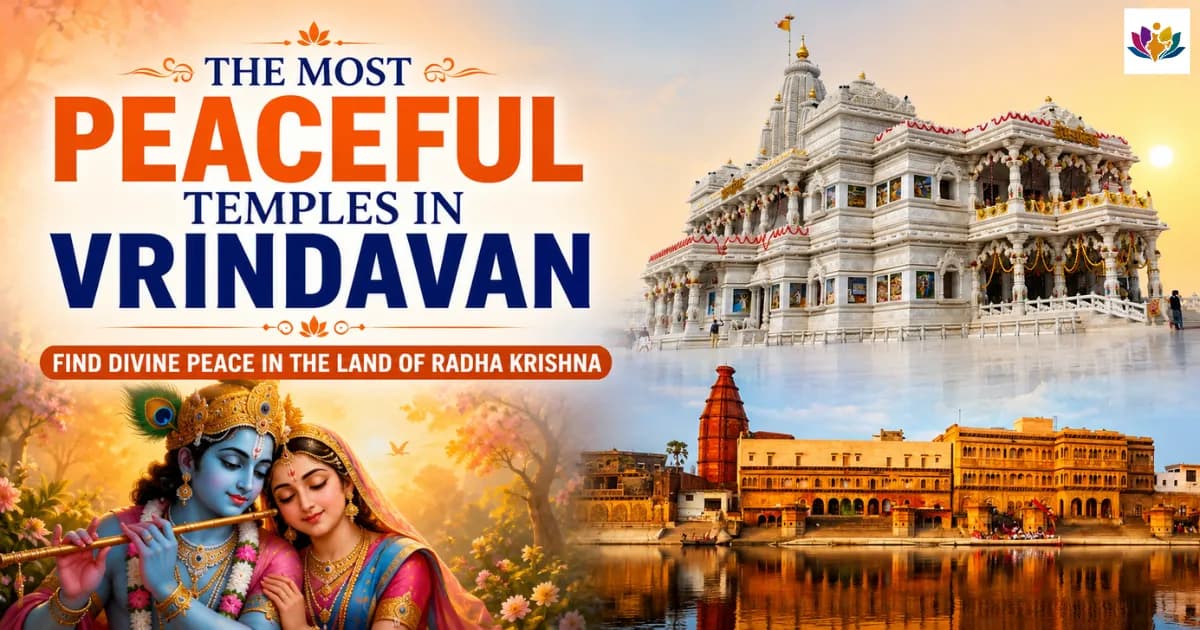
The most peaceful temples in Vrindavan include Radha Raman, Radha Vallabh, Gopeshwar Mahadev, Madan Mohan and Seva Kunj. These older, quieter sites offer calm darshan and space to sit — a contrast to the busy Banke Bihari and ISKCON, especially in the early morning.
Located on the western bank of the Yamuna River, Vrindavan is about 15 km north of Mathura. It belongs to the Mathura district, the state of Uttar Pradesh. The town has more than 5,000 registered temples and many more unregistered ones, that are tucked into such narrow lanes that even a car cannot enter. Each and every one of these temples is dedicated to Lord Krishna or Radha. Figuring out which temple in Vrindavan to visit first and in which order is really a matter of guess for a first-time pilgrim. An incorrect sequence can bring a situation where one ends up at a locked gate after a 3-hour journey.
I am Gurudutt, native of Braj Bhoomi. Since 2018, I have been helping pilgrims navigate around Vrindavan. At Experience My India, my team and I have spent time with 50,000+ devotees including senior citizens who rely on a chair for rest, families with children, visitors who have never seen a jhanki darshan, NRI groups who have heard stories about Banke Bihari all their lives but have never really come face to face with him. I am well-aware that temple A is the quietest at 7:00 AM and temple B is the one where it is impossible to get through by 9:30 AM.
This guide will tell you about the 10 most important temples of Vrindavan with their exact darshan timings, distances from key reference points, and honest peace ratings. Besides, you will get the list of hidden temples that most guides do not mention, a practical darshan sequence, a shopping guide for temple lanes, and the five ground truths that most travel websites leave out. Everything here is based on what I see on the ground-not taken from a brochure.
What Makes a Vrindavan Temple Peaceful and Which Ones Qualify
Just about every Vrindavan temple does not offer a serene darshan premise. Banke Bihari Mandir, though all its spiritual fervor, is a heavily crowded place from the first moment the curtains are drawn. On a Sunday in winter, the number of devotees flowing through the temple can be as high as 8,000-12,000 in one day. That Sure shows power of devotion but at the same time quite challenging to keep peace when looking at it through the eyes of the first time visitor to the pilgrim sites. Locating a peaceful Vrindavan temple among many busy ones, the key factors are:
where the temple is situated within the town, - how darshan is conducted, e.g. jhanki or open, does the temple permit sitting and spending time at the temple rather than just quickly moving people through it. By the virtue of these factors, the three most peaceful Vrindavan temples are:
Radha Raman Temple is a small, 500-year-old temple that has been managed by the same Goswami family since 1542. The idol which is made from a Shaligram shila is only about 30 cm tall. The courtyard has a capacity of not more than 80 people. You can take your time here sitting down. - Madan Mohan Temple is a temple on the top of a small hill near Kali Ghat, constructed in 1580 AD. Its location makes it less accessible as the lane is not visibly marked. From the top, there is a view of the Yamuna as well as the town.
Radha Damodar Temple is famous due to its library. This temple has been the home of three of the Vrindavan Goswamis. Rupa Goswami's samadhi, is located in the courtyard. This place is visited by both pilgrims and scholars. Whereas tourist crowds very rarely come. ISKCON Krishna Balaram Mandira is especially quiet in a different sense: it has a large, organised structure with clean facilities but since it attracts international visitors it can get busy mostly at aarti time. But, the kirtans here rank among the best in Vrindavan.
The 10 Most Important Vrindavan Temples with Darshan Timings
All temples in Vrindavan follow an afternoon closure between noon and 4:00 PM (approximately). This is for the bhog (offering of food) and the deity's rest period. The exact times shift slightly season to season. The timings below are verified by Experience My India's on-ground team as of May 2026.
Temple | Morning Darshan | Evening Darshan | From ISKCON | Peace Rating |
Banke Bihari Mandir | 7:45 AM – 12:00 PM | 5:30 PM – 9:30 PM | 0.9 km | ★★★☆☆ |
ISKCON Krishna Balaram | 4:30 AM – 1:00 PM | 4:00 PM – 8:30 PM | 0 km (reference) | ★★★★☆ |
Prem Mandir | 5:30 AM – 12:00 PM | 4:30 PM – 8:30 PM | 1.1 km | ★★★★☆ |
Radha Raman Temple | 6:00 AM – 11:30 AM | 5:00 PM – 9:00 PM | 1.6 km | ★★★★★ |
Madan Mohan Temple | 6:00 AM – 12:00 PM | 4:00 PM – 8:00 PM | 2.3 km | ★★★★★ |
Radha Vallabh Temple | 5:00 AM – 12:00 PM | 6:00 PM – 9:00 PM | 1.4 km | ★★★★☆ |
Nidhivan Temple | 5:00 AM – 12:00 PM | 4:00 PM – 7:00 PM | 0.7 km | ★★★★☆ |
Radha Damodar Temple | 6:00 AM – 12:00 PM | 4:30 PM – 8:00 PM | 1.8 km | ★★★★★ |
Shahji Temple (Rangji) | 8:00 AM – 12:00 PM | 4:00 PM – 7:30 PM | 1.5 km | ★★★☆☆ |
Govinda Dev Ji Temple | 4:30 AM – 12:45 PM | 4:30 PM – 8:00 PM | 3.2 km | ★★★★☆ |
Note: Winter timings (November–February) shift by 30–45 minutes. Experience My India confirms schedules 24 hours before your visit call +91-7302265809 if your trip is during a festival, when timings change without notice.
Temples
Shri Banke Bihari Mandir The Heartbeat of Vrindavan
This temple is the most popular one in Vrindavan as most of the visitors come to this temple only. Usually, travelers plan to see this temple first throughout the entire Vrindavan. The statue of Lord Bihari is shown in Tribhanga posture which means that he is bent at the knees, waist, and neck. This idol is shown by a curtain system which is called jhanki. Curtains open and close at short intervals. Legend says that long uninterrupted eye contact with the idol is overpowering and might be harmful to ordinary devotees. Don't be surprised when you see, the temple is situated on a very narrow street and that street is full of stalls. Vendor stalls selling garlands, prasads (sweets).
Distance from Mathura railway station:
16 km Distance from ISKCON: 0.9 km
Photography is strictly prohibited inside the shrine.
Festival note: During Holi Janmashtami Radhashtami,
There is only a single general queue, no VIP lane, 2-3 hours waiting.
ISKCON Krishna Balaram Mandir The Organised Pilgrimage
Srila Prabhupada, the founder of the International Society for Krishna Consciousness, built this temple in 1975. It was the first one. When you approach Vrindavan from Mathura, this is the large temple complex that you first encounter on the main road. The marble architecture is a combination of white and red sandstone. There are six aartis daily. The Mangala Aarti at 4:30 AM is the most spiritually potent time of worship. Priests chant in the hall assisted by the absence of people, the sound going residually outside. Besides the temple, there is Prabhupada's samadhi, a library, and a guesthouse.
Travel time from Mathura railway station: 15 min
Beginner class on Bhagavad Gita at 7:00 PM, open to all, free of charge
After distributing morning aarti prasad is served on the spot, no charge
Prem Mandir White Marble and the Light Show
During the years 2001 - 2012, Prem Mandir (Temple of Love) was constructed under the supervision of Kripalu Maharaj. It is located on the southern periphery of Vrindavan and spans 54 acres. The building material is entirely Italian white marble. Several figures on the exterior walls depict episodes of Krishna's life in Braj Govardhan leela, Kaliya daman, Raas mandala. The temple is lit up in changing colours during the light show at dusk (7:00 PM to 8:00 PM). Getting to the pathway by 6:45 PM will allow you to have a good position.
From Banke Bihari: 1.5 km
Gardens remain open till 8:30 PM photography permitted in the grounds
No photography inside the sanctum
Radha Raman Temple-500 Years of Unbroken Worship
This temple is one of the most important historically Vrindavan temples and is by far the most peaceful for the quiet darshan experience. It was founded in 1542 by Gopala Bhatta Goswami, one of the six Goswamis disciples of Chaitanya Mahaprabhu who were sent to Vrindavan. Over the past 480 years, worship at this temple has been carried out daily without fail by the same Goswami family. Radha Raman, the idol people see as self-manifested, a fact that means it came out of the Shaligram shrila (sacred stone) instead of being carved. This figure is quite small, about 30 cm and yet it is treated with great love and respect. Also, this graven idol of Radha is not placed next to the main deity instead, only a crown is kept beside him, which graphically shows that she is there.
This temple was not shifted even once during the Mughal period because the little size of the deity made it quite easy to conceal
In the rear courtyard most mornings, a harmonium player and singer are performing bhajans
The courtyard could hold: approximately 80 people during weekday mornings, it is never too crowded
Madan Mohan Temple The Oldest Living Temple
Constructed in 1580 AD of red sandstone in the Nagara architectural style, it seems to be the oldest Vrindavan temple in continuous operation. It is located on a small hill by Kali Ghat, 1 km from Vrindavan railway station. The original deity, which was installed by Sanatana Goswami, the immediate disciple of Chaitanya Mahaprabhu, was secretly shifted to Karak, Rajasthan during Aurangzeb's reign for safety. The deity currently worshipped here is a substitute of Madan Mohan. The hilltop site entails a climb of 4050 stone steps but rewards with a spectacular view of the Yamuna River and Vrindavan cityscape.
Temple structure height: 50 feet
Design: red sandstone, Rajasthani-Mughal mixed style
Sight from the temple top: Yamuna enfolds in three directions, old Vrindavan terraces bestrewn in all directions
Visitor traffic: quite a bit lesser than Banke Bihariso perfect for a quiet 1015 minutes seating
Radha Vallabh Temple The Radha-Centred Shrine
Radha Vallabh Temple, founded in 1585 by Hit Harivamsa who is counted among the greatest Braj saints, follows a unique theological strand here. Radha, rather than Krishna, is identified as the supreme deity. The figure of Radha Vallabh (which translates to "beloved of Radha") is shown holding a crown that is set next to the statue, symbolizing Radha's invisible yet royal presence. Within a 100-metre radius of Banke Bihari lies this temple, the crowd at which is only a fraction of those going to Banke Bihari. The inner courtyard is adorned with a marble floor and has the feeling of a continuous meditation.
Distance from Banke Bihari Mandir: 0.6 km, easily walkable.
The temple opens at 5:00 AM, one of the earliest morning darshans available in Vrindavan.
Evening aarti at 6:00-7:00 PM intimate with 3050 devotees on weekday evenings.
Nidhivan The Grove Where Night Falls Early
Nidhivan is not a temple as such but a sacred grove of some 16,000 trees, each of which people say is a gopi who joins in the Raas Leela with Krishna, the grove surrounding Banke Bihari Mandir on 3 sides. This garden takes up some 3 acres.
The trees in the grove have truncated, gnarled branches, which grow downward, rather than up and are said to be a result of the gopi's bowing to Krishna in prayer. No one is allowed into the grove after 7:00 PM.
This rule is enforced strictly, as the caretakers, security and priests all leave the temple before the evening shayana aarti. Many of the travel sites I checked say "sunset"or (8:00 PM) neither of which is true; the actual closure time is 7:00 PM.
Near to Banke Bihari Mandir (5-minute walk from ISKCON 0.7 km)
Morning visit (before 9:00 am)recommended the grove is noticeably quieter and the light through the tangled branches is strongest in the first hour after sunrise.
Radha Damodar Temple Where the Goswamis Wrote
3 of the 6 Goswamis of Vrindavan Rupa Goswami, Jiva Goswami Krishnadasa Kavirajara studied, wrote here their dictionaries, found initial inspiration, and compiled their thoughts. Rupa Goswami's samadhi (memorial tomb) is in the courtyard.
The temple library's manuscripts date to the 16th century and it continues to be used by scholars. It is an active academic and devotional building rather than a tourist site.
It will be quiet and full of reading and chanting most days in the morning.
Distance from ISKCON:
1.8 km (use e rickshaw or auto rickshaw) No access,
books and scholars encountered on most mornings with library texts out in courtyard
Within this complex is where the Prabhupada rooms Sri Srila Prabhupada stayed before he even attended to establish ISKCON.
Shahji Temple (Rangji Mandir)The South Indian Footprint
Located near Rangji road about 1.5 km from ISKCON, Shahji Temple was constructed in 1851 by Kundan Lal Shah, a Lucknow jeweller of great wealth. It is the only South Indian Dravidian-style temple in Vrindavan. Some major features of the temple complex are the 50-foot gold-plated Dwajasthambha (flag pillar) and a large water tank. The architectural difference from the rest of Vrindavan's temples, which are mostly Rajasthani and Mughal-inspired, is quite noticeable. The Brahmotsavam festival, which is celebrated in Chaitra (March-April), attracts tens of thousands of South Indian devotees. On other days, the temple does not see as many visitors as the main temples.
Location: close to Rangji Road, about 1.5 km from ISKCON
Much less crowded on regular days calm darshan possible without pre-planning
The water tank is about 1-acre in size which is very uncommon for a Vrindavan temple complex
Govind Dev Ji Temple The Largest Original Vrindavan Temple
Constructed around 1590 AD under Akbar's reign, who generously donated red sandstone, Govinda Dev Ji Temple was at first the largest and tallest temple in Vrindavan with its seven-storey structure. Aurangzeb gave the order to demolish the top four storeys in the 17th century. The existing three storeys still make it the most architecturally significant original temple in the town. The present idol of Govinda Dev Ji is now kept at Jaipur (it was shifted there for safety in the 1700s). At the Vrindavan site, a substitute idol is worshipped. The temple is located 3.2 km from ISKCON auto-rickshaw.
Distance from ISKCON: 3.2 km the furthest of the top-10 temples; plan transportation
Original temple height (before demolition): 7 storeys only 3 remain today
Open from 4:30 AM for Mangala Aarti one of Vrindavan's earliest opening temples
Hidden Places to Visit in Vrindavan Temples Most Tourists Never Find
You have probably read about Banke Bihari and Prem Mandir. Here are four places in Vrindavan that even many repeat visitors have never entered.
Radha Damodar Temple Where the Goswamis Wrote
Out of the six Goswamis of Vrindavan Rupa Goswami, Jiva Goswami Krishna dasa Kaviraja lived and wrote here. Rupa Goswami's samadhi (memorial tomb) is in the courtyard. The temple library contains manuscripts dating back to the 16th century. This is a living academic and devotional institution, not a tourist attraction. It is quiet on most mornings. You will often find scholars and sadhus sitting with texts in the courtyard.
Seva Kunj The Grove Where Krishna Played
Close to Banke Bihari Temple, Seva Kunj is an enclosed garden grove that closes at sunset. As Braj tradition, this is where Krishna performed Raas Leela with the gopis. The trees here are old and interlocked. The atmosphere inside is noticeably different from the temple lane just 30 metres away; there is almost no noise. Entry is free. Open from 5:00 AM to approximately sunset.
Katyayani Peeth The Devi Temple in a Krishna Town
Though Vrindavan is noted for Krishna temples, this Shakti peeth is one of the 51 shakti peeth as of India, linked to the Vrindavan devi tradition. It is quiet precisely because most pilgrims come to Vrindavan for Krishna darshan and don't expect a Devi temple. Located near Rangji Temple, about 2 km from ISKCON.
Pagal Baba Temple The Multi-Storey Curiosity
A multi-level modern temple built by a saint called Pagal Baba ("mad saint"). Each floor has a different Krishna's pastimes/sculpted scenes on marble and plaster. It is very unusual, layered take 2030 minutes to walk through properly. Most pilgrims pass outside without going in.
If you want to include 2 or 3 of these hidden places in your Vrindavan itinerary, the 2 Days Mathura Vrindavan Tour Package from Experience My India incorporates time for the lesser-known sites-they are not an afterthought. See tour packages below or call +91-7302265809. Mathura Vrindavan Tour Packages
Vrindavan Temple Distance Guide How Far Is Each Temple?
Vrindavan's inner temple lanes are not navigable by car. Move between temples by e-rickshaw (₹20–₹40 shared, ₹80–₹120 per e-rickshaw for a group), auto-rickshaw (₹50–₹100 between points) on foot. All distances below use ISKCON as the central reference point.
Temple | From ISKCON | From Banke Bihari | Walk Time | Best Transport |
0.9 km | 0 km (reference) | 12 min | Walk / e-rickshaw | |
1.1 km | 1.5 km | 20 min | E-rickshaw | |
Nidhivan / Seva Kunj | 0.7 km | 0.3 km | 5 min | Walk |
Radha Raman Temple | 1.6 km | 0.8 km | 18 min | Walk / e-rickshaw |
Madan Mohan Temple | 2.3 km | 1.8 km | 28 min | Auto / e-rickshaw |
Radha Damodar Temple | 1.8 km | 1.1 km | 22 min | Walk / e-rickshaw |
Radha Vallabh Temple | 1.4 km | 0.6 km | 16 min | Walk |
Govinda Dev Ji Temple | 3.2 km | 2.5 km | 38 min | Auto-rickshaw |
Mathura (Janmabhoomi) | 15 km | 15 km | N/A | Car / cab (₹400–600) |
Mathura is 15 km from central Vrindavan. A private Taxi Booking Service in Mathura costs ₹400–₹600 one way. If you combine Mathura and Vrindavan in one day, start in Mathura by 6:00 AM and reach Vrindavan by 10:30 AM. The Same Day Mathura Vrindavan Tour Package from Experience My India is built around this exact sequence call +91-7302265809 to book.
Suggested Darshan Sequence for One Day in Vrindavan
This is the sequence Experience My India uses for most single-day pilgrims. It follows temple opening windows and avoids the noon closure crunch.
Time | Temple / Place | Practical Note |
5:30 AM | Keshi Ghat | Priests start morning rituals at 5:30 AM quietest time on the ghat. By 9 AM it is full of visitors. |
6:30 AM | Radha Raman Temple | Arrive at opening. The courtyard usually holds under 30 people at this hour. Bhajan singer performs in the rear portico. |
8:00 AM | Madan Mohan Temple | Climb 40–50 steps. Panoramic Yamuna view from the top. Budget 30–40 minutes. |
9:30 AM | Banke Bihari Mandir | Arrives before the peak 10:30 AM crowd. E-rickshaw drops 300 m from the gate. No phones or bags inside. |
11:00 AM | Nidhivan / Seva Kunj | Three-minute walk from Banke Bihari. Photography prohibited inside Nidhivan. |
12:00 PM | Lunch Break | All temples close. Kachori-sabzi at lane dhabas (₹30–₹50). Kulhad lassi near Banke Bihari lane (₹40–₹60). |
4:30 PM | ISKCON Temple (Krishna Balaram) | Sandhya Aarti at 7:00 PM. Bhagavad Gita class at 7:00 PM attend one if time allows. |
6:45 PM | Prem Mandir | The light show begins at 7:00 PM. Reach by 6:45 PM to find a good spot on the garden path. |
8:30 PM | Depart or check in | Return to Delhi (3 hours) or check in to hotel in Vrindavan. |
Want to add 2 Days Mathura Vrindavan Govardhan, Barsana Tour Package? That requires Day 2. The 3-day Braj circuit from Experience My India covers those sites on Day 2 and Day 3call +91-7302265809 or see tour packages section below.
What to Buy Near the Vrindavan Temples Shopping in the Temple Lanes
Vrindavan's commercial lanes are inseparable from its temple culture. Everything sold here is connected to devotion; there is no souvenir market in the tourist sense. Here is what the lanes near each major temple actually offer, with honest prices.
Near Banke Bihari Mandir Banke bihari Colony Lane
Mathura ke Pede, the dense milk sweets, are the most famous product of the region. Rs.120-Rs.200 for a 250g box.
Brijwasi Sweets (since 1941) is the most well-known shop.
Buy the fresh one, do not go for the packaged one as the taste difference is quite significant. Flower garlands for darshan: Rs. 2060 per garland.
Marigold and rose garlands are the most common ones.
It is also possible to take darshan of Banke Bihari after getting a garland from the sanctioned vendors outside the gate.
Peacock feather items: Peacock feathers relate to Krishna's crown.
A single feather will cost Rs. 10-20.
Fans and ornamental arrangements are in the range of Rs. 80-300.
Near ISKCON Bhakti vedanta Swami Marg
Bhagavad Gita and spiritual books:
The ISKCON book counter situated inside the temple complex has the Bhagavad Gita As It Is in 15+ languages.
Prices start at Rs. 80 (pocket edition) up to Rs. 600 (hardback illustrated).
Incense and dhoop: Several varieties.
Govardhan incense is locally made in the Braj region.
Rs.30-Rs.80 per pack.
Near Prem Mandir Garden Stalls Marble idols:
Miniature marble Krishna/Radha idols, 520 cm, prices between Rs. 200 and Rs. 2,500 based on the quality of the workmanship.
Make sure to verify whether the base is steady before finalizing the purchase.
Bangles and traditional jewellery:
Glass bangles in Radha pink and Vrindavan green.
Priced at Rs. 30-Rs.150 per dozen.
Chura sets (traditional bangles) Rs. 200-Rs.800.
Ground Truth What Nobody Tells You About Vrindavan Temples
I have been walking these lanes since before I started leading tours in 2018. Here are five things that almost no travel article tells you clearly but every pilgrim learns by experience.
1. "Peaceful darshan at Banke Bihari" before 8:00 AM on a weekday is real. After 10:00 AM on any day, it is not.
By 10:30 AM on a Saturday in winter, 3,000–5,000 people are in the Banke Bihari lane. The curtain is still opening and closing, but the crowd is dense enough that you move when the crowd moves. Plan for Banke Bihari before 9:30 AM if you want to stand still for a few minutes.
2. Every e-rickshaw driver near the temples has a commission arrangement with specific shops.
This is not malicious, it is how the economy of the town works but it means a driver who "recommends" a sweet shop or marble idol stall is earning a cut. Buy from whichever shop you prefer, not from the recommendation of a driver who just met you. Experience My India guides do not take commissions from any shop in Vrindavan.
3. ISKCON Vrindavan is open 24 hours for meditation in the outer courtyard, the sanctum closes at 8:30 PM.
If you are staying in Vrindavan overnight and want to sit in a temple space after 9:00 PM, the ISKCON outer courtyard is accessible. Security is present. The actual temple hall and deity are not available for darshan after 8:30 PM.
4. Nidhivan closes at 7:00 PM not at sunset, not at 8:00 PM, not "sometime in the evening."
The grove closes at 7:00 PM for the evening shayan aarti. After that, no one, not the priests, not the caretakers remains inside. Multiple travel blogs say "8:00 PM or sunset." The actual closure is 7:00 PM. If you arrive at 6:55 PM, you will be asked to leave almost immediately.
5. Prem Mandir's 54-acre complex is easy to underestimate budget 90 minutes, not 30.
Most tour guides allocate 30 minutes at Prem Mandir. That is enough to see the exterior and leave. To walk the full circumambulation path, read the 27 carved panels on the outer walls depicting Krishna's life, and watch the water features stay for the 7:00 PM light show, you need 90 minutes minimum. Experience My India allocates 90 minutes in its evening slot.
Know Before You Plan
Before booking your Vrindavan temple visit, here are eight planning realities our Experience My India team shares with every pilgrim before their trip:
Plan around temple timings, not map distances in Vrindavan, a 1 km route can take 25 minutes during peak hours due to narrow lanes and e-rickshaw congestion.
Arrive at Banke Bihari before 9:30 AM on weekdays for a composed darshan after 10:30 AM, crowd density makes quiet standing impossible.
No phones or bags inside Krishna Janmabhoomi (Mathura)cloakrooms are free but add 10–15 minutes to your entry time. Plan accordingly.
Nidhivan closes at 7:00 PM not at sunset. The grove is emptied before the evening ritual. Arriving at 6:55 PM means being asked to leave.
All major Vrindavan temples close from noon to 4:00 PM use this time for lunch, rest/travel between Mathura and Vrindavan, not for temple visits.
E-rickshaws inside Vrindavan are shared and negotiated after the price before boarding. Standard Banke Bihari to ISKCON: ₹20–₹40 shared, ₹80–₹120 private.
Dress code applies across all temples, shoulders and knees covered, no leather goods inside temple premises, carry a dupatta for head covering at some temples.
Experience My India confirms real-time temple timings before each tour festival days shift all schedules without advance notice. Call +91-7302265809 the morning of your visit for the latest update.
Conclusion
Vrindavan's 5,000+ temples are not just a list. They are a walking devotional landscape with its own tempo regulations- around the clock closings, seasonal time transitions/ lanes too tight to walk in by heart.
The pilgrims who leave happy are those who had planned for those best times, not against them. The complete info for 10 Vrindavan temples, including their exact hours of opening, credible peace rating, inter temple distances and a darshan schedule that ticked all the boxes for what practically could be achieved in a single day is what this guide gives you.
Include the five secret temples, the shopping guide, the five ground rules, the 8 tips to Know Before You Plan and you have everything you need for a My India Experience level of visit even without a guide. Want us to organize it, car hotel guide us, need darshan sequence tours from. Rated 4.5 from 204+ authentic pilgrims.
📲 Book Your Mathura Vrindavan Trip with Experience My India
WhatsApp or Call to Book Your Mathura Vrindavan Trip Experience My India | +91-7302265809 We Reply Within 30 minutes, Packages start from ₹1,999/ person | Rated 4.5★ / 204+ Reviews Explore all: Mathura Vrindavan Tour Packages Jai Shri Krishna 🙏 |
Gurudutt — Born & Raised in Braj Bhoomi
Guiding pilgrims through Mathura & Vrindavan since 2018 · 50,000+ pilgrims served