📌 QUICK ANSWER
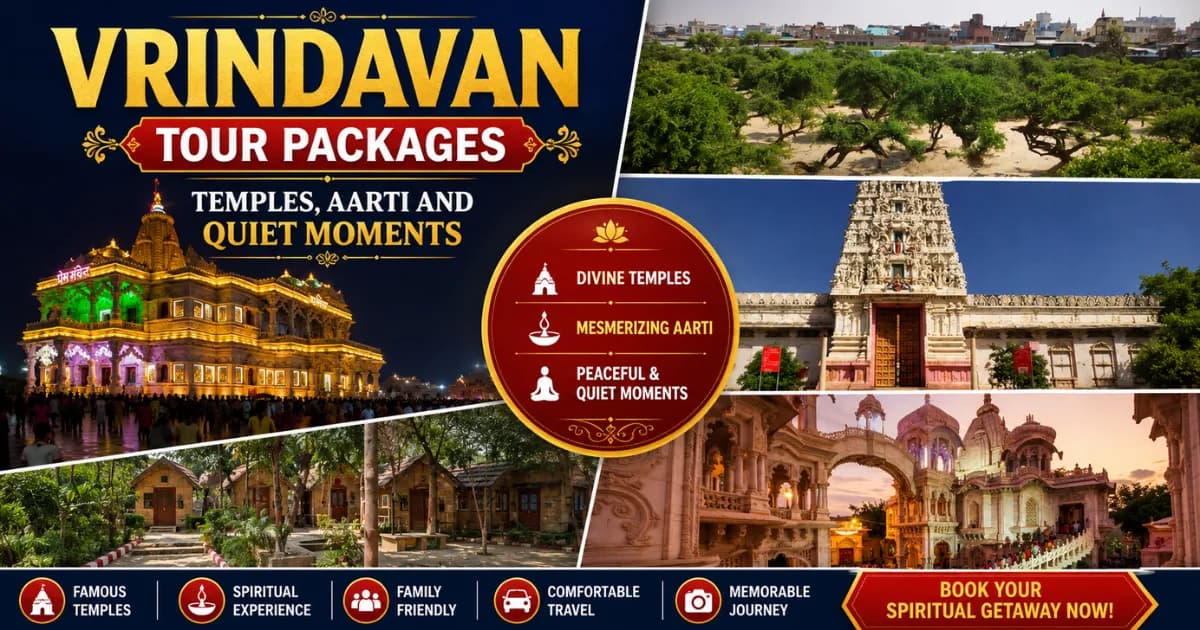
The Vrindavan tour packages by Experience My India start at just Rs 1,999 per person and will take care of the 6 major temples – Banke Bihari, ISKCON, Prem Mandir, Radha Raman, Nidhivan & Radha Vallabh temples with Aartis timed at each stop. Gurudutt (a native of Braj Bhoomi and assisting pilgrims since 2018) has guided more than 50,000+ devotees on the holy lanes. These packages are from one day.guided day to a 4-day Braj circuit. To book or customise, call +91-7302265809 or 7300620809. Rated 4.5★ by 204+ pilgrims. Jai Shri Krishna 🙏
Vrindavan is a place of 5,000 temples, lanes only three meters wide, and a spiritual beat driven not by alarm clocks but aarti bells. Most people looking for Vrindavan tour packages are ultimately asking: "How do I be there, where the place can seep into me?" To find the answer you need to know where and when to visit the temples, when the curtain falls at Banke Bihari, and where to stand by the Yamuna as the evening lights die down on the water.
I am Gurudutt, a son of Braj Bhoomi-the very land sanctified by Lord Krishna’s life and laughter. As founder of Experience My India, I’ve been leading over 50,000+ pilgrims around Vrindavan since 2018. This guide will walk you through our vrindavan tour packages, the temples that truly matter and when they’re most significant, and the sacred peace that most groups fly through.
By the end of this blog post, you will have a full insight into all available packages, fair pricing at just 1,999, a complete aarti timetable, and section by season guide. If you wish to book directly, then just make a call on 7302265809 or 7300620809, and we will arrange your complete trip on call.
What a Vrindavan Tour Package Actually Includes
"vrindavan tour package" has the whole spectrum-a simple car trip with driver to point out the temples to you from the window to a three day guided pilgrimage including boarding, lodging and food, and a Braj born tour guide to know the left side of Banke Bihari's idol which has the least queue at 9 on a Tuesday morning.
At Experience My India, every vrindavan darshan tour package includes three non-negotiable elements:
Book Your Tour with Mathura Vrindavan Tour
Darshan sequencing — temples are visited in an order that respects opening times, avoids peak queues, and connects complementary aarti sessions. You will never arrive at a closed gate on an Experience My India tour.
A Braj-born guide — not a generic city guide trained on pamphlets, but someone who grew up inside this tradition. Gurudutt and his team explain the reason behind every ritual, the significance of the curtain movement at Banke Bihari, and why Nidhivan's gates close before sunset.
Logistics handled — transport, shoe counters, cloak rooms at Krishna Janmabhoomi, temple entry queues, and the 30–45 minute Mathura–Vrindavan transit are all factored in. You carry only a small cloth bag.
Six Temples That Define a Vrindavan Darshan
Vrindavan has over 5,000 temples. These six are the ones that define a complete vrindavan pilgrimage tour package — each serving a different purpose in the devotional arc of the day.
Temple | Significance | Best Darshan Window | Crowd Level |
Banke Bihari Temple | The central deity of Vrindavan — Thakurji darshan; curtain opens and closes repeatedly | Morning: 7:45 AM–12:00 PM (summer) | Very high weekends |
ISKCON Sri Krishna Balaram Mandir | Accessible devotion, prasadam, English commentary available | Mangala Aarti 4:30 AM; morning darshan until 1:00 PM | Moderate |
Prem Mandir | White marble temple with evening light show; best experienced at 7:00–8:30 PM | Evening: 5:30 PM–8:30 PM | High evenings |
Radha Raman Temple | One of Vrindavan's most revered and intimate temples; flower seva is elaborate | Morning: 8:00 AM–12:30 PM | Low to moderate |
Nidhivan | Sacred grove where Krishna's leelas are said to continue at night; gates close at sunset | Morning only | Moderate |
Radha Vallabh Temple | One of the oldest temples in Vrindavan; quieter than Banke Bihari | Morning: 7:30 AM–12:00 PM | Low |
A well-designed vrindavan temple tour weaves these six into a two-block day: morning darshan (6:00–12:00) and evening darshan (5:00–9:00), with the 12:00–5:00 window reserved for rest and transit. Experience My India's guides build every itinerary around this flow. Call +91-7302265809, 7300620809 to discuss your priorities.
Aarti Timings — The Heart of Any Vrindavan Tour
The aarti sessions are not supplementary — they are the point. A vrindavan tour package that doesn't build aarti timings into the itinerary is a sightseeing trip with a religious backdrop.
Here are the key aarti timings across the main temples (Summer: April–September; Winter: October–March):
Temple | Aarti Name | Summer Time | Winter Time |
ISKCON Vrindavan | Mangala Aarti | 4:30 AM | 4:30 AM |
ISKCON Vrindavan | Sandhya Aarti | 7:00 PM | 6:30 PM |
Banke Bihari | Mangala Aarti | 5:45 AM | 8:45 AM |
Banke Bihari | Shayan Aarti (closing) | 9:00–9:30 PM | 8:30 PM |
Radha Raman | Shringar Aarti | 8:00 AM | 8:30 AM |
Radha Raman | Shayan Aarti | 8:30 PM | 8:00 PM |
Prem Mandir | Evening aarti + light show | 7:00 PM | 6:30 PM |
Dwarkadhish (Mathura) | Mangala Aarti | 6:30 AM | 7:00 AM |
Note: Timings shift on Ekadashi, Janmashtami, Holi, and Radhashtami. Gurudutt's team tracks these in real time. Call +91-7302265809, 7300620809 on the morning of your visit for that day's confirmed timings.
The Mangala Aarti at ISKCON at 4:30 AM is the quietest and most intimate experience in Vrindavan — fewer than 50 devotees on most weekday mornings, lamp flames reflected in the marble floor, and no audio amplification. Experience My India includes this in our 2-day and longer vrindavan tour packages.
See Our All Mathura Vrindavan Tour Package
How to Choose the Right Package Duration
The right vrindavan tour package depends on three variables: how many temples you want to absorb (not just visit), whether you want to include Mathura, and whether Govardhan Hill is on your list.
Duration | Temples Covered | Right For |
1 Day | 4–5 Vrindavan temples | First visit from Delhi/Agra; focused darshan, no overnight stay |
2 Days | Vrindavan (Day 1) + Mathura full day (Day 2) | Those wanting both towns without rushing |
3 Days | Vrindavan + Mathura + Govardhan Hill | Genuine pilgrimage; includes Govardhan Parikrama (23 km) |
4 Days | Full Braj circuit: Vrindavan + Mathura + Govardhan + Nandgaon + Barsana + Gokul | Complete Braj pilgrimage for families and senior devotees |
The most common mistake is booking a 1-day Mathura Vrindavan tour package and then trying to cover 10 temples. Experience My India's standard recommendation: 4–5 temples in 1 day, visited properly, with time at each aarti. Ten temples in one day means you experience nothing deeply.
For the right choice for your group, call +91-7302265809 or 7300620809. We will ask three questions and have a recommendation in two minutes.
Season-by-Season Guide to Vrindavan Tour Packages
Vrindavan looks and feels different in every season — and the right vrindavan tour package for October is not the right one for March.
Season | Months | Temperature | Crowd Level | What Makes It Special | What to Watch For |
Post-Monsoon / Autumn | October – November | 20–30°C | Moderate | Sharad Purnima; clear skies; temples at full darshan windows | Kartik Maas (Oct–Nov) brings large crowds for 30 days |
Winter | December – February | 8–20°C | Low–Moderate | Best overall conditions; full darshan hours; low queues | Fog in Jan–Feb can delay travel from Delhi |
Spring | March | 22–35°C | Very High (Holi) | Holi in Vrindavan (Lathmar, Phoolon ki Holi) — a once-in-a-year experience | Queues at Banke Bihari during Holi: 3–5 hours; book well ahead |
Summer | April – June | 38–44°C | Low | Quietest time for temple visits; shortest queues at Banke Bihari | Restrict temple visits to before 11:00 AM and after 5:30 PM |
Monsoon | July – September | 28–35°C | Moderate–High | Janmashtami (August) is the most spiritually charged day of the year | Janmashtami queues at Janmabhoomi: 4–6 hours; need advance planning |
Experience My India adjusts all vrindavan tour package itineraries seasonally. The summer timing blocks (6:00–11:00 AM and 5:30–9:00 PM) are different from winter blocks. Speak with Gurudutt at +91-7302265809, 7300620809 to get the right itinerary for your travel dates.
Quiet Moments in Vrindavan — What the Itineraries Miss
Every standard vrindavan trip package lists temples. Almost none of them mention the moments that pilgrims remember for years.
Yamuna at sunrise. Prior to the start of the tours, and the arrival of thousands of people at the ghats, at 5:30am Keshi ghat offers by far the most peaceful time in Vrindavan. The Yamuna reflects the silver light of morning, there are a few boats to be found and the temple bells can be heard drifting on the breeze from afar. Experience My India includes the Keshi ghat experience in all tour packages lasting 2 days and more.
Radha Raman's flower seva. There are specific days (especiallyEkadashi mornings and festival mornings) where the priests of Radha Raman Temple adorn Radha Raman in flowers which requires 4-5 hours to prepare. Gurudutt's team is aware of when this occurs and accommodates that information. This is not listed online.
The Nidhivan lane at dusk. Nidhivan closes before sunset, but the lane outside — lined with ancient trees, a few dhaba lights coming on, the last of the afternoon crowd thinning — is a Vrindavan that most package tourists never see because they are already back in their car.
Prasadam at ISKCON. Free prasadam (a full cooked meal) is distributed at ISKCON Vrindavan every day, but it runs out by 9:30 AM. For pilgrims who arrive early enough, this is both a meal and an experience that connects them to the temple's ethos.
These moments do not appear in a brochure. They appear when your guide is from Braj. Call +91-7302265809, 7300620809 and tell Gurudutt what kind of experience you are looking for — he will build it in.
Ground Truth — What Nobody Tells You Before You Book
After guiding 50,000+ pilgrims through Vrindavan since 2018, here are the realities that most vrindavan travel guides leave out:
1. Vrindavan's lanes are genuinely narrow. A 1.5 km walk between Banke Bihari and Radha Raman takes 25–40 minutes on a weekday and over an hour on a festival day. A 12 km drive from Mathura Junction to Banke Bihari Road takes 35–50 minutes. Google Maps is not useful here.
2. The shoe counter adds 15–20 minutes per temple — always. Vrindavan has no centralised shoe storage. Every temple has its own counter. On a 5-temple day, that is 75–100 minutes in shoe counters alone. Plan for it.
3. Banke Bihari's curtain is not open continuously. The curtain at Banke Bihari opens and closes repeatedly throughout the darshan session — sometimes every 30 seconds, sometimes every 2–3 minutes. This is a tradition specific to this temple (so that devotees do not fix their gaze too long). First-time visitors are often confused. A guide explains it immediately.
4. Three focused darshans beat eight rushed ones. Pilgrims who attempt 10 temples in a single day on a vrindavan darshan tour typically connect deeply with none of them. The Experience My India standard is 4–5 temples per day, with time at each one to absorb the space, the bhajan, and the darshan.
5. The streets smell of incense, cow dung, flowers, and frying jalebi simultaneously. Vrindavan is not a sanitised spiritual resort. It is a living, functioning pilgrimage town that has been active for 500+ years. If you expect clean pavements and quiet streets, adjust the expectation before you arrive.
Call +91-7302265809 or 7300620809. We will tell you exactly what to expect on your specific travel dates.
Plan Your Vrindavan Tour with Experience My India
Vrindavan rewards the pilgrim who arrives knowing what to expect — the two daily darshan windows, the temple-specific rules, the quiet hours between noon and late afternoon when the lanes empty and the birds return to the trees near Nidhivan. It does not reward the visitor who tries to tick temples off a list.
Experience My India exists to make sure you get the first experience, not the second.
WhatsApp +91-7302265809, 7300620809 — Book Now
Jai Shri Krishna 🙏
Gurudutt — Born & Raised in Braj Bhoomi
Guiding pilgrims through Mathura & Vrindavan since 2018 · 50,000+ pilgrims served