
Huranga 2027 at Dauji: The Play That Closes the Braj Holi Season
Huranga falls the day after the main Holi, on Phalguna Krishna Pratipada, at the Dauji (Baldev) temple in Baldeo, around late March 2027 (confirm the tithi). In a rumbustious play in the temple courtyard, the women tear and twist the men's garments and swing the wet cloth while the men drench the women in colour, a unique post-Holi tradition at the temple of Krishna's elder brother Balarama. It closes the Braj Holi season.
Read full guide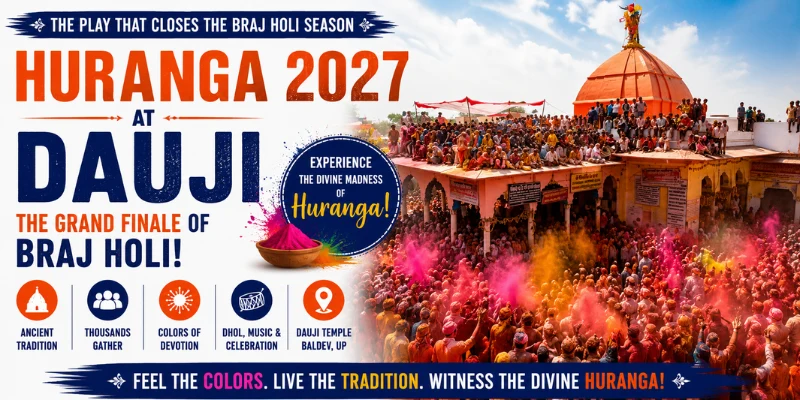
Tuesday, March 23, 2027
Mathura
Quick answer
Huranga falls the day after the main Holi, on Phalguna Krishna Pratipada, at the Dauji (Baldev) temple in Baldeo, around late March 2027 (confirm the tithi). In a rumbustious play in the temple courtyard, the women tear and twist the men's garments and swing the wet cloth while the men drench the women in colour, a unique post-Holi tradition at the temple of Krishna's elder brother Balarama. It closes the Braj Holi season.
Last updated: 23 June 2026 · written by Guru Dutt, born in Gokul · Experience My India
When is Huranga 2027 and the tithi behind it
Huranga 2027 falls the day after the main Holi, on Phalguna Krishna Pratipada, around late March 2027. It is fixed by tithi, so confirm the day on the panchang. It is the last great burst of the forty-day Braj Holi, kept at the Dauji temple in Baldeo, a short way from Mathura and Gokul. While the rest of India has put away its colour, Braj plays one more, wilder day.
What Huranga is
In Huranga, the women of the temple community tear and twist the men's kurtas into ropes and swing the wet, coloured cloth at them, while the men drench the women in colour from the temple tank, a boisterous, joyous play unique to Dauji. It is rough, wet and exuberant, the men taking the lashes of cloth as the colour flies, a courtship-in-play in the spirit of the Lathmar but with its own form, in the courtyard of Balarama's temple. It is the rowdiest, most uninhibited day of the Braj Holi and it closes the season.
The Dauji temple and Balarama
The Dauji temple at Baldeo is one of the principal temples of Balarama, Krishna's elder brother, called Dauji, the respected elder, in Braj. Balarama is the strong, plough-bearing brother and Baldeo is his town; the temple is ancient and beloved and Balarama's appearance is also kept here at Hal Shashthi, Baldev Chhath, before Janmashtami. On Huranga, his courtyard becomes the stage for the season's last play.
Where the play unfolds and how to watch
Huranga unfolds in the courtyard of the Dauji temple, a contained, packed space, which is why watching it well means a planned vantage and a guide who knows the temple. The play is for the temple community; visitors watch the spectacle of the swinging cloth and the flying colour from the side, not from the centre. The courtyard is wet and slippery with colour and water, so footing and position matter and we plan both.
Why Huranga closes the Braj Holi season
Huranga is the final day of the forty-day Braj Holi, the one last, wildest burst after the main festival has ended everywhere else. Coming for Huranga is coming for the cycle's exuberant full stop, at the temple of the elder brother, when Braj plays Holi one more time. For those who want to see the season through to its very end, this is it.
Huranga 2027 at a glance
Tithi durable; 2027 date approximate, confirm on the panchang. | | Tithi | Phalguna Krishna Pratipada (day after Holi) | | 2027 date | late March (confirm) | | Where | Dauji (Baldev) temple, Baldeo | | What | Women swing twisted wet cloth; men drench with colour | | Honours | Balarama, Krishna's elder brother | | Crowd | High, rough and wet in the courtyard |
⚠️ Honest cautions. The play is rough, wet and slippery in a packed courtyard; spectators watch from a safe vantage, not the centre. The cloth and colour fly hard. Bhang-laced thandai circulates, so refuse what you do not know. Open-crowd play can turn rough, especially for women, so we plan safe vantages and stay with you. Wear old full-cover clothes, leave valuables behind and mind footing on the wet floor.
Why book with Experience My India, not a faceless OTA
Huranga is a rough, wet, packed courtyard play where footing and position decide whether you enjoy the spectacle or get hurt in it; a planned vantage, a guide with you and honest crowd-craft are the difference. An aggregator sells the day; a Brajwasi keeps it safe and joyful.
What matters for a Braj yatra | Experience My India | A typical online travel aggregator |
Who plans and guides you | Gurudutt, born in Gokul, guiding Braj since 2018 | A listing engine; no one on the ground |
Local knowledge | Knows the Dauji courtyard, the vantages, the footing | Generic, often copied itinerary text |
Honesty | Warns of the rough wet play, the crush, bhang, the safety reality | Rarely warns; sometimes repeats the myths |
Safety | Safe vantage, group kept together, guide present | One-size package, no one with you |
Pricing | Transparent, all-inclusive; no hidden charges | Markups, hidden fees |
Support | Direct WhatsApp, a real person, reply within two hours | App or call-centre, slow human help |
Track record | 50,000+ pilgrims guided, 4.5 star on Google | Reviews pooled across unrelated vendors |
Plan your Huranga yatra on WhatsApp +91 7302265809 and a real person replies within two hours.
Festival dates follow the lunar tithi and can shift by a few days each year. Always confirm against the current panchang before booking travel.
Frequently asked questions
When is Huranga 2027?
The day after the main Holi, on Phalguna Krishna Pratipada, around late March 2027. Confirm on the panchang.
What time does Huranga happen?
It is kept through the day at the Dauji temple, the play building in the courtyard. There is no single fixed clock moment; we time your arrival.
How many days do I need?
One day for Huranga, ideally with the main Holi the day before, so a short stay catches the close of the season. We build the days.
How far ahead should I book?
Two to three months for the Holi week; Huranga is the season's finale and the area is busy. The earlier the better.
Where should I stay?
In Mathura or Vrindavan with a transfer to Baldeo for Huranga, or near Gokul and Mahavan on the same side. We book to your budget and the plan.
What weather should I expect?
Warm spring by late March, comfortable for the wet play, drying quickly after. Carry a change of clothes.
Is it suitable for senior citizens?
From a safe vantage, yes, but the courtyard is wet, packed and rough; we keep elders well clear of the play and mind the footing.
Is it good for children?
From a safe vantage only; the rough, wet play and the crush mean we keep children close and well back.
What is Huranga?
A rumbustious play the day after Holi at the Dauji temple, in which the women tear and twist the men's garments and swing the wet cloth while the men drench the women in colour. It is unique to Dauji.
What does Huranga mean?
It names this boisterous post-Holi play at Dauji, the swinging of the twisted cloth and the flying colour. It is the Baldeo form of the season's courtship-in-play.
Why do the women swing the cloth?
It is the play's form, the women answering the men's colour with the twisted, wet garment, a vigorous, joyous exchange in the spirit of the Lathmar but with its own Dauji character.
Is anyone hurt in Huranga?
It is rough and wet and it is play; like Lathmar, it is for the temple community and spectators watch from a safe vantage, not the centre.
What colour is used?
Colour and coloured water from the temple tank, traditionally natural colour, flung through the courtyard. The floor turns wet and bright.
How is Huranga like and unlike Lathmar?
Both are courtship-in-play with rough, joyous exchange, but Lathmar uses sticks at Barsana and Nandgaon nine days before Holi, while Huranga uses the twisted cloth at Dauji the day after Holi.
Is Huranga religious or just play?
It is devotional, the temple's own Holi play in Balarama's courtyard, rooted in the leela, not a staged show. The exuberance and the bhava are one.
Why is it the rowdiest day?
Because it is the season's last, uninhibited burst, after the main Holi has ended everywhere else; Braj lets loose one final time in Dauji's courtyard.
Who is Dauji?
Dauji, the respected elder, is Balarama, Krishna's elder brother, the strong, plough-bearing one. Baldeo is his town and the Dauji temple his principal seat in Braj.
What is the Dauji temple?
An ancient, beloved temple of Balarama at Baldeo, where Huranga is kept the day after Holi and Balarama's appearance is honoured at Hal Shashthi before Janmashtami.
Where is Baldeo?
Baldeo, the Dauji town, lies a short way from Mathura and near the Gokul and Mahavan side of Braj, Krishna's infancy country. We arrange the transfer.
Why is Balarama important in Braj?
As Krishna's elder brother and protector, the strong plough-bearer, he is deeply loved; Baldeo is his town and Hal Shashthi, Baldev Chhath, marks his appearance, when mothers fast for their sons.
Can I take darshan of Dauji on Huranga?
Yes, around the play, in the festive crowd; we plan position so you have the darshan and the spectacle both, safely.
Is the Dauji temple old?
Yes, it is among the principal and ancient Balarama temples of Braj with its own self-revealed tradition. We tell its story as part of the day.
What is Hal Shashthi or Baldev Chhath?
Balarama's appearance day, kept at Dauji two days before Janmashtami, when mothers fast for the wellbeing of their sons. It is a separate festival from Huranga.
Can I take part in Huranga?
The play is for the temple community; visitors watch the spectacle from a safe vantage. The wet cloth and colour fly hard, so the centre is not for spectators.
Where is the safest place to watch?
From a planned vantage at the side of the courtyard, clear of the swinging cloth and the worst crush, on stable footing. We position you there.
Will I get covered in colour?
Near the play, very likely; if you prefer to stay drier and watch, we choose a vantage for that. Tell us your preference.
Can I photograph Huranga?
From a safe vantage, yes, but protect your phone from colour and water and the crowd and never push into the play for a shot.
Is the courtyard slippery?
Yes, wet with colour and water; footing is a real care. We plan position and keep your group on stable ground.
Is it safe to be near the play?
No, the play-zone is for the participants; spectators belong at a vantage. We keep your group clear and together.
How do I reach Dauji for Huranga?
Mathura Junction is the railhead; Agra and Delhi the airports. Baldeo is a short drive from Mathura. We arrange pickups with parking pushed out on the day.
How far is Baldeo from Mathura?
A short drive, on the Gokul and Mahavan side of Braj. We plan the transfer and timing around the day's crowd.
Can I do Huranga as a day trip from Delhi?
It is a long day after the Holi crowds; for the close of the season we prefer a Braj stay. We arrange both and advise.
Will there be diversions?
Yes, parking is pushed out and the approach is on foot near the temple on the day. We plan pickups and approach around them.
Can I combine Huranga with Gokul and Mahavan?
Yes, Baldeo is near Krishna's infancy country, so Huranga pairs naturally with Gokul and Mahavan. We build the route.
Is Huranga safe?
From a safe vantage, yes; the risks are the rough wet play and the slippery, packed courtyard, not general danger. With local positioning and footing it is thrilling and safe. We plan it.
Is the bhang thandai safe?
Be cautious; Holi-season thandai can be laced with bhang. If you do not know the shop, do not drink it and never let an elder or child drink it unknowingly.
Is Huranga safe for women?
From the planned vantage and with a guide present, yes; the open crowd can turn rough and we do not put anyone into a crush we would not enter with our own family.
How do I protect myself in the wet play?
Wear old full-cover clothes, mind the slippery floor, stay where the guide places you and keep clear of the swinging cloth. We manage position and footing.
What about my phone and valuables?
Leave valuables behind or seal them; colour and water ruin phones. Carry only what can get wet and guard against the crowd and monkeys.
Are the crowds dangerous?
The risk is the crush and the wet footing in the courtyard, not general danger. With local positioning it is safe and joyous. We plan around the pinch points.
Are the monkeys a problem?
As across Braj, yes; keep glasses, phones and prasad zipped inside, especially in the crowd.
Why book Huranga with you rather than an OTA?
Because it is a rough, wet, packed courtyard play where footing and position decide whether you enjoy it or get hurt and a planned vantage with a guide is the difference. An aggregator cannot give that.
Are you local to Baldeo and Dauji?
Yes, Gurudutt is a born Brajwasi guiding since 2018, who knows the Dauji courtyard, the vantages and the footing. Home ground.
Can you keep my group safe?
Yes, a safe vantage, the group kept together on stable footing and a guide with you throughout. Tell us your group.
Is your pricing transparent?
Yes, all-inclusive with no hidden charges, unlike aggregator markups. The price quoted is the price paid.
Can I see Huranga and the main Holi?
Yes, Huranga is the day after the main Holi, so a short stay catches the main Holi and the season's finale at Dauji. We build it.
Can I see the whole Holi cycle ending with Huranga?
Yes, a longer trip can take Lathmar, the flower Holi, the main Holi and Huranga, the cycle from the famous days to its last burst. We plan the stretch.
Do you offer a package including Huranga?
Yes, we build a Braj Holi tour around the days you can come for, closing with Huranga at Dauji. See the money page below.
Can you provide a regional-language guide?
Yes, Hindi and English as standard with Telugu, Tamil and other support on request.
How do I book?
Message us on WhatsApp at +91 7302265809 with your dates and group size; we reply within two hours, plan the safe vantage and secure your stay. Holi hai, Radhe Radhe.
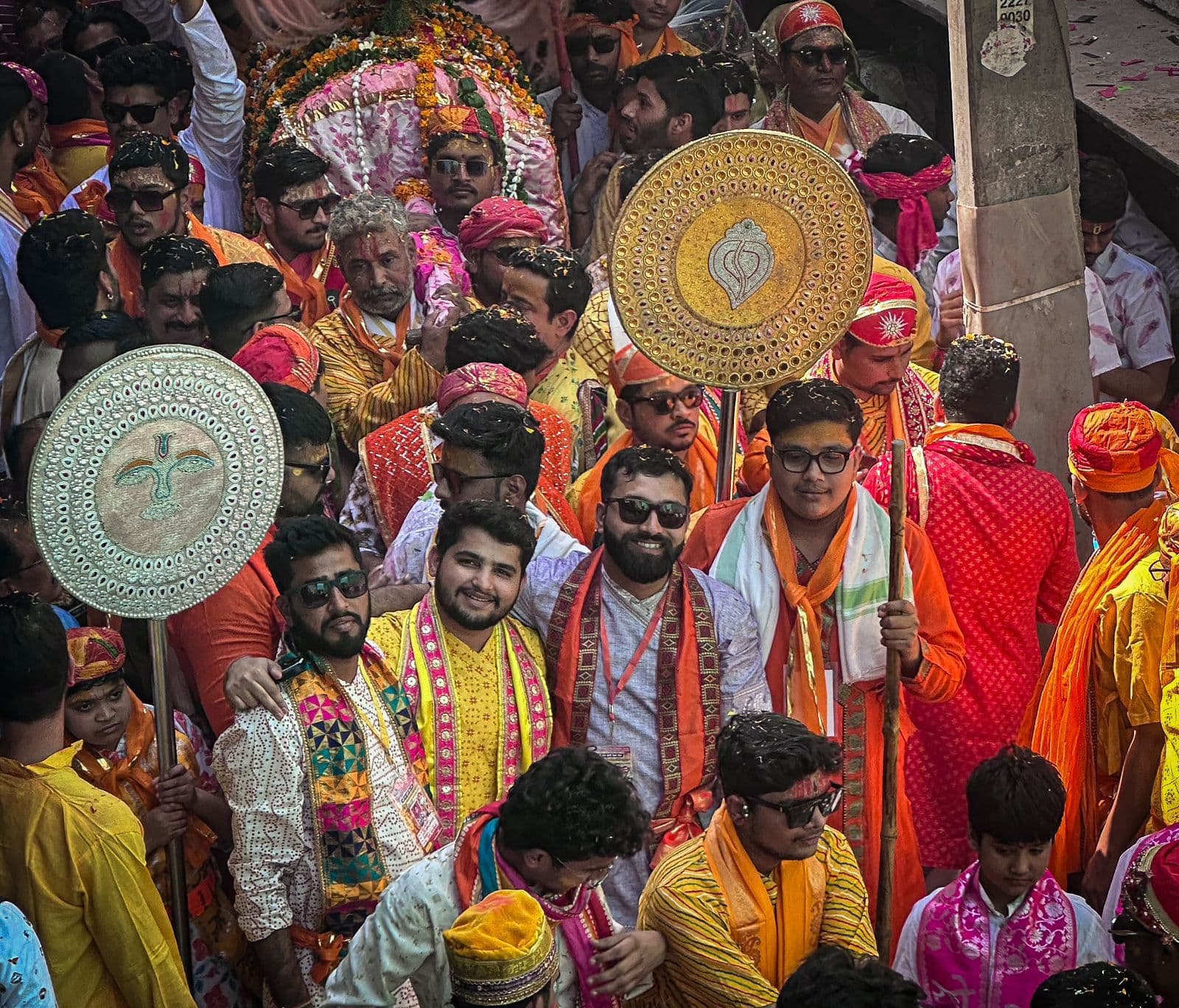
Born in Gokul, a lifelong Brajwasi, guiding Mathura–Vrindavan pilgrimages since 2018.
Jai Shri Krishna 🙏