
Every tithi on this page is manual-verified; every 2026 Gregorian date is checked against Drik Panchang and labelled accordingly. 2027 spring dates are carried at tithi level only, marked “confirm panchang”, exactly because festivals are tithi-fixed and move on the English calendar every year.
What Festivals Are Celebrated in Braj Mandal?
Braj Mandal, the land of Krishna, keeps a festival in almost every fortnight of the year, and all of them are fixed by tithi (lunar day), so they shift on the English calendar. The greatest are Janmashtami (Krishna's midnight birth), Radhashtami(Radha's midday birth, fifteen days later), the forty-day Braj Holi cycle, and Govardhan Puja and Annakut. Always confirm the year's date against the panchang.
Table of Contents
- The master festival calendar of Braj (2026 to 2027)
- How Braj festivals work: tithi, not date
- The two birthdays: Janmashtami and Radhashtami
- The Braj Holi cycle (six Holis across forty days)
- The luminous autumn: Sharad Purnima, Diwali, Annakut, Kartik
- The cow and harvest festivals: Gopashtami and Annakut
- The swing and monsoon season: Jhulan and Hindola
- The jyotish observances: Radha Kund snan, Kokilavan Shani, Ekadashi
- The rare darshans: Akshaya Tritiya and the appearance days
- Which festival should you come for?
- Honest cautions for any Braj festival
- Tip from Gurudutt
- 50 real questions, answered
- Explore every festival (full link map)
- Plan your festival yatra
2026 to 2027, in One Table
The Master Festival Calendar of Braj
This is the whole year of Braj in one table. The tithi is the fixed truth; the Gregorian date moves each year, so confirm it on the panchang before you travel.
| Festival | Tithi (fixed) | 2026 / 27 Date | Where in Braj | Full Guide |
|---|---|---|---|---|
| Vasant Panchami (Holi season opens) | Magha Shukla Panchami | ~Feb 2027Confirm panchang | Braj-wide, first gulal | Read guide |
| Lathmar Holi | Phalguna, days before Holi | ~Mar 2027Confirm panchang | Barsana then Nandgaon | Read guide |
| Laddu Holi | Phalguna, before Lathmar | ~Mar 2027Confirm panchang | Barsana | Read guide |
| Phoolon-wali (flower) Holi | Phalguna Ekadashi | ~Mar 2027Confirm panchang | Banke Bihari, Vrindavan | Read guide |
| Holi / Dhulandi | Phalguna Purnima to Pratipada | ~Mar 2027Confirm panchang | Braj-wide | Guide coming soon |
| Huranga | Day after Holi | ~Mar 2027Confirm panchang | Dauji (Baldeo) | Read guide |
| Widows' Holi | Holi week | ~Mar 2027Confirm panchang | Vrindavan ashrams | Read guide |
| Yamuna Jayanti | Chaitra Shukla Shashthi | ~Apr 2027Confirm panchang | Vishram Ghat, Mathura | Guide coming soon |
| Rangji Brahmotsav | Chaitra to Vaishakh (spring fair) | ~Apr 2027Confirm panchang | Rangji Mandir, Vrindavan | Read guide |
| Akshaya Tritiya (charan darshan) | Vaishakh Shukla Tritiya | ~Apr/May 2027Confirm panchang | Banke Bihari, Vrindavan | Guide coming soon |
| Radha Raman appearance | Vaishakh Purnima | ~May 2027Confirm panchang | Radha Raman, Vrindavan | Read guide |
| Shani Jayanti / Shani Amavasya | Jyeshtha Amavasya | ~late May 2027Confirm panchang | Kokilavan Shani Dham | Guide coming soon |
| Mudia Purnima | Ashadha Purnima | ~29 Jul 2026Confirm panchang | Govardhan parikrama | Guide coming soon |
| Guru Purnima | Ashadha Purnima | ~29 Jul 2026Confirm panchang | Govardhan parikrama | Guide coming soon |
| Jhulan / Hindola | Shravana (swing season) | ~mid to late Aug 2026Confirm panchang | Vrindavan temples | Read guide |
| Hariyali Teej | Shravana Shukla Tritiya | ~Aug 2026Confirm panchang | Vrindavan | Guide coming soon |
| Hal Shashthi / Baldev Chhath (Balarama) | Bhadrapada Krishna Shashthi | 2 Sep 2026 Drik-verified | Dauji (Baldeo) | Guide coming soon |
| Krishna Janmashtami | Bhadrapada Krishna Ashtami + Rohini, midnight | 4 Sep 2026 (ISKCON 5 Sep) Drik-verified | Mathura Janmabhoomi, Dwarkadhish, Gokul, Banke Bihari | Read guide |
| Nand Mahotsav / Dahi Handi | Day after Janmashtami | 5 Sep 2026 Drik-verified | Gokul, Nandgaon | In the Janmashtami guide |
| Radhashtami | Bhadrapada Shukla Ashtami, midday | 19 Sep 2026 Drik-verified | Barsana, Raval | Read guide |
| Sharad Purnima / Maha-Raas | Ashvin Purnima | ~25 Oct 2026Confirm panchang | Chandra Sarovar, Vrindavan, Nidhivan | Read guide |
| Ahoi Ashtami / Radha Kund snan (midnight) | Kartik Krishna Ashtami | ~2 Nov 2026 Drik-verified | Radha Kund | Read guide |
| Diwali | Kartik Amavasya | 8 Nov 2026 Drik-verified | Braj-wide | Guide coming soon |
| Govardhan Puja / Annakut | Kartik Shukla Pratipada (day after Diwali) | ~10 Nov 2026 (some 9 Nov) Drik-verified | Govardhan, Jatipura, Anyor | Read guide |
| Gopashtami | Kartik Shukla Ashtami | ~17 Nov 2026Confirm panchang | gaushalas, Nandgaon, Govardhan | Read guide |
| Tulsi Vivah | Kartik Shukla Ekadashi to Dwadashi | ~21 Nov 2026Confirm panchang | Vrindavan | Read guide |
| Kartik / Damodar Deepdaan | Whole Kartik month | ~26 Oct to 24 Nov 2026Confirm panchang | Vrindavan, Mansi Ganga | Read guide |
| Dev Diwali / Kartik Purnima | Kartik Purnima | ~24 Nov 2026Confirm panchang | Yamuna ghats, Vrindavan | Guide coming soon |
| Ekadashi cycle | Every 11th tithi (both pakshas) | ~twice a monthRecurring | Gaudiya temples, Vrindavan | Guide coming soon |
| Shani Amavasya (monthly) | Amavasya on a Saturday | recurringRecurring | Kokilavan Shani Dham | Guide coming soon |
| Adhik Maas parikrama | The lunar leap-month, when it falls | next: confirmRecurring | Kaman, Govardhan, Chaurasi Kos | Guide coming soon |
Planning from today (June 2026)? Your next windows in order: Guru and Mudia Purnima (late July), Jhulan (August), Janmashtami (4 September), Radhashtami (19 September), then the luminous Kartik season from late October. The two September birthdays book out six to eight weeks ahead.
25 Full Guides Published So Far
 Wednesday, 29 July 2026
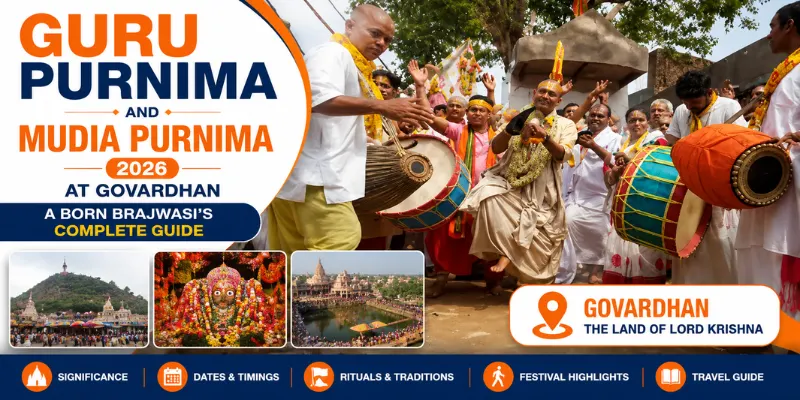
Guru Purnima and Mudia Purnima 2026 at Govardhan: A Born Brajwasi's Guide
Govardhan
Guru Purnima falls on Ashadh Purnima, around 29 July 2026 (confirm the tithi), and at Govardhan it is kept as Mudia Purnima, one of the hill's greatest melas, when the Gaudiya sadhus shave their heads and do the Govardhan parikrama in joy, honouring Sanatana Goswami. Lakhs of pilgrims walk the 21 km parikrama in the monsoon. It is among the most crowded and devotional days of the Braj year.
Read full guide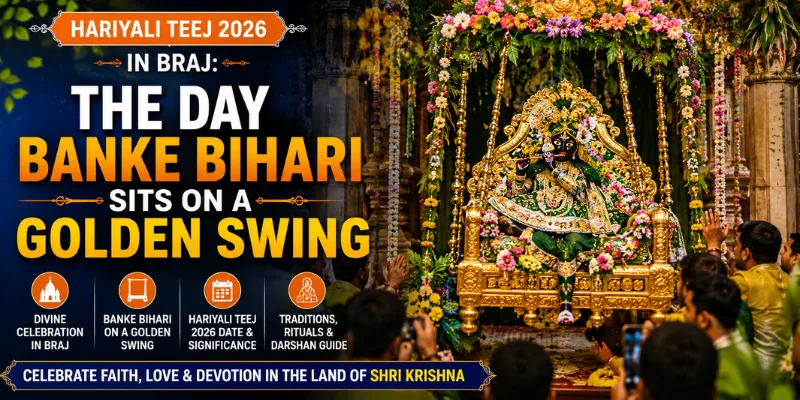 Saturday, 15 August 2026
Hariyali Teej 2026 in Braj: The Day Banke Bihari Sits on a Golden Swing
Shri Banke Bihari Mandir, Vrindavan
Hariyali Teej, on Shravan Shukla Tritiya, around late July or early August 2026 (confirm the tithi), is the green monsoon festival of swings, and in Vrindavan it is the one day of the year Banke Bihari is placed on a golden swing, the swarna hindola. It is a rare and longed-for darshan, drawing great crowds, and it opens the Jhulan swing season across the Braj temples.
Read full guide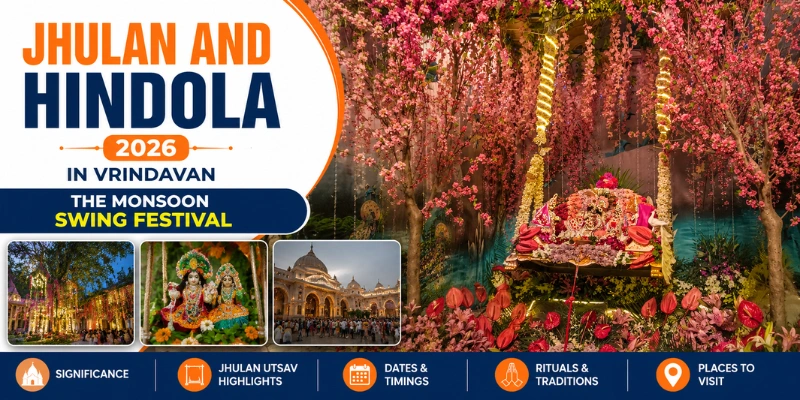 Friday, 28 August 2026
Jhulan and Hindola 2026 in Vrindavan: The Monsoon Swing Festival
Vrindavan
Jhulan Yatra, the monsoon swing festival, runs over several days to Jhulan Purnima in Shravan, in August 2026 (confirm the dates), when the deities of Vrindavan are placed on beautifully decorated swings, hindolas, and swung in celebration of the swing-play of Radha and Krishna. The Vrindavan temples deck spectacular flower-and-ornament swings, a glowing sight of the monsoon-green Braj.
Read full guide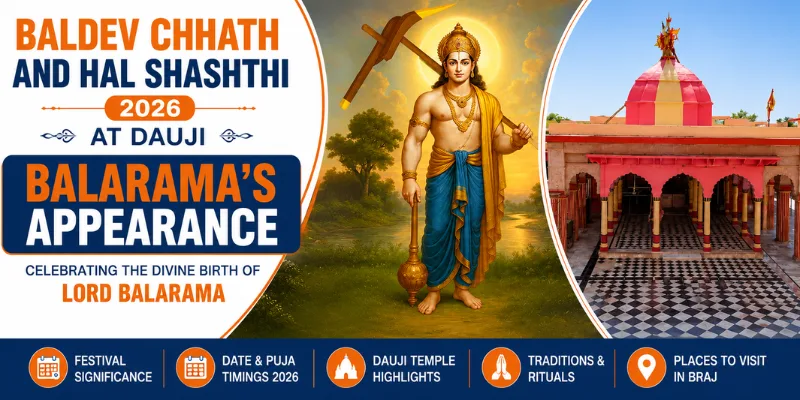 Wednesday, 2 September 2026
Baldev Chhath and Hal Shashthi 2026 at Dauji: Balarama's Appearance
Dauji (Baldev) Temple Mathura
Hal Shashthi, kept in Braj as Baldev Chhath, falls on Bhadrapada Krishna Shashthi, around 2 September 2026 (confirm the tithi), two days before Janmashtami, honouring the appearance of Balarama, Krishna's elder brother, at the Dauji temple in Baldeo. Mothers keep the Hal Shashthi vrat, fasting for the wellbeing of their sons and using only the produce of un-ploughed land.
Read full guide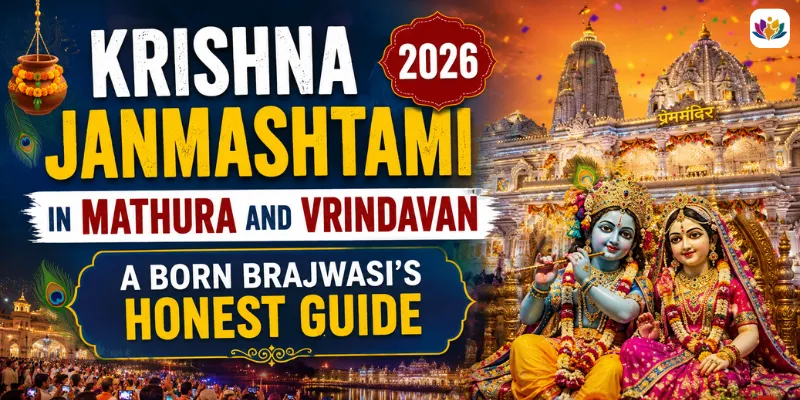 Friday, 4 September 2026
Krishna Janmashtami 2026 in Mathura and Vrindavan: A Born Brajwasi's Honest Guide
Mathura & Vrindavan
Krishna Janmashtami 2026 falls on 4 September, the midnight birth of Krishna at Mathura's Shri Krishna Janmabhoomi. Tradition gives his birth as Bhadrapada Krishna Ashtami under Rohini nakshatra at midnight, which is why it is a midnight festival. ISKCON and the Gokul Nand Mahotsav follow on 5 September, and Banke Bihari gives its only Mangala aarti of the year.
Read full guide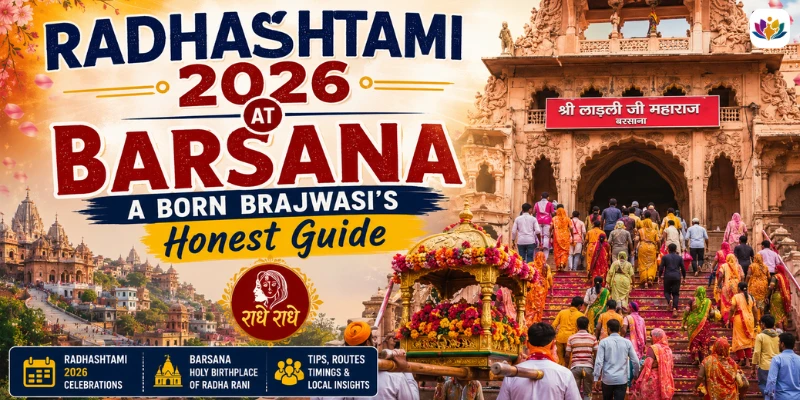 Saturday, 19 September
Radhashtami 2026 at Barsana: A Born Brajwasi's Honest Guide
Barsana
Radhashtami 2026 falls on Saturday, 19 September, Radha Rani's appearance, kept at midday at Barsana, her town. Tradition gives her birth as Bhadrapada Shukla Ashtami at midday, fifteen days after Krishna's midnight birth. The heart of the day is the noon abhishek at the Shriji (Ladli Lal) Temple, the rare temple where Radha is primary and Krishna secondary.
Read full guide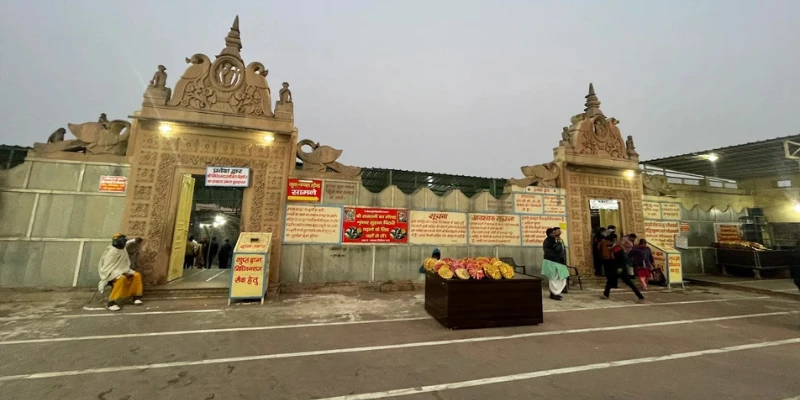 Sunday, October 25, 2026
Sharad Purnima and the Maha-Raas in Vrindavan 2026: A Brajwasi's Guide
Mathura & Vrindavan
Sharad Purnima, the full-moon night of the great Raas, falls about 25 October 2026. On this Ashvin Purnima, tradition holds the moon poured amrit and stood still for the Maha-Raas, the dance Krishna shared with the gopis, multiplying himself so each felt him beside her. Its seat is Chandra Sarovar near Parasoli, and across Vrindavan kheer is set under the moonlight.
Read full guide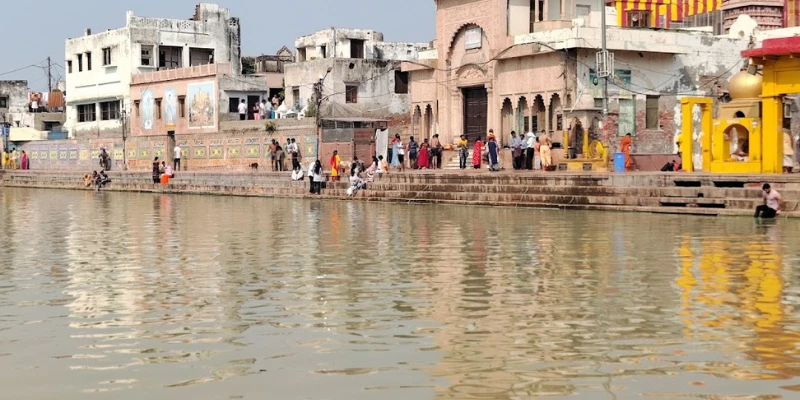 Sunday, 1 November 2026
Radha Kund Snan 2026: The Ahoi Ashtami Midnight Bath, Honestly Explained
Radha Kund
The Radha Kund midnight snan falls on Kartik Krishna Ashtami (Ahoi Ashtami), about 1 November 2026. At Radha Kund, at Govardhan's eastern foot, the holiest spot in creation for the Gaudiya tradition, devotees take a midnight bath held to grant Radha-prema, and it is the bath couples take when desiring a child.
Read full guide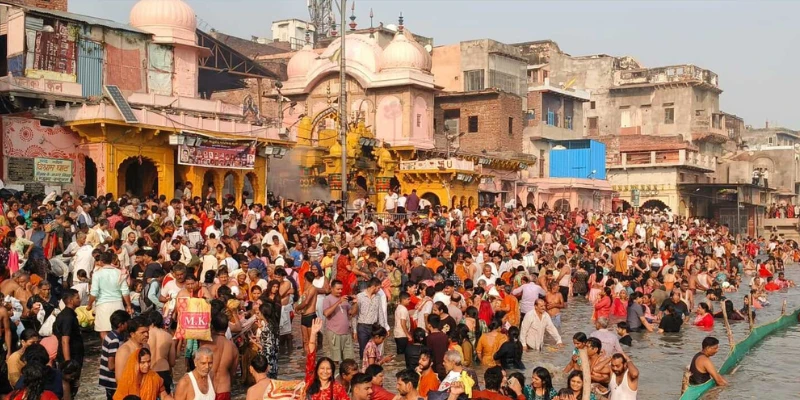 Sunday, November 8, 2026
Diwali in Braj 2026: Lamps on the Yamuna and the Threshold of Kartik
Braj
Diwali in Braj falls on 8 November 2026, on Kartik Amavasya, and it opens the most luminous stretch of the Braj year. It lights Mathura, Vrindavan and the whole region, and the very next day brings Govardhan Puja and Annakut. Diwali also sits inside the holy Kartik (Damodar) month, when Vrindavan and Mansi Ganga fill with lamps.
Read full guide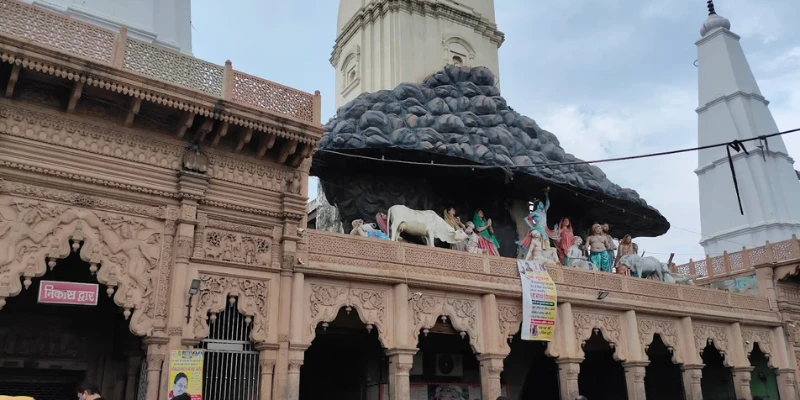 Tuesday, 10 November 2026
Govardhan Puja and Annakut 2026 at Govardhan: A Born Brajwasi's Honest Guide
Govardhan
Govardhan Puja, or Annakut, falls the day after Diwali, on 9 to 10 November 2026 (confirm the tithi). It honours Krishna lifting Govardhan Hill on his little finger to shelter Braj from Indra's storm. At Govardhan the heart of the day is the Annakut, a mountain of food, traditionally fifty-six dishes, offered to Giriraj, with cow worship and the famous parikrama.
Read full guide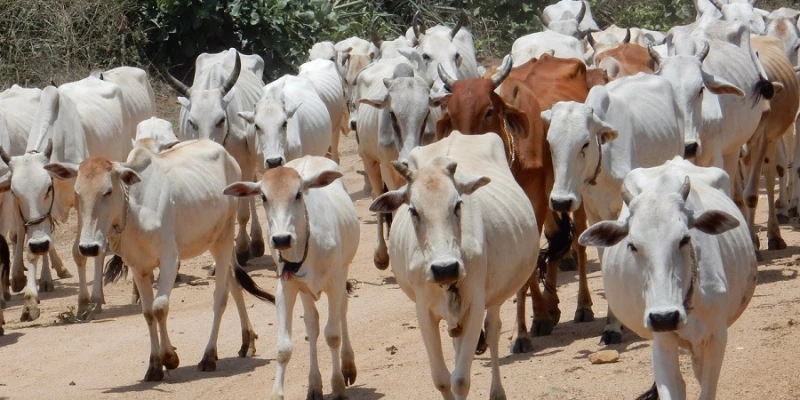 Tuesday, 17 November 2026
Gopashtami 2026 in Braj: The Festival of Krishna and the Cows
Vrindavan
Gopashtami falls on Kartik Shukla Ashtami, about 17 November 2026. It marks the day tradition says Krishna first took the cows out to graze, becoming the cowherd Gopal. The cow is central to Braj, not incidental, and Gopashtami is her festival, best where the gaushalas and the Nandgaon and Govardhan cow-country are strong.
Read full guide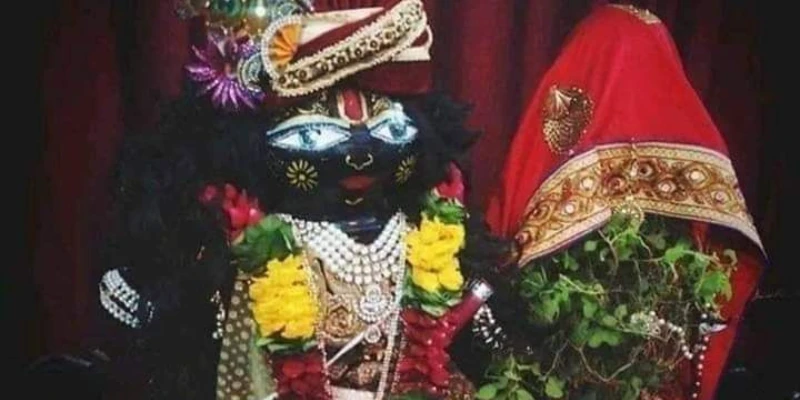 Saturday, 21 November 2026
Tulsi Vivah 2026 in Vrindavan: The Marriage of Tulsi and Krishna
Mathura & Vrindavan
Tulsi Vivah 2026 falls about 21 November, in Kartik, on the days from Prabodhini (Devutthana) Ekadashi to Kartik Purnima. It is fixed by tithi, so confirm the exact day on the panchang. It is kept in the evening as a wedding, in homes and temples, on the day chosen between Ekadashi and Purnima, a gentle, domestic festival that falls in the busy late-Kartik stretch, so booking the stay ahead matters.
Read full guide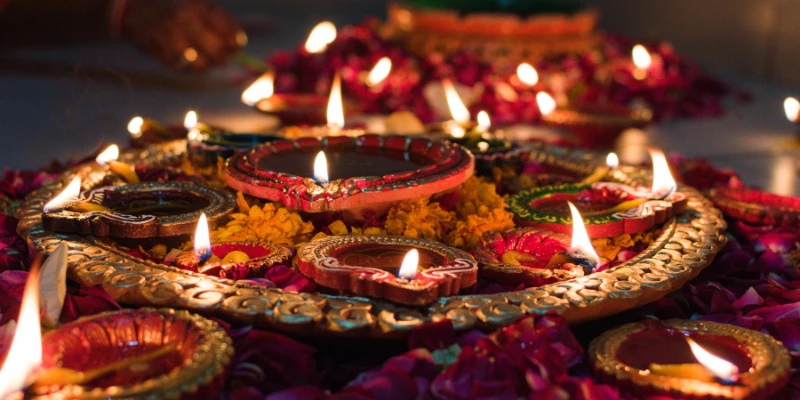 Tuesday, November 24, 2026
Kartik Deepdaan and Dev Diwali in Braj 2026: The Month of Lamps
Complete Braj
Kartik, the Damodar month, is the holiest in Vrindavan, a whole month of lamp-offering (Deepdaan) running roughly from late October to Kartik Purnima, when Dev Diwali falls, about 24 November 2026. The town and the Yamuna ghats and Mansi Ganga glow nightly with lamps, amid the Damodar leela, intensive parikrama and bhajan.
Read full guide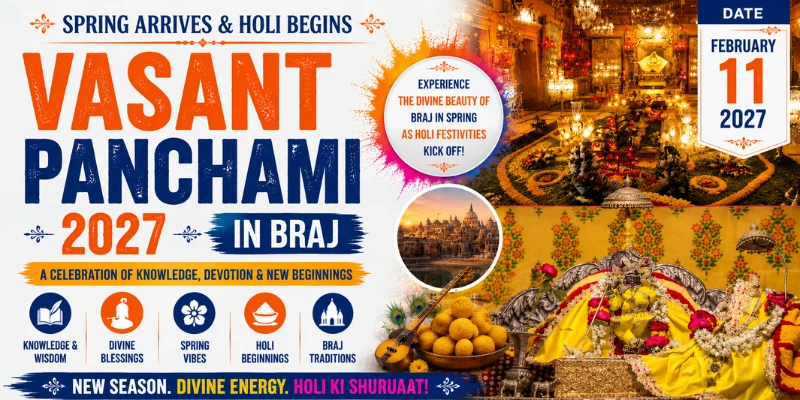 Thursday, February 11, 2027
Vasant Panchami 2027 in Braj: Spring Arrives and Holi Begins
Braj
Vasant Panchami, on Magha Shukla Panchami, falls around late January or early February 2027 (confirm the tithi), the day spring arrives in Braj and the forty-day Holi season begins. The holi-danda is planted, the first gulal is offered to the deities in their spring yellow and the temples begin the Holi songs. It is also Saraswati's day, honouring learning and the arts.
Read full guide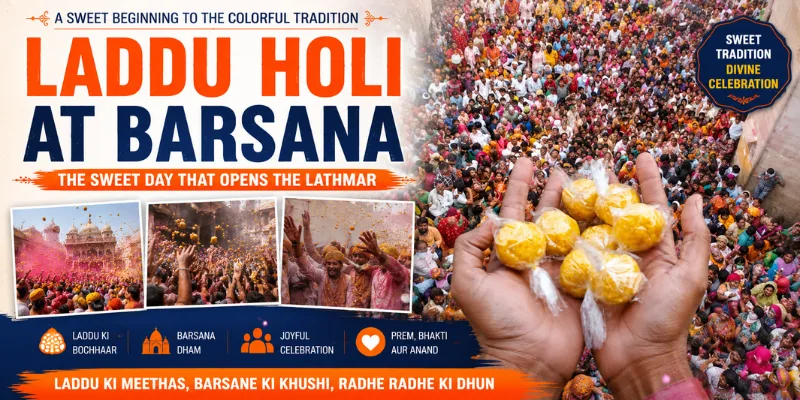 Monday, 15 March 2027
Laddu Holi 2027 at Barsana: The Sweet Day That Opens the Lathmar
Barsana
Laddu Holi falls at Barsana the day before Lathmar Holi, in mid-March 2027 (confirm the tithi), when the invitation to play Holi is joyfully accepted and thousands of laddus are showered over the crowd at the Shriji (Ladli Lal) Temple. It is shorter and sweeter than the stick Holi, the warm opening of the famous Barsana days, full of song, gulal and falling sweets.
Read full guide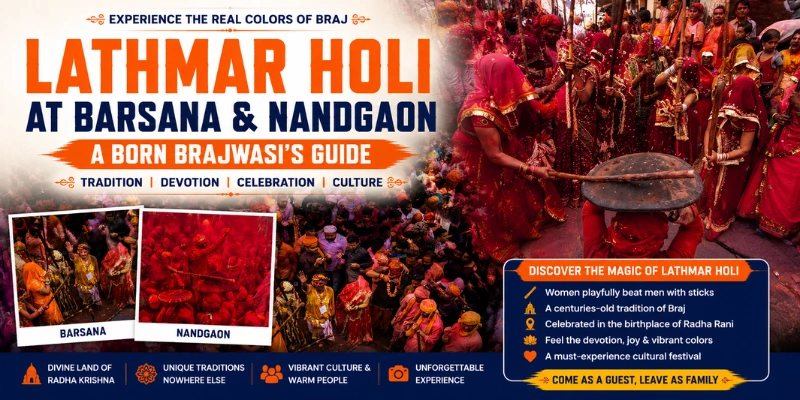 Tuesday, March 16, 2027
Lathmar Holi 2027 at Barsana and Nandgaon: A Born Brajwasi's Guide
Barsana and Nandgaon
Lathmar Holi, the stick Holi, falls about nine days before the main Holi, at Barsana around Phalguna Shukla Navami and at Nandgaon the next day, in mid-March 2027 (confirm the tithi). The women of Barsana playfully beat the shield-bearing men of Nandgaon with lathis, reenacting Krishna and his friends teasing Radha and the gopis. It is exhilarating, rough at the centre, and best watched from a safe vantage.
Read full guide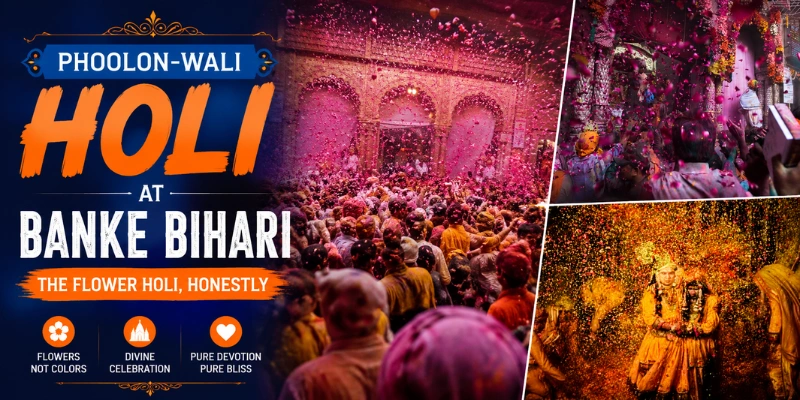 Saturday, 20 March 2027
Phoolon-wali Holi 2027 at Banke Bihari: The Flower Holi, Honestly
Banke Bihari Temple, Vrindavan
Phoolon-wali Holi, the flower Holi, is a brief, breathtaking window at the Banke Bihari Temple in Vrindavan, when the priests shower the devotees with flowers, around Phalguna Shukla Ekadashi, a few days before the main Holi, in March 2027 (confirm the tithi). It is one of the most beautiful sights in Braj, and one of the most dangerously crowded, in a small temple with no VIP pass.
Read full guide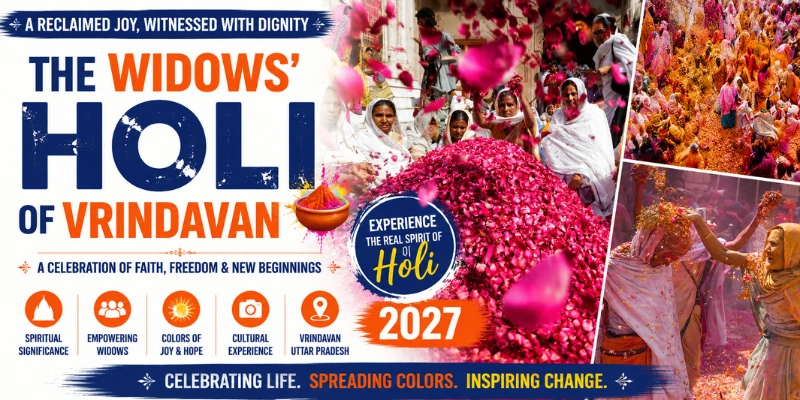 Monday, 22 March 2027
The Widows' Holi of Vrindavan 2027: A Reclaimed Joy, Witnessed with Dignity
Vrindavan
The widows' Holi of Vrindavan, held in the days before the main Holi in March 2027 (confirm the date), is a recent and moving reclamation in which the city's widows, long forbidden colour and festivity by custom, now play Holi with flowers and gulal. It is kept at temples such as Gopinath, in the care of those who serve them. It deserves to be witnessed with dignity and reverence, never as a spectacle.
Read full guide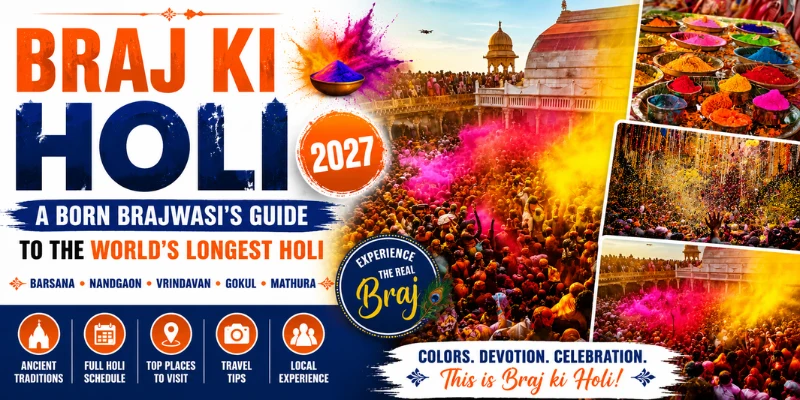 Monday, 22 March 2027
Braj ki Holi 2027: A Born Brajwasi's Guide to the World's Longest Holi
Mathura & Vrindavan
Braj ki Holi is the longest Holi in the world, running about forty days, from Vasant Panchami, around late January or early February 2027, to Huranga at Dauji the day after Holi, around late March 2027 (confirm on the panchang). Its famous days are Lathmar Holi at Barsana and Nandgaon, Phoolon-wali Holi at Banke Bihari, the widows' Holi of Vrindavan, and Huranga at Dauji.
Read full guide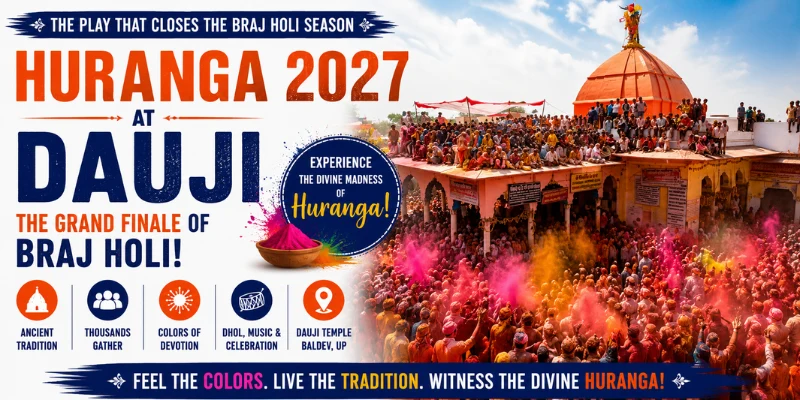 Tuesday, March 23, 2027
Huranga 2027 at Dauji: The Play That Closes the Braj Holi Season
Mathura
Huranga falls the day after the main Holi, on Phalguna Krishna Pratipada, at the Dauji (Baldev) temple in Baldeo, around late March 2027 (confirm the tithi). In a rumbustious play in the temple courtyard, the women tear and twist the men's garments and swing the wet cloth while the men drench the women in colour, a unique post-Holi tradition at the temple of Krishna's elder brother Balarama. It closes the Braj Holi season.
Read full guide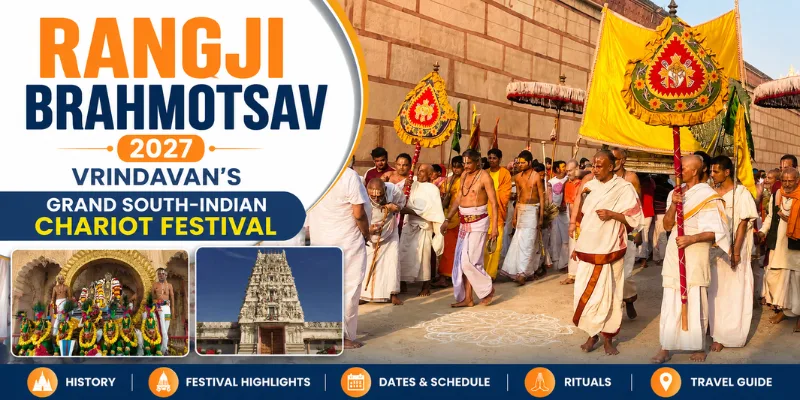 Wednesday, 24 March 2027
Rangji Brahmotsav 2027: Vrindavan's Grand South-Indian Chariot Festival
Sri Rangji Mandir Vrindavan
The Rangji Brahmotsav, a ten-day festival at the Sri Ranganatha (Rangji) temple in Vrindavan, falls in spring, around March or April 2027 (confirm the dates) and climaxes in a great chariot procession, the rath ka mela. Rangji is Vrindavan's grand South-Indian-style temple with a towering gopuram and a gold flag-pillar, a slice of Tamil Srivaishnava tradition in the heart of Braj.
Read full guide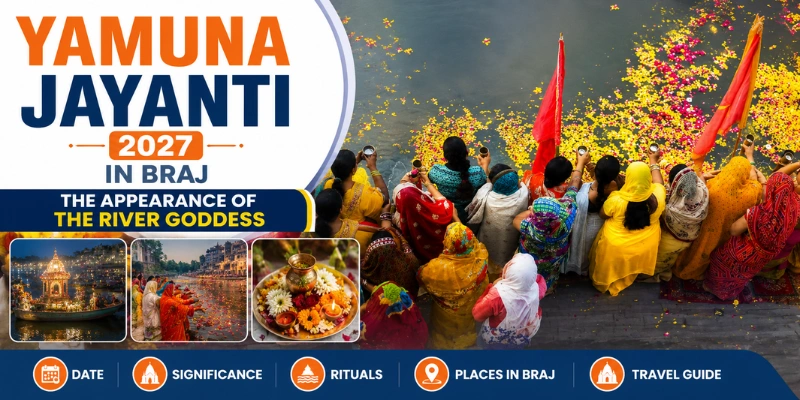 Monday, 12 April 2027
Yamuna Jayanti 2027 in Braj: The Appearance of the River Goddess
Complete Braj
Yamuna Jayanti, the appearance day of the river goddess Yamuna, falls on Chaitra Shukla Shashthi, around late March or early April 2027 (confirm the tithi). She is honoured with aartis and offerings at the ghats, above all Vishram Ghat in Mathura and Keshi Ghat in Vrindavan. Yamuna is the most beloved river of Braj, daughter of the sun and sister of Yama, and she is also, honestly, a gravely polluted river.
Read full guide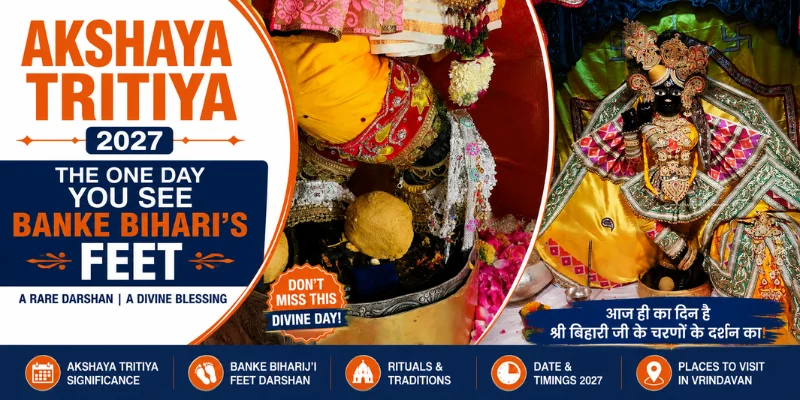 Saturday, 8 May 2027
Akshaya Tritiya 2027: The One Day You See Banke Bihari's Feet
Shri Banke Bihari Mandir Vrindavan
On Akshaya Tritiya, Vaishakh Shukla Tritiya, around early May 2027 (confirm the tithi), the Banke Bihari Temple in Vrindavan grants its single yearly charan darshan, the only day of the year the deity's feet are visible. The rest of the year his feet are never shown. It is free, there is no VIP pass, and it is also the day the cooling sandalwood, chandan, season begins.
Read full guide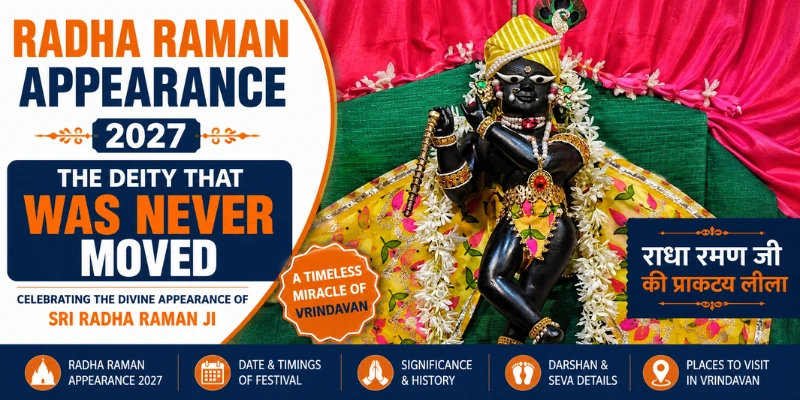 Thursday, 20 May 2027
Radha Raman Appearance 2027: The Deity That Was Never Moved
Shri Radha Raman Temple Vrindavan
Radha Raman's appearance day, his pragatya, falls on a full moon in late spring, around Vaishakh or Jyeshtha Purnima in 2027 (confirm the tithi), honoured with a grand abhishek at the Radha Raman Temple in Vrindavan. Radha Raman is a self-manifest deity, one of the few whose original was never moved or hidden during the invasions, and whose sacred fire has burned since his appearance.
Read full guide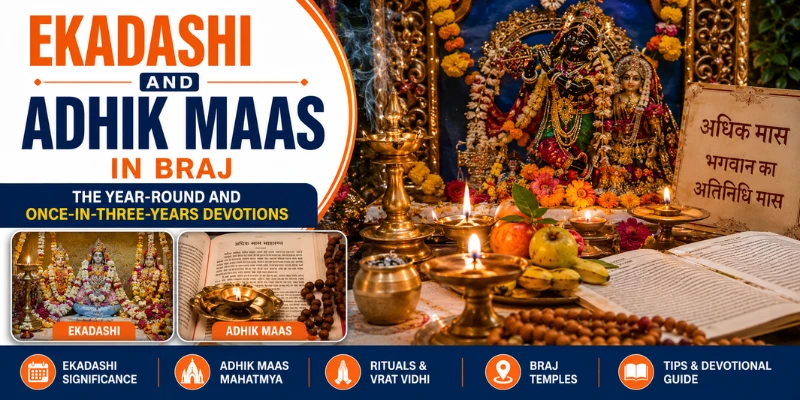 Friday, 16 Mar, 2029
Ekadashi and Adhik Maas in Braj: The Year-Round and Once-in-Three-Years Devotions
Braj
Ekadashi, the eleventh tithi of each fortnight, is the great fasting day of the Vaishnavas, kept intensely in Vrindavan twice a month, and Adhik Maas, the extra lunar month that recurs about every three years, is the supreme season of the Braj Chaurasi Kos parikrama, the 84-kos circuit of the whole of Braj. Both are recurring devotions rather than single festivals; confirm the year's dates on the panchang.
Read full guideHow Braj Festivals Work: Tithi, Not Date
Every Braj festival is fixed by a tithi, a lunar day, not by a solar date, which is why Janmashtami, Holi and Diwali slide across the English calendar each year. A festival falls on its tithi within a particular paksha (Shukla, the waxing fortnight, or Krishna, the waning) of a particular lunar month. Because the tithi and the Gregorian day rarely line up the same way twice, the same festival lands on a different English date every year, and a festival can even fall on two days for two traditions. This is the single thing a pilgrim must understand before booking: trust the tithi, confirm the date.
The Two Birthdays: Janmashtami and Radhashtami
Krishna and Radha are born on the same tithi-number on opposite fortnights, one at night and one at noon, fifteen days apart. Tradition gives Krishna's birth as Bhadrapada Krishna Ashtami, under Rohini nakshatra, at midnight (Nishita), Moon in Taurus, which is why Janmashtami is a midnight festival and strict observers wait for Ashtami and Rohini to overlap before breaking the fast. Radha's appearance is kept as Radhashtami, Bhadrapada Shukla Ashtami, at midday, fifteen days later. He on the waning Ashtami at night, She on the waxing Ashtami at noon: moon and sun, two halves of one whole.
Six Holis, Forty Days
The Braj Holi Cycle
Braj does not keep one Holi, it keeps a cycle that begins about forty days early at Vasant Panchami and runs through six distinct celebrations, the most photographed Holi on earth. It is genuinely rough in the crush, so a pilgrim should know what each event is and how wild it gets.
| Holi | Where | What Happens | Guide |
|---|---|---|---|
| Vasant Panchami (Holi season opens) | Braj-wide, first gulal | The first gulal of the season is thrown here, about forty days before main Holi. | Read guide |
| Lathmar Holi | Barsana then Nandgaon | The women of Barsana drive off the men of Nandgaon with staves, a Radha-Krishna leela re-enacted in reverse at Nandgaon the next day. | Read guide |
| Laddu Holi | Barsana | Sweets are thrown and shared at Barsana the day before Lathmar Holi begins. | Read guide |
| Phoolon-wali (flower) Holi | Banke Bihari, Vrindavan | Banke Bihari's priests shower devotees with flowers instead of colour, for a short and beautiful window. | Read guide |
| Holi / Dhulandi | Braj-wide | The main day, colour play across all of Braj, Phalguna Purnima into Pratipada. | Coming soon |
| Huranga | Dauji (Baldeo) | At Dauji (Baldeo) the day after Holi, women drench and playfully whip the men with cloth-twists. | Read guide |
| Widows' Holi | Vrindavan ashrams | Once excluded from Holi, the widows of Vrindavan now play colour and flowers together, a quiet reclaiming of joy. | Read guide |
Bhang-laced thandai caution: thandai sold during Holi week in Barsana and Mathura is sometimes laced with bhang (cannabis). It is traditional, not always labelled, and stronger than it tastes, so ask before you drink if you would rather avoid it.
The Luminous Autumn: Sharad Purnima, Diwali, Annakut and Kartik
The richest stretch of the Braj year runs from the autumn full moon through the whole month of Kartik. Sharad Purnima (Ashvin Purnima) is the night of the great Maha-Raas, when tradition holds the moon poured amrit and stood still; kheer is set under its light at Chandra Sarovar and across Vrindavan. Diwali lights Braj; the day after is Govardhan Puja and Annakut, when Giriraj is fed a mountain of food, the chappan bhog of fifty-six dishes, at Govardhan, Jatipura and Anyor. Then the whole of Kartik (Damodar) month, the holiest in Vrindavan, fills the town and Mansi Ganga with lamps (Deepdaan), closing on Kartik Purnima (Dev Diwali).
The Cow and Harvest Festivals: Gopashtami and Annakut
The cow is central to Braj, not incidental, and Gopashtami is her festival. On Kartik Shukla Ashtami, tradition marks the day Krishna first took the cows out to graze; the gaushalas, Nandgaon and the Govardhan cow-country celebrate it with gau puja. It sits a week after Annakut, in the same gratitude-to-the-land spirit that runs through Govardhan Puja, where the hill, the cows and the pasture are honoured as one.
The Swing and Monsoon Season: Jhulan and Hindola
The monsoon brings the green swing-festival, Jhulan or Hindola, in the month of Shravana, when the deities are placed on beautifully decorated swings and gently rocked amid kirtan. It is one of Vrindavan's most tender and visually lovely seasons, paired with Hariyali Teej, and it is the gentlest of the big celebrations, far calmer than Janmashtami or Holi.
The Jyotish Observances: Radha Kund Snan, Kokilavan Shani, Ekadashi
Braj's calendar carries a thread of jyotish observances that pilgrims come specifically to keep. The midnight snan at Radha Kund on Kartik Krishna Ashtami (Ahoi Ashtami) is the bath couples take desiring a child, and all take for prema. Kokilavan Shani Dham, near Nandgaon, is where those troubled by Shani dosha, sade-sati or dhaiya come, above all on Saturdays and Shani Amavasya or Shani Jayanti (Jyeshtha Amavasya), with offerings of black sesame, mustard oil, black cloth and iron. And the Ekadashi cycle, every eleventh tithi, draws the Gaudiya temples strongly. For any personal muhurat, a child's mundan, a wedding sankalp or a graha-shanti, take the individual's nakshatra to a qualified panditji; the tradition is meant to reassure, never to frighten.
The Rare Darshans: Akshaya Tritiya and the Appearance Days
Some days open a darshan you cannot get the rest of the year, and a Brajwasi plans around them. On Akshaya Tritiya (Vaishakh Shukla Tritiya) Banke Bihari grants the one yearly sight of his feet, the charan darshan. Banke Bihari also gives his only Mangala aarti of the year on Janmashtami, and on no other day. Radha Raman, the rare original deity never hidden during the invasions, keeps his appearance on Vaishakh Purnima with a continuous abhishek. These are the “only a local knows” draws that reward exact timing.
The Honest Comparison We Give Travellers
Which Festival Should You Come For?
There is no single best Braj festival, only the right one for what you want.
| Festival | The Feeling | Crowd | Best For |
|---|---|---|---|
| Janmashtami | Awe, midnight vigil | Extreme | The central pilgrimage; the believed birthplace |
| Radhashtami | Joy, flowers, midday kirtan | High | Radha devotees; a calmer high than Janmashtami |
| Lathmar Holi | Wild colour and play | Very high | Those who want Braj's famous spectacle |
| Govardhan Puja / Annakut | Gratitude, food, cows | Moderate | Families; the Govardhan connection |
| Sharad Purnima | Moonlit, contemplative | Moderate | Quiet seekers; the Maha-Raas night |
| Jhulan / Hindola | Tender, green, gentle | Low to moderate | Elders, families, first-timers wanting peace |
| Off-festival (Oct to Mar) | Calm, unhurried darshan | Low | Anyone wanting stillness and clear darshan |
Original insight from guiding since 2018: the most-requested festival is Janmashtami, but the highest-satisfaction one for families and elders is Radhashtami, because the midday timing means no midnight crush, or Jhulan, because the monsoon swing season is the gentlest celebration of all. We send the fit and determined to the Janmashtami vigil and the Banke Bihari Mangala aarti, and elders to Prem Mandir, ISKCON, Sharad Purnima and Jhulan.
True for Every Big Festival Here
Honest Cautions for Any Braj Festival
Book six to eight weeks ahead. Festival stays and good drivers go first.
Banke Bihari is dangerous at peak. Its festival crowds, above all the once-a-year Janmashtami Mangala aarti, have a real history of stampede deaths. Keep frail elders and small children out of the crush.
There is no daily Mangala aarti at Banke Bihari, and no official VIP darshan pass. Darshan is free; anyone selling a "special pass" is a tout.
Bhang-laced thandai circulates at Holi and festival time. If you do not know the shop, do not drink it, and never let an elder or child drink it unknowingly.
Govardhan is circled, never climbed. The parikrama is about 21 km; vehicle parikrama exists for the elderly; never tread on the hill or pocket its stone.
Radha Kund touts rush pilgrims to a lesser tank for a fee; the genuine pair is specific, so go with someone who knows.
Monkeys at Kesi Ghat, Govardhan and the temples take glasses, phones and prasad. Keep valuables zipped inside.
Heat in summer (45C and above), fog at winter dawns, mud in the monsoon. Pack for the season and carry water and electrolytes.
Tip From Gurudutt
“People ask me which festival is the best. I ask them back: do you want to be awed, or do you want to be at peace? Janmashtami will overwhelm you in the best and the hardest way. Radhashtami will fill you up gently. The Jhulan swings in the green monsoon, and the lamps on the Yamuna through Kartik, those are the Braj I would take my own mother to. There is no wrong time, only the right time for you.”
Gurudutt
Born in Gokul · Guiding Braj since 2018
Your Questions Answered
50 Real Questions, Answered
A. The calendar and choosing
What festivals are celebrated in Braj Mandal?
Braj keeps a festival in almost every fortnight: Janmashtami, Radhashtami, the six-part Holi cycle, Govardhan Puja and Annakut, Gopashtami, Sharad Purnima, Jhulan, Tulsi Vivah, the Kartik lamp festivals, Yamuna Jayanti, Akshaya Tritiya, plus the Ekadashi and Shani observances. All are fixed by tithi and shift on the English calendar each year.
Why do Braj festival dates change every year?
Because they follow the Hindu lunar calendar, fixed by tithi (lunar day) within a waxing or waning fortnight, not by a solar date. The tithi and the English day rarely align the same way twice, so the festival lands on a different Gregorian date each year, and can even fall on two days for two traditions.
Which is the biggest festival in Braj?
Janmashtami, Krishna's midnight birthday, is the largest and most charged, centred on Mathura's Janmabhoomi. Radhashtami fifteen days later and the forty-day Braj Holi cycle in spring are the next greatest. Each draws huge crowds to its particular town.
When is the best time to visit Braj for festivals?
August and September bring Janmashtami and Radhashtami; October and November bring Sharad Purnima, Diwali, Annakut and the luminous Kartik festivals; spring brings the Holi cycle. For the most comfortable weather with deep festivity, the autumn after Diwali is ideal.
What is the best festival for a first visit?
For the central pilgrimage and awe, Janmashtami. For gentle joy, Radhashtami or the monsoon Jhulan. For famous spectacle, Lathmar Holi. For quiet beauty, Sharad Purnima or the calm October to March window. We match the festival to your group and temperament.
Can I see two festivals in one trip?
Yes. Janmashtami (4 September 2026) and Radhashtami (19 September 2026) are fifteen days apart and pair beautifully, with the fortnight between spent across Mathura, Govardhan, Gokul and Vrindavan. The Kartik season also stacks Diwali, Annakut, Gopashtami and Dev Diwali within three weeks.
How far in advance should I book a festival trip?
At least six to eight weeks for the big festivals, more if you can. Festival stays near the temples and reliable drivers go first, and Barsana in particular has few quality rooms. Booking early is the single biggest factor in a calm festival trip.
Which festivals are gentlest for senior citizens?
Radhashtami (midday, no midnight crush), the monsoon Jhulan, Govardhan Puja by vehicle parikrama, and the calm Sharad Purnima and Kartik lamp evenings. We steer elders away from the Banke Bihari festival crush and the densest Janmashtami midnight, toward ISKCON and Prem Mandir.
Which festivals are best for children?
Children love the colour of Holi, the swings of Jhulan, the lamps of Kartik, and the Dahi Handi of Nand Mahotsav. We keep them out of the dangerous crush points and toward the joyful, manageable celebrations.
How many days do I need for a festival trip?
Two days is the minimum for a big festival, the day itself plus surrounding darshan. Three to four lets you add Govardhan, Barsana or Gokul gently, or pair two festivals. The midnight or midday timing of the main festivals shapes how the days are built.
B. The two birthdays
When is Janmashtami 2026?
Krishna Janmashtami 2026 falls on 4 September, with the midnight Janmotsav at Mathura's Janmabhoomi; ISKCON and the Gokul Nand Mahotsav are on 5 September. The tithi is Bhadrapada Krishna Ashtami with Rohini nakshatra. Confirm the muhurat on the panchang.
When is Radhashtami 2026?
Radhashtami 2026 falls on 19 September, fifteen days after Janmashtami, with the great celebration at Barsana's Shriji (Ladli Lal) Temple. The tithi is Bhadrapada Shukla Ashtami, and Radha's birth is honoured at midday, not midnight.
Why is Krishna's birth at midnight and Radha's at midday?
Tradition gives Krishna's birth at midnight (Nishita) under Rohini, and Radha's appearance at midday, fifteen days later. Devotees read it as the symmetry of moon and sun, night and day, the same tithi-number on opposite fortnights, two halves of one whole.
What nakshatra was Krishna born under?
Rohini, on Bhadrapada Krishna Ashtami at midnight, with the Moon in Taurus, by tradition. That overlap of Ashtami and Rohini is why Janmashtami is a midnight festival and why strict observers wait for both before breaking the fast.
What was Radha's birth nakshatra?
This varies by tradition, and an honest guide says so rather than picking one; some name Anuradha, noting the Radha and Anu-radha echo. What is agreed is the tithi, Bhadrapada Shukla Ashtami at midday, and that tradition holds she was found on a lotus, not womb-born.
What is Nand Mahotsav?
Nand Mahotsav is Nanda's celebration of Krishna's birth, kept the day after Janmashtami (5 September 2026) with sweets and curd-throwing (dadhikana), especially at Gokul and Nandgaon, Krishna's foster country. It is the joyful morning-after of the vigil.
Where is Janmashtami best celebrated?
At Mathura's Janmabhoomi for the central midnight Janmotsav, with Dwarkadhish, Gokul and Nandgaon also strong, and Banke Bihari giving its once-a-year Mangala aarti. For an organised, safer celebration, ISKCON Vrindavan on 5 September.
Where is Radhashtami best celebrated?
At Barsana, Radha's town, on the Shriji (Ladli Lal) hilltop temple, the rare temple where Radha is primary and Krishna secondary. Raval, her birthplace by another tradition, also celebrates, far more quietly.
C. The Holi cycle
When is Holi in Braj and how is it different?
Braj Holi is a cycle of about forty days in spring, beginning at Vasant Panchami and running through Lathmar, Laddu, flower, main and Huranga Holi, not a single day. It is the most photographed Holi on earth. Confirm the year's dates on the panchang.
What is Lathmar Holi and where is it?
At Barsana and Nandgaon, days before main Holi, the women of Barsana playfully drive off the men of Nandgaon with staves (lathis), re-enacting a Radha-Krishna leela, then the play reverses at Nandgaon the next day. Two villages, two days, mirror images.
What is Phoolon-wali Holi?
The flower Holi at Banke Bihari, Vrindavan, where the priests shower devotees with flowers rather than colour, for a short and beautiful window. It is gentler than the colour play, and intensely crowded for its brief duration.
What is Huranga?
The riotous play at Dauji (Baldeo), the day after Holi, where the women drench and playfully whip the men with cloth-twists. It is Dauji's signature, tied to Balarama's town, wild and joyful.
What is the widows' Holi of Vrindavan?
For generations the widows of Vrindavan were excluded from Holi; in recent years they have been included in colour and flower celebrations, a moving reclaiming of joy and dignity. We speak of it with respect, never as spectacle.
Is Braj Holi safe?
It is joyful but genuinely rough in the crush, and the colour play can be intense. Go with a plan, keep your group together, mind elders and children, and be cautious of bhang-laced thandai. We position you for the spectacle without the worst of the crush.
D. The autumn and Kartik festivals
When is Govardhan Puja 2026?
Govardhan Puja and Annakut fall the day after Diwali. Diwali 2026 is 8 November, and the Annakut is on Kartik Shukla Pratipada, which most panchang place on 10 November, with some on 9 November. Confirm the Braj temple date before travelling.
What is Annakut and the chappan bhog?
Annakut means a mountain of food offered to Krishna and to Giriraj on Govardhan Puja, traditionally fifty-six dishes (chappan bhog), recalling the meals Braj offered after Krishna sheltered them under the hill for seven days. At Govardhan and Jatipura the Annakut is breathtaking.
When is Sharad Purnima 2026?
Sharad Purnima, the full-moon night of the Maha-Raas, falls about 25 October 2026 (confirm the tithi). In Vrindavan and at Chandra Sarovar it is a luminous, contemplative night, and kheer is set under the moonlight, held to catch its amrit.
What is Kartik or Damodar month?
Kartik is the holiest month in Vrindavan, called Damodara in the Vaishnava tradition: a month of lamp-offering (Deepdaan), the Damodar leela, intensive parikrama and bhajan, when the whole town glows. It runs roughly from late October to Kartik Purnima.
When is Gopashtami 2026?
Gopashtami, the cow festival marking Krishna's first taking of the cows to graze, falls on Kartik Shukla Ashtami, about 17 November 2026 (confirm). It is best where the gaushalas and the Nandgaon and Govardhan cow-culture are strong.
What is Tulsi Vivah?
Tulsi Vivah, about 21 November 2026 (confirm), ceremonially marries the sacred tulsi (Vrinda) to Krishna, opening the Hindu wedding season. In Vrindavan, named for Vrinda Devi, it is observed with devotion in homes and temples.
What is Dev Diwali in Braj?
Dev Diwali, on Kartik Purnima, about 24 November 2026 (confirm), closes the luminous Kartik season with lamps on the Yamuna ghats. It is the culmination of the month-long Kartik Deepdaan.
E. The jyotish observances
We are trying for a child. Where in Braj should we go?
The traditional answer is the midnight bath at Radha Kund on Kartik Krishna Ashtami (Ahoi Ashtami), about 2 November 2026, taken especially by couples desiring a child, and by all for prema. Go with someone who knows the genuine Radha and Shyam Kund pair, as touts rush pilgrims to a lesser tank.
I have Shani dosha. Which festival and place?
Kokilavan Shani Dham, near Nandgaon, on a Saturday, above all on Shani Amavasya or Shani Jayanti (Jyeshtha Amavasya); customary offerings are black sesame, mustard oil, black cloth and iron. And carry the fear lightly: the blessing is about relief, not dread.
What is the Radha Kund midnight snan?
On Kartik Krishna Ashtami, devotees take a midnight bath at Radha Kund, at Govardhan's eastern foot, the holiest spot in creation for the Gaudiya tradition. It is held to grant Radha-prema, and is the classic festival for couples desiring a child.
What is the Ekadashi cycle?
Every eleventh tithi of each fortnight is Ekadashi, sacred to Vishnu and Krishna and kept as a fasting day, drawing the Gaudiya temples of Vrindavan strongly. There are roughly twenty-four through the year, and Devshayani and Devutthana Ekadashi anchor the holy four-month Chaturmas window.
Can you tell me my personal muhurat for a ceremony in Braj?
For any personal muhurat, a child's mundan, a naming, a wedding sankalp or a graha-shanti, the honest answer is to take the individual's nakshatra to a qualified panditji, never an improvised time. We will introduce you to a genuine one; we never read a chart back as a threat to sell a remedy.
F. The gentler and rarer festivals
What is Jhulan or Hindola?
The monsoon swing festival of Shravana (about mid to late August), when the deities are placed on decorated swings and gently rocked amid kirtan, across several days. It is one of Vrindavan's most tender and lovely seasons, and the gentlest of the big celebrations.
What is Akshaya Tritiya at Banke Bihari?
On Akshaya Tritiya (Vaishakh Shukla Tritiya, about April or May), Banke Bihari grants the one day of the year his feet (charan) are visible, the charan darshan. It draws enormous crowds for a brief, cherished sight.
When can I see Banke Bihari's Mangala aarti?
Only once a year, on Janmashtami. On every other day there is no Mangala aarti at Banke Bihari, because the deity is served as a child who must not be woken early. Beware anyone who claims to arrange a daily Mangala aarti darshan; it does not exist.
What is Mudia Purnima and Guru Purnima?
Both fall on Ashadha Purnima (about 29 July 2026) and bring peak crowds to the Govardhan parikrama; Mudia Purnima is tied to Sanatana Goswami. They are among the busiest days on the 21 km circuit, so plan the timing carefully.
What is Yamuna Jayanti?
Yamuna Jayanti (Chaitra Shukla Shashthi, about April) marks the appearance of the river-goddess Yamuni, daughter of Surya and sister of Yama, with special ghat worship at Vishram Ghat. To honour her is woven through the whole leela.
G. Crowds, safety and trust
Are Braj festivals safe?
Broadly yes, and deeply devotional, but the biggest festivals draw enormous crowds, and a few points carry real risk, above all the Banke Bihari festival crush, which has a history of stampede deaths. With early arrival, the right venues and local crowd-craft, festivals are safe and moving.
Is there VIP darshan during festivals?
There is no official VIP or online special-darshan pass at Banke Bihari; anyone selling one is a tout, and darshan is free. Smooth darshan comes from arriving early and knowing the routes, which is what we arrange. We never sell a queue-jump that does not exist.
How do I avoid touts and donation rackets?
Festival days draw aggressive donation collectors, fake pandas and gemstone or puja upsells. Genuine seva never corners you; give only through a temple hundi or a real gaushala. At Radha Kund, do not follow a tout to a lesser tank. Travelling with a known local removes most of this.
Is the bhang thandai safe?
Be cautious, as at Holi and festival time some thandai is laced with bhang (cannabis). If you do not know the shop, do not drink it, especially before a vigil, a climb or a drive, and never let an elder, child or someone with a medical condition drink it unknowingly.
Are the monkeys a problem during festivals?
Yes, year-round and especially in the crowds. The monkeys at Kesi Ghat, Govardhan and the temples snatch glasses, phones and prasad and will bite. Keep nothing loose in hand, zip valuables inside, and do not try to retrieve a taken item yourself.
H. Planning and booking
Can you arrange a complete festival trip?
Yes, that is exactly what we do: temple-adjacent stay, AC cab, a born-Brajwasi guide, darshan timed around the crowd, and elder-safe choices, so you feel the festival rather than fight it. Message us with your dates and we build the yatra.
Do you have festival tour packages?
Yes, dedicated Janmashtami and Radhashtami packages, and we customise for any festival. Ask us for the Janmashtami Special and the Radhashtami Barsana Special.
Can you arrange a guide who speaks my language?
Yes, Hindi and English as standard, with regional-language support such as Telugu and Tamil available on request for groups from the southern source cities. Tell us your group's language and we arrange it.
How do I start planning my festival yatra?
Message us on WhatsApp with the festival that calls you, or ask us to suggest one, with your dates and group size. We reply within two hours, recommend the right festival and venues for your group, and build the full yatra, stay, cab, guide and crowd-craft included. Radhe Radhe.
By Season
Explore Every Festival
Every guide is being built in calendar order. A muted link below simply means that spoke isn't published yet, it will route you safely back to this calendar rather than a dead page.
Spring
Monsoon
Autumn
Up to the Region and Temples
The Difference Between a Blessing and a Bruise
Why Book Your Braj Festival With Experience My India
On a festival day in Braj, with the crowds, the touts and the once-a-year darshans, the difference between a blessing and a bruise is a born Brajwasi who knows the gates, the tithi and the safe path. An aggregator sells inventory; a Brajwasi gives you the yatra.
| What Matters for a Braj Yatra | Experience My India | A Typical Online Aggregator |
|---|---|---|
| Who plans and guides you | Gurudutt, born in Gokul, guiding Braj since 2018 | A listing engine; no one on the ground |
| Local knowledge | Knows the gates, side galleries and the day's tithi | Generic, often copied itinerary text |
| Honesty | Warns of touts, fake VIP passes, crowd crush, bhang thandai | Rarely warns; sometimes repeats the myths |
| Darshan timing | Verified, season and festival aware, with crowd-craft | Generic timings, frequently outdated |
| Pricing | Transparent, all-inclusive, no hidden charges | Markups, dynamic pricing, hidden fees |
| Support | Direct WhatsApp, a real person, reply within two hours | App or call-centre, slow human help |
| Elders and families | Vehicle parikrama, side routes, rest stops planned | One-size package |
| Track record | 50,000+ pilgrims guided, 4.5 star on Google | Reviews pooled across unrelated vendors |
| Languages | Hindi, English, regional (Telugu, Tamil) on request | Limited |
Radhe Radhe!
Plan Your Festival Yatra
Tell us which festival calls you, or let us suggest the right one. The big festivals book out six to eight weeks ahead.
Since 2018 · born Brajwasi of Gokul · 50,000+ pilgrims · 4.5 star on Google · WhatsApp reply within two hours.
Explore more travel guides
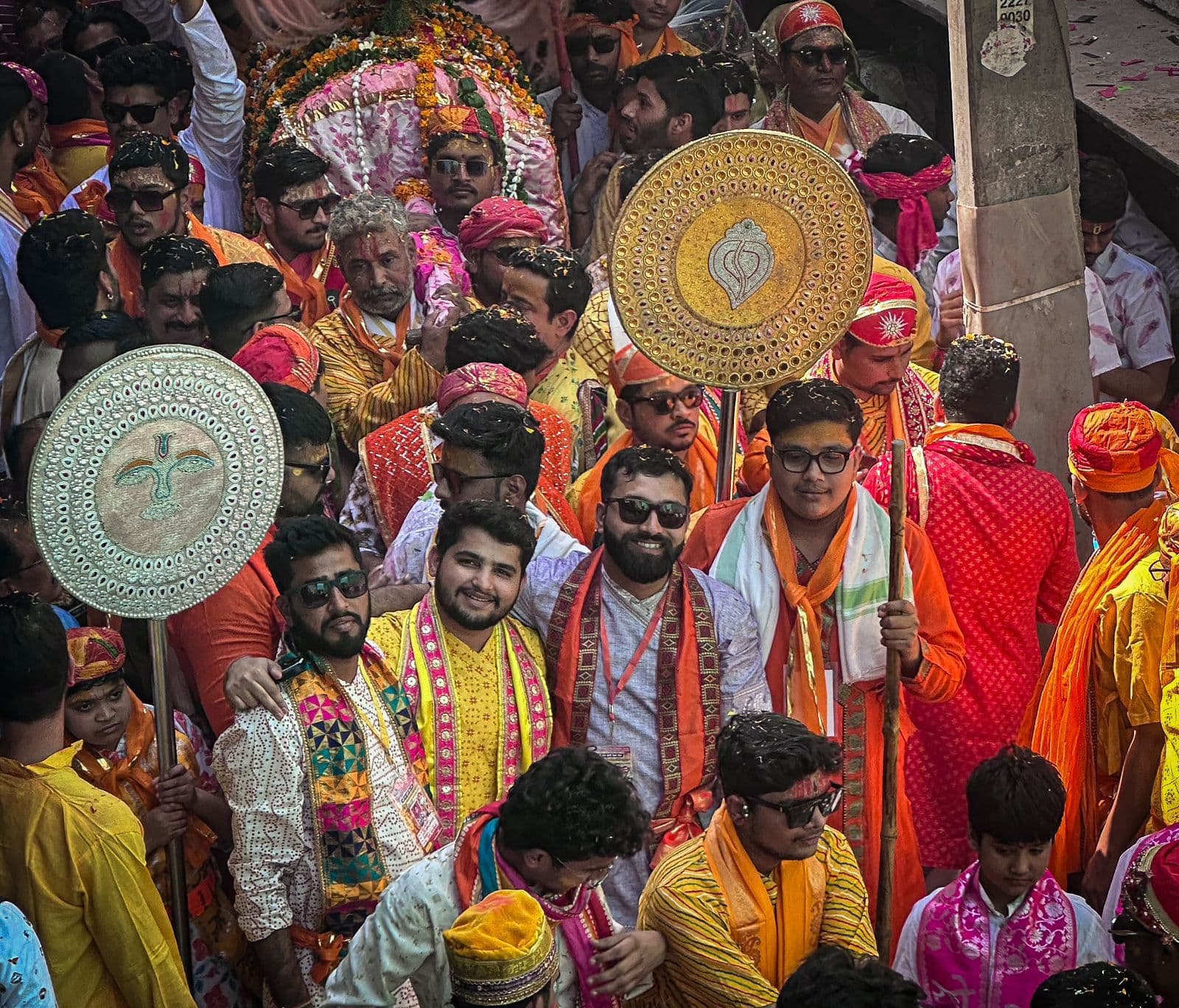
Born and raised in Braj Bhoomi. Guiding pilgrims through Mathura Vrindavan since 2018, through every Braj festival, every season, for seven years. Experience My India was built on one belief: a well-planned yatra is a deeply felt one. 50,000+ pilgrims have trusted us with their most sacred journeys.
Jai Shri Krishna 🙏