
Rangji Brahmotsav 2027: Vrindavan's Grand South-Indian Chariot Festival
The Rangji Brahmotsav, a ten-day festival at the Sri Ranganatha (Rangji) temple in Vrindavan, falls in spring, around March or April 2027 (confirm the dates) and climaxes in a great chariot procession, the rath ka mela. Rangji is Vrindavan's grand South-Indian-style temple with a towering gopuram and a gold flag-pillar, a slice of Tamil Srivaishnava tradition in the heart of Braj.
Read full guide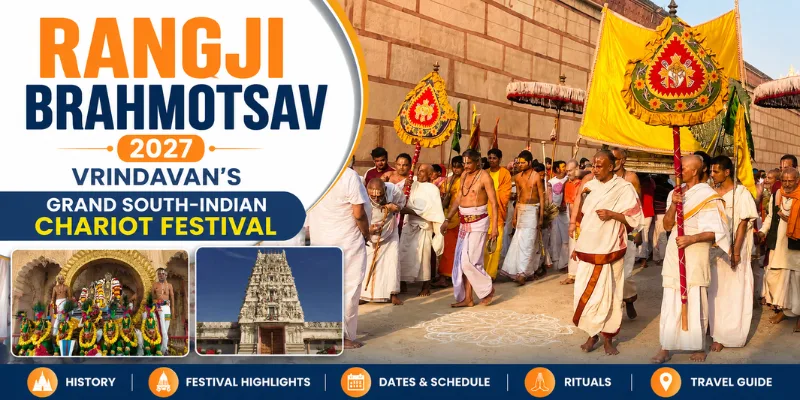
Wednesday, 24 March 2027
Sri Rangji Mandir Vrindavan
Quick answer
The Rangji Brahmotsav, a ten-day festival at the Sri Ranganatha (Rangji) temple in Vrindavan, falls in spring, around March or April 2027 (confirm the dates) and climaxes in a great chariot procession, the rath ka mela. Rangji is Vrindavan's grand South-Indian-style temple with a towering gopuram and a gold flag-pillar, a slice of Tamil Srivaishnava tradition in the heart of Braj.
Last updated: 24 June 2026 · written by Guru Dutt, born in Gokul · Experience My India
When is the Rangji Brahmotsav 2027
The Rangji Brahmotsav 2027 falls in spring, around March or April, a ten-day festival at the Rangji temple climaxing in the great chariot procession. The dates are set by the temple's Srivaishnava calendar, so confirm them on the temple's reckoning. It is one of Vrindavan's most distinctive festivals, utterly unlike the Braj temples around it, ten days of South-Indian ritual, processions and the pulling of the towering rath through the streets.
What the Brahmotsav is and the rath ka mela
A Brahmotsav is the grand annual festival of a Srivaishnava temple, ten days in which the deity is taken in procession each day on a different vahana, a mount, climaxing in the rath ka mela, the chariot festival. On the great day the towering wooden rath is pulled through the streets of Vrindavan by the devotees, a sight more of Tamil Nadu than of Braj, drawing huge crowds. It is colour, music, processions and the slow, mighty progress of the chariot.
Rangji Mandir: a South-Indian temple in Braj
The Rangji or Sri Ranganatha temple, built in the nineteenth century in the grand Dravidian style, is a piece of the south set down in Vrindavan, with a soaring rajagopuram gateway, a gold-plated flag-pillar, long pillared corridors, a temple tank and gardens. It is one of the largest temple complexes in Braj and quite unlike the intimate Braj shrines, modelled on the great Ranganatha temple of Srirangam in the far south. To enter it is to step out of north India for an afternoon.
Who Rangji (Ranganatha) is
Rangji is Ranganatha, the form of Vishnu reclining on the serpent Shesha upon the cosmic ocean, the presiding deity of Srirangam, brought here to Vrindavan. He is worshipped in the full Srivaishnava manner, with the traditions of the Tamil alvar saints, of Andal and of Ramanuja's lineage. The Brahmotsav is his great festival, kept in Vrindavan with the rituals of the deep south.
The vahanas and the chariot
Across the ten days, Rangji is carried in procession each day on a different vahana, the Garuda, the Hanuman, the horse, the elephant and others, often in gold and silver, each with its own meaning, building to the chariot day. The rath itself is the climax, the great wooden chariot drawn through the streets by hundreds of hands. We sequence your visit to catch the vahanas and, above all, the chariot procession and tell you the meaning of each.
Rangji Brahmotsav 2027 at a glance
Dates set by the temple's Srivaishnava calendar, confirm on the temple's reckoning. | | When | Ten days in spring, around March or April 2027 (confirm) | | Where | Sri Ranganatha (Rangji) temple, Vrindavan | | Climax | The rath ka mela, the chariot procession | | Tradition | South-Indian, Srivaishnava | | Distinctive | The towering gopuram, the gold flag-pillar | | Crowd | High on the chariot day |
⚠️ Honest cautions. The chariot day is very crowded; arrive early and keep your group together, minding elders and children. The temple may charge a small entry to its inner areas, so carry a little cash. Spring warms toward summer, so carry water. Follow the temple's South-Indian conduct and dress customs. Mind the monkeys in the lanes.
Why book with Experience My India, not a faceless OTA
The Rangji Brahmotsav is ten days of unfamiliar South-Indian ritual most visitors do not understand; knowing which day brings which vahana, when the chariot rolls and what it all means is exactly the local knowledge that turns a confusing crowd into a wonder. An aggregator gives a date; a Brajwasi gives the meaning.
What matters for a Braj yatra | Experience My India | A typical online travel aggregator |
Who plans and guides you | Gurudutt, born in Gokul, guiding Braj since 2018 | A listing engine; no one on the ground |
Local knowledge | Knows the vahana days, the chariot timing, the rituals | Generic, often copied itinerary text |
Depth | Explains the South-Indian tradition in a Braj setting | A name on a list |
Honesty | Real timing and customs, no fabricated detail | Rarely warns; sometimes repeats the myths |
Pricing | Transparent, all-inclusive; no hidden charges | Markups, hidden fees |
Support | Direct WhatsApp, a real person, reply within two hours | App or call-centre, slow human help |
Languages | Hindi, English and Tamil and Telugu support on request | Limited |
Plan your Rangji Brahmotsav yatra on WhatsApp +91 7302265809 and a real person replies within two hours.
Festival dates follow the lunar tithi and can shift by a few days each year. Always confirm against the current panchang before booking travel.
Frequently asked questions
When is the Rangji Brahmotsav 2027?
A ten-day festival in spring, around March or April 2027, set by the temple's Srivaishnava calendar. Confirm the dates on the temple's reckoning.
When is the chariot procession?
The rath ka mela is the climax of the ten days; the exact day is set by the temple. We confirm it and sequence your visit to catch it.
How many days do I need?
One day for the chariot procession, but two to three lets you catch several vahana days and the wider Vrindavan temples. We build to your time.
How far ahead should I book?
Three to four weeks, more for the chariot day, which draws large crowds and fills stays. The earlier the better.
Where should I stay?
In Vrindavan, within reach of the Rangji temple and the procession route. We book to your budget and the plan.
What weather should I expect?
Warming spring, mild days and pleasant evenings, hotter if it falls later. Carry water for the procession.
Is it suitable for senior citizens?
Yes, with the chariot-day crowd managed; we plan a clear vantage and keep elders from the worst crush.
Is it good for families?
Yes, the processions, the vahanas and the great chariot delight families; we keep children safe in the crowd.
Is it good for South-Indian pilgrims?
Especially, as it keeps the Srivaishnava tradition of the deep south in Braj; many southern pilgrims cherish it. We offer Tamil and Telugu support.
What is a Brahmotsav?
The grand annual festival of a Srivaishnava temple, ten days in which the deity is taken in procession each day on a different vahana, climaxing in the chariot festival. Rangji's is among the most famous in the north.
What is the rath ka mela?
The chariot festival, the climax of the Brahmotsav, when the towering wooden rath is pulled through the streets of Vrindavan by the devotees. It is the great day of the festival.
How big is the chariot?
A towering wooden temple-chariot, drawn by hundreds of hands through the streets, a sight more of the deep south than of Braj. Its slow, mighty progress is the festival's heart.
Can I help pull the chariot?
Devotees join in pulling the rath as an act of devotion; it is open and joyous. We place you where you can take part or watch safely, as you wish.
Why is the chariot pulled through the streets?
So the deity comes out to bless the whole town, the procession bringing Rangji to the people. It is the Srivaishnava way of the deity's annual progress among the devotees.
Is the Brahmotsav religious or a fair?
Both; it is a deep Srivaishnava religious festival, and the rath ka mela is also a great mela, a fair, drawing crowds, stalls and festivity around the sacred procession.
What music and ritual will I see?
South-Indian temple music, Vedic and Tamil chanting, the alvar hymns, the processions of the vahanas, quite unlike the Braj kirtan around it. We explain it as it unfolds.
Is it the same as a Braj festival?
No, it is utterly distinct, the ritual, the music, the architecture all of the deep south, set in Vrindavan. That contrast is what makes it so remarkable.
What is the Rangji temple?
The Sri Ranganatha temple, a grand nineteenth-century Dravidian-style complex in Vrindavan, with a soaring gopuram, a gold flag-pillar, pillared corridors, a tank and gardens. One of the largest temples in Braj.
Why is there a South-Indian temple in Vrindavan?
Because it was built in the nineteenth century by devotees in the grand southern style, modelled on Srirangam, bringing the Ranganatha worship and the Srivaishnava tradition to Braj. It is a deliberate piece of the south in the north.
What is the gopuram?
The towering, ornately carved gateway-tower of a South-Indian temple; Rangji's rajagopuram soars above Vrindavan, instantly marking the temple as southern. It is a landmark of the town.
What is the gold flag-pillar?
The dhwaja stambha, the gold-plated flag-pillar before the sanctum, a feature of Srivaishnava temples. Rangji's is one of its distinctive sights.
Is the Rangji temple old?
It dates to the nineteenth century, built in the grand southern style; it is among the largest temple complexes in Braj. We tell its story on the visit.
Is there an entry fee?
The temple may charge a small fee for its inner areas; carry a little cash. We advise on the day.
What is Srirangam, and the link to Rangji?
Srirangam, in the far south, is the foremost Ranganatha temple in the world; Rangji in Vrindavan brings that Ranganatha worship to Braj. The Vrindavan temple echoes the great southern original.
Can I visit Rangji outside the Brahmotsav?
Yes, the temple is a wonder year-round, the gopuram, the corridors, the tank; the Brahmotsav is its great festival. We include it on any Vrindavan darshan.
Who is Rangji or Ranganatha?
The form of Vishnu reclining on the serpent Shesha upon the cosmic ocean, the presiding deity of Srirangam, worshipped here in the full Srivaishnava manner. He is the temple's deity.
What does the reclining form mean?
Ranganatha reclining on Shesha represents Vishnu in cosmic rest, sustaining all worlds, between creation and dissolution. It is one of the great forms of Vishnu.
What is a vahana, and why a different one each day?
A vahana is the mount on which the deity is carried in procession; across the Brahmotsav Rangji rides a different one each day, the Garuda, the Hanuman, the horse, the elephant and more, each with its own meaning and beauty.
Which vahana day is best to see?
Each is beautiful, and the chariot day is the climax; the Garuda vahana is especially beloved. We sequence your visit to catch the most meaningful and the rath.
Are the vahanas of gold and silver?
Several of the processional vahanas are richly worked, in gold and silver, splendid in the processions. We tell you which days bring which.
What is the Garuda vahana?
The procession of Rangji on Garuda, the divine eagle and Vishnu's mount, one of the most beloved days of the Brahmotsav. It is a magnificent sight.
How do I reach the Rangji temple?
Mathura Junction is the railhead; Agra and Delhi the airports, about three to four hours by road. Vrindavan is a short hop, and Rangji is a landmark of the town. We arrange pickups.
Is the procession route crowded?
Very, on the chariot day; we plan a clear vantage and the approach, and keep your group together.
Can I do it as a day trip from Delhi?
For the chariot day, possible, though a Vrindavan stay is calmer and lets you catch more of the ten days. We arrange both and advise.
What weather should I expect?
Warming spring, mild to hot depending on the dates; carry water for the procession. We plan around the heat.
What should I carry?
Modest temple cover, comfortable shoes, water, a little cash for the entry, and minimal valuables. We advise for the day.
Is the Rangji Brahmotsav safe?
Yes, the main care is the chariot-day crowd; with a clear vantage, early arrival and a guide it is joyful and safe. We plan around the crush.
Are the monkeys a problem?
As across Vrindavan, yes; keep glasses, phones and prasad zipped inside in the lanes.
How do I avoid touts?
Follow the temple's own staff and your guide, give only at a temple hundi, and decline anyone selling special access. We point you to the genuine path.
Is it safe for solo female travellers?
Braj is broadly safe and devotional, and the temple is well-ordered; normal sense applies in the chariot-day crowd. Travelling with a known local and group is best.
GWhy book the Rangji Brahmotsav with you rather than an OTA?
Because ten days of unfamiliar South-Indian ritual confuse most visitors; knowing the vahana days, the chariot timing and the meaning turns a baffling crowd into a wonder. An aggregator gives a date; a Brajwasi gives the meaning.
Are you local to Vrindavan and Rangji?
Yes, Gurudutt is a born Brajwasi guiding since 2018, who knows the Rangji temple, the Brahmotsav and the procession. Home.
Can you explain the South-Indian rituals?
Yes, the vahanas, the chariot, the Srivaishnava tradition and the alvar heritage, told as the temple keeps them, with reverence and without invention.
Can you provide a Tamil or Telugu guide?
Yes, Hindi and English as standard, with Tamil and Telugu support on request, fitting for this southern festival in the north.
Can I combine the Brahmotsav with the Vrindavan temples?
Yes, Rangji pairs with Banke Bihari, Radha Raman, ISKCON and Prem Mandir over two to three days. We build the circuit.
Can I combine it with Holi?
The Brahmotsav falls in spring, sometimes near Holi; if the dates align, a trip can take both. We advise by the year's dates.
Do you offer a package for the Brahmotsav?
We tailor a Vrindavan trip around the chariot day and the vahanas rather than a fixed package. Tell us your dates and group.
Is one day enough?
For the chariot day, yes; for several vahana days and the wider temples, two to three. We build to your time.
Can you handle the chariot-day crowd for elders?
Yes, a clear vantage, early arrival, and a guide with you. Tell us your group.
How do I book?
Message us on WhatsApp at +91 7302265809 with your dates and group size; we reply within two hours, plan the chariot day and secure your stay. Radhe Radhe.
Born in Gokul, a lifelong Brajwasi, guiding Mathura–Vrindavan pilgrimages since 2018.
Jai Shri Krishna 🙏