
The Widows' Holi of Vrindavan 2027: A Reclaimed Joy, Witnessed with Dignity
The widows' Holi of Vrindavan, held in the days before the main Holi in March 2027 (confirm the date), is a recent and moving reclamation in which the city's widows, long forbidden colour and festivity by custom, now play Holi with flowers and gulal. It is kept at temples such as Gopinath, in the care of those who serve them. It deserves to be witnessed with dignity and reverence, never as a spectacle.
Read full guide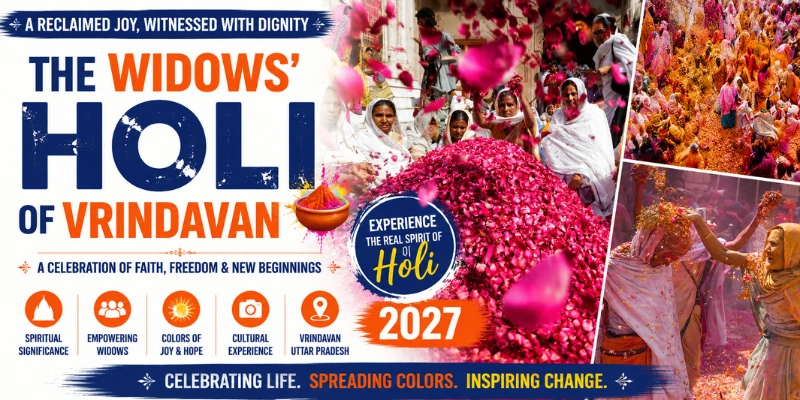
Monday, 22 March 2027
Vrindavan
Quick answer
The widows' Holi of Vrindavan, held in the days before the main Holi in March 2027 (confirm the date), is a recent and moving reclamation in which the city's widows, long forbidden colour and festivity by custom, now play Holi with flowers and gulal. It is kept at temples such as Gopinath, in the care of those who serve them. It deserves to be witnessed with dignity and reverence, never as a spectacle.
Last updated: 23 June 2026 · written by Guru Dutt, born in Gokul · Experience My India
When is the widows' Holi 2027
The widows' Holi is held in the days before the main Holi, in March 2027. It is not a single fixed temple-tithi like Lathmar but an organised observance kept in the run-up to Holi at temples and ashrams that serve Vrindavan's widows, so the exact day is set each year; confirm it close to the time. It sits within the wider Braj Holi season, a quiet, powerful note amid the colour.
What the widows' Holi is and why it matters
For centuries, custom denied Hindu widows colour, festivity and Holi, asking them to live out their lives in white and in austerity; the widows' Holi of Vrindavan, begun in recent years, gives that joy back. The widows of the city gather and play Holi with flower petals and gulal, breaking a taboo that had set them apart from the festival of their own faith. It is one of the most meaningful sights in all of Braj, not for its spectacle but for its restoration of dignity and it has drawn attention across the world as a quiet act of justice.
Vrindavan, the city of widows
Vrindavan is sometimes called the city of widows, because over generations thousands of widowed women, many abandoned by their families, have come here to live out their lives in devotion, in ashrams and bhajan-ashrams, singing for their keep. It is a hard and real part of Vrindavan that an honest guide does not hide behind the temples and the colour. The widows' Holi exists against that backdrop, which is why it carries the weight it does and why it must be approached with compassion rather than curiosity.
A reclamation, not a spectacle
The single most important thing to understand is that the widows' Holi is a reclamation of joy by women society had set aside and it is to be honoured, not consumed. It is not a photo-opportunity, not a colourful backdrop for a holiday reel and not a show staged for visitors. To witness it well is to witness it quietly, with reverence, following the wishes of the women and those who care for them, and, where welcomed, to support the ashrams that serve them. We bring only guests who wish to honour it in that spirit.
Where it is held and how to witness it with dignity
It is kept at temples such as Gopinath and at the ashrams that serve the widows, in the care of the organisations and sevadars who work with them. To witness it with dignity is to arrive quietly, to follow the hosts' wishes on where to stand and whether to photograph, to keep cameras low and respectful or away entirely and to treat the women as the elders and devotees they are, not as subjects. Where it is welcomed, a respectful contribution to the ashrams is a far better thing to leave behind than a photograph.
The widows' Holi 2027 at a glance
Date set each year, confirm close to the time. | | When | The days before the main Holi, March 2027 (confirm) | | Where | Gopinath temple and widows' ashrams, Vrindavan | | What | Holi with flowers and gulal, long denied to widows | | Spirit | A reclamation of dignity, to honour quietly | | How to attend | With reverence, following the hosts' wishes |
⚠️ Honest cautions. This is a reclamation of dignity, not a spectacle. Witness it quietly; do not treat it as a photo-opportunity. Follow the wishes of the women and the sevadars on where to stand and whether to photograph. Where welcomed, support the ashrams rather than take only images. The wider Vrindavan Holi crowds and the bhang-laced thandai cautions apply around it; refuse what you do not know.
Why book with Experience My India, not a faceless OTA
The widows' Holi is the one day where how you attend matters more than that you attend; it asks for reverence, the right introductions and respect for the women and their carers, which a faceless tour herding visitors for photos cannot give. A born Brajwasi brings you as a respectful guest.
What matters for a Braj yatra | Experience My India | A typical online travel aggregator |
Who plans and guides you | Gurudutt, born in Gokul, guiding Braj since 2018 | A listing engine; no one on the ground |
Local knowledge | Knows the temples and ashrams and how to honour the day | Generic, often copied itinerary text |
Dignity | Brings respectful guests, never a photo-safari | May treat it as a colourful backdrop |
Honesty | Names Vrindavan's widow reality with compassion | Sells a feel-good image |
Support | Can direct a respectful contribution to the ashrams | No connection to those served |
Reach | Direct WhatsApp, a real person, reply within two hours | App or call-centre, slow human help |
Track record | 50,000+ pilgrims guided, 4.5 star on Google | Reviews pooled across unrelated vendors |
Plan your visit on WhatsApp +91 7302265809 and a real person replies within two hours.
Festival dates follow the lunar tithi and can shift by a few days each year. Always confirm against the current panchang before booking travel.
Frequently asked questions
When is the widows' Holi 2027?
In the days before the main Holi, in March 2027. It is an organised observance whose exact day is set each year, so confirm close to the time.
Is it a fixed tithi?
Not a single temple-tithi like Lathmar; it is an organised observance kept in the run-up to Holi at the temples and ashrams that serve the widows. We confirm the day for you.
How many days do I need?
It is part of a wider Vrindavan Holi visit; one day to honour it, within a stay that holds the other Holi days. We build it in respectfully.
How far ahead should I book?
Two to three months for the Holi week and we confirm the widows' Holi day closer to the time. The earlier you plan the trip, the better.
Where should I stay?
In Vrindavan, near the temples. We secure temple-adjacent stays for the Holi week.
Is it suitable for senior citizens and families?
Yes, it is gentle and moving rather than a crush and it is a meaningful thing for families to witness respectfully. We plan a calm visit.
Can I attend if I am not Hindu?
Yes, all respectful witnesses are welcome to honour it; the only requirement is reverence, not religion. We ask the same dignity of everyone.
What should I wear?
Modest, respectful clothing suitable for a temple and for elders; you may receive some colour, so nothing precious. We advise for the day.
What is the widows' Holi?
A recent, moving reclamation in which Vrindavan's widows, long denied colour and festivity, now play Holi with flowers and gulal, breaking a centuries-old taboo. It restores joy to women society set aside.
Why were widows denied Holi?
By old custom, Hindu widows were asked to live in austerity and white, set apart from colour and festivity, including Holi. The widows' Holi gives that denied joy back.
When did the widows' Holi begin?
It is a recent observance, of the last several years, organised with the temples and the groups that serve Vrindavan's widows. It has grown into a known and moving part of the Braj Holi.
Why is it so significant?
Because it is not a spectacle but a restoration of dignity, joy returned to women long denied it. It is one of the most meaningful sights in Braj and it has drawn attention worldwide.
Who organises it?
The temples and the organisations and sevadars that work with Vrindavan's widows. We can connect respectful guests and contributions appropriately.
Is it a religious or a social event?
Both; it is Holi, a devotional festival, played by women restored to it and it is also a quiet act of social justice. The two are inseparable here.
What do the widows play with?
Flower petals and gulal, colour and blossom, the festival they were once denied. The sight of white saris flecked with colour is the heart of the day.
Is it the same as the main Holi?
No, it is its own observance in the days before, in the company of the ashrams and it carries a meaning the street Holi does not.
Why is Vrindavan called the city of widows?
Because over generations thousands of widowed women, many abandoned by their families, have come here to live out their lives in devotion, in ashrams and bhajan-ashrams. It is a real and hard part of the city.
How do the widows live?
Many live austerely in ashrams, some singing bhajans for their keep, often with little family support. An honest guide does not hide this behind the temples.
Why do widows come to Vrindavan?
For refuge and devotion, to spend their last years in Krishna's town and sometimes because they have nowhere else to go. The reasons are devotional and, painfully, often economic.
Is the situation improving?
There is more attention and support than before, including the widows' Holi itself, but the need remains real. Supporting the ashrams is a meaningful way to help.
Should I talk about the hardship while attending?
Be gentle and led by the women and their carers; the day is about joy restored, so honour that and engage with the hardship through respectful support, not intrusive questions.
Can I support the widows?
Yes, where welcomed, a respectful contribution to the ashrams that serve them is the best thing to leave behind. We can direct it appropriately.
Is it appropriate to bring this to children?
Yes, gently; it can teach children compassion and dignity, witnessed quietly. We frame it for families with care.
How do I witness the widows' Holi respectfully?
Arrive quietly, follow the hosts' wishes on where to stand and whether to photograph, treat the women as the elders and devotees they are and come to honour, not to consume.
Is it a photo-opportunity?
No. It is a reclamation of dignity, not a colourful backdrop for a holiday reel. Keep cameras low and respectful or away and follow the hosts' wishes entirely.
Can I photograph the widows?
Only with the hosts' permission and the women's comfort and even then with restraint. Where in doubt, do not; a respectful memory matters more than an image.
Should I play colour with the widows?
Only if welcomed to, gently and respectfully; this is their reclaimed joy, not a colour-fight for visitors. We follow the hosts' lead.
What should I not do?
Do not crowd, film intrusively, treat the women as subjects, or come only for images. Do not bring the rowdiness of the street Holi into this gentle observance.
How is this different from the rest of Braj Holi?
It is quieter, weightier and about dignity rather than spectacle. It asks for reverence where the street Holi asks for exuberance.
Will I feel like an intruder?
Not if you come in the right spirit and are brought respectfully; witnessed with reverence, it is a privilege to share, not an intrusion. We ensure the right footing.
Can I speak with the widows?
Gently and if welcomed, led by the women and their carers; many are warm, but follow their comfort and the sevadars' guidance, never pressing.
Where is the widows' Holi held?
At temples such as Gopinath and at the ashrams that serve Vrindavan's widows, in the care of the organisations and sevadars who work with them.
What is the Gopinath temple?
One of the principal Radha-Krishna temples of Vrindavan, associated with the Goswami heritage of the city, among the settings where the widows' Holi is kept.
Can I visit the ashrams?
Where welcomed and appropriate, yes, respectfully and through the right introductions; we arrange it in the spirit of support, not tourism.
Is it in one place or several?
It is kept at temples and ashrams across the run-up to Holi, so the setting depends on the year's organisation. We confirm and plan it.
What is the best way to support the widows?
A respectful contribution to the ashrams that feed and house them, given through the right channels, is the most meaningful thing to leave behind. We can direct it.
Should I bring gifts?
Led by the ashrams' needs and wishes; cash support through the right channels is usually more useful than goods. Ask us and we advise appropriately.
Is it appropriate to share images on social media?
Only with permission and great care; do not turn the women's dignity into content. Where in doubt, share the story, not their faces.
What if I find the day emotionally hard?
It can be moving and heavy; that is part of witnessing it honestly. Take your time, be gentle with yourself and let the joy of the day, not only the hardship, stay with you.
How do I avoid being exploitative?
Come to honour, not to consume; follow the hosts' wishes; support rather than only photograph; and let the women lead. We hold you to that, gently.
Are the bhang and crowd cautions relevant here?
The wider Vrindavan Holi crowds and the bhang-laced thandai are around it, so refuse what you do not know and mind the town's Holi-week crush. The widows' Holi itself is gentle.
Why attend the widows' Holi with you rather than an OTA?
Because how you attend matters more than that you attend; it asks for reverence and the right introductions, which a faceless tour herding visitors for photos cannot give. We bring you as a respectful guest.
Are you local to Vrindavan?
Yes, Gurudutt is a born Brajwasi guiding since 2018, who knows the temples and ashrams and the right way to honour this day. Home.
Will you keep my visit respectful?
Yes, that is the point; we bring only guests who come to honour the day and we follow the women's and the sevadars' wishes throughout.
Can you direct a contribution to the ashrams?
Yes, where welcomed we can direct a respectful contribution through the right channels. It is the best thing to leave behind.
Can I attend the widows' Holi and the main Holi?
Yes, it is in the days before the main Holi, within the Vrindavan Holi week, so a stay can hold both, honouring each in its own spirit.
Can I combine it with the flower Holi and Lathmar?
Yes, all fall within the Holi week; we plan the gentle widows' Holi alongside the flower Holi and Lathmar, each witnessed appropriately.
Do you offer a package that includes it?
We build a Braj Holi tour around the days you can come for and weave the widows' Holi in respectfully where you wish. See the money page below.
Can you provide a regional-language guide?
Yes, Hindi and English as standard, with Telugu, Tamil and other support on request.
How do I book?
Message us on WhatsApp at +91 7302265809 with your dates and group size; we reply within two hours, plan a respectful visit and your Holi-week stay. Radhe Radhe.
Born in Gokul, a lifelong Brajwasi, guiding Mathura–Vrindavan pilgrimages since 2018.
Jai Shri Krishna 🙏