
Jaipur Temple, Vrindavan: The Radha Madhava Temple, Explained
The Jaipur Temple, dedicated to Sri Radha Madhava, is one of Vrindavan's grandest temples, built by Maharaja Sawai Madho Singh II of Jaipur and completed in 1917 over about three decades. It is famous for its carved red sandstone, single-rock pillars and spacious carved courtyard, in a Rajasthani and Mughal style. Calmer than the marquee temples, it is a serene, majestic darshan. Entry is free; reconfirm timings.
Read full guide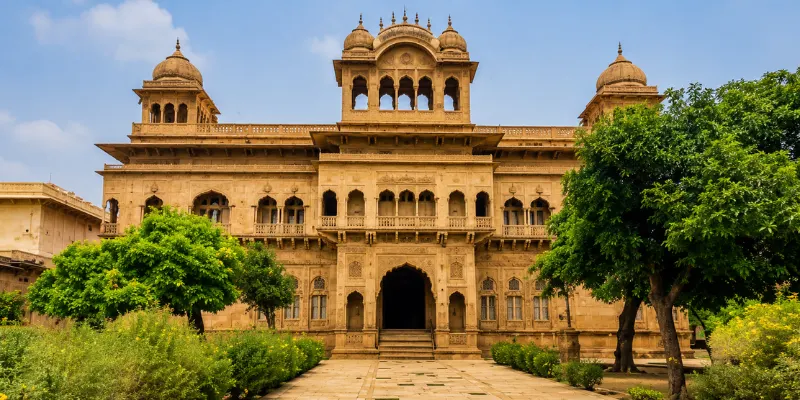
Quick answer
The Jaipur Temple, dedicated to Sri Radha Madhava, is one of Vrindavan's grandest temples, built by Maharaja Sawai Madho Singh II of Jaipur and completed in 1917 over about three decades. It is famous for its carved red sandstone, single-rock pillars and spacious carved courtyard, in a Rajasthani and Mughal style. Calmer than the marquee temples, it is a serene, majestic darshan. Entry is free; reconfirm timings.
At a glance
| What it is | A grand red-sandstone temple, among Vrindavan's largest |
|---|---|
| Deity | Sri Radha Madhava (with Anand Bihari and Hans Gopala) |
| Built by | Maharaja Sawai Madho Singh II of Jaipur |
| Completed | 1917 (built over about three decades) |
| Style | Rajasthani and Mughal; carved red sandstone |
| Famous for | Single-rock carved pillars, jaali work, a large courtyard |
| Also called | Radha Madhav Temple |
| Where | Near Atalla Chungi / Bhuteshwar road area, Vrindavan |
| Entry fee | Free |
| Distance | 12 km from Mathura |
| Best time | October to March; calm most days |
What is the Jaipur Temple and why visit it?
The Jaipur Temple, properly the Sri Radha Madhava temple, is one of the largest and most majestic temples in Vrindavan, built by Maharaja Sawai Madho Singh II of Jaipur and completed in 1917 after roughly three decades of work. It is a monument of royal devotion: the Maharaja is said to have laid a railway line between Mathura and Vrindavan to carry the heavy stone, the same fine sandstone used in great buildings of the era. The result is a temple of carved red sandstone, single-rock pillars, delicate jaali latticework and a spacious courtyard, in a blend of Rajasthani and Mughal style.
The deity is Sri Radha Madhava, worshipped with Anand Bihari and Hans Gopala in the temple's sanctums.
The architecture
What sets the Jaipur Temple apart is its craftsmanship and scale. The temple is built almost entirely of red sandstone, intricately carved, with large pillars said to be cut from single rocks, a carved courtyard, fine jaali screens and a marble altar. It is calmer and less crowded than the marquee temples, which makes its grandeur easier to take in: a place for an unhurried, majestic darshan rather than a jostling queue. Today it is cared for under the Jaipur royal trust's legacy.
A tip from Gurudutt: Go to the Jaipur Temple precisely because it is not crowded. After the crush of Banke Bihari, this is where you can stand in a vast carved courtyard in relative quiet and actually look up at the stonework. Late morning or mid-afternoon, between the darshan rushes, is ideal. Bring a moment of patience for the carving, a good guide will show you details, the single-rock pillars and the jaali screens, that most visitors walk straight past. |
The deities and the royal devotion
The temple's sanctums enshrine Sri Radha Madhava at the centre, with Anand Bihari and Hans Gopala alongside, installed when the temple was completed in 1917. The temple stands as an expression of the Jaipur royal family's long devotion to Krishna and to Vrindavan, the same devotion that, generations earlier, had carried the deities of Govind Dev, Gopinath and Madan Mohan to safety in Rajasthan. Here that bond is written in stone.
How do you reach the Jaipur Temple?
The Jaipur Temple is in Vrindavan, near the Atalla Chungi and Bhuteshwar road area.
From | Distance | Notes |
Vrindavan railway station | 2 km | Auto |
Banke Bihari temple | 1.5 km | Auto or walk |
Radha Damodar temple | Close by | Short walk |
Mathura | 12 km | 30-40 min |
Delhi | 150 km | 3-3.5 hrs |
Tips for your visit
The Jaipur Temple is free; darshan is in morning and evening slots that vary by season, so reconfirm. Dress modestly and leave footwear at the racks. Because it is spacious and calm, it is a good counterpoint to the busier temples, and pairs well with the nearby Radha Damodar and Banke Bihari on a Vrindavan temple day.
What is nearby?
TheJaipurTemplesitsincentralVrindavannearseveralgreattemples.Toplanyourvisit,see our Banke Bihari guide, our Radha Damodar guide and our Madan Mohan guide.
Meet Gurudutt — Your Mathura
Vrindavan Guide
Not just a tour operator — Gurudutt was born and raised in Braj Bhoomi. 8+ years, every week, through every sacred lane of Mathura & Vrindavan.
- 🛕Born in Braj Bhoomi
- 🙏50,000+ Pilgrims Guided
- 📅Guiding Since 2018
- ⭐4.5 Google Rating
Gurudutt
Founder · Experience My India
Frequently asked questions
What is the Jaipur Temple in Vrindavan famous for?
The Jaipur Temple, dedicated to Sri Radha Madhava, is famous as one of Vrindavan's grandest temples, built by the Maharaja of Jaipur and completed in 1917, with carved red sandstone, single-rock pillars and a spacious courtyard.
Who built the Jaipur Temple?
The Jaipur Temple was built by Maharaja Sawai Madho Singh II of Jaipur, completed in 1917 after about three decades of construction, as an expression of the Jaipur royal family's devotion to Krishna.
Who is worshipped at the Jaipur Temple?
The deity is Sri Radha Madhava, a form of Radha and Krishna, worshipped at the centre, with Anand Bihari and Hans Gopala in the temple's other sanctums.
When was the Jaipur Temple built?
The Jaipur Temple was completed in 1917, after roughly three decades of construction, making it an early twentieth-century temple, a monument of the Jaipur royal family's devotion.
Why is it called the Jaipur Temple?
It is called the Jaipur Temple because it was built by the Maharaja of Jaipur; its proper name is the Sri Radha Madhava temple, after its presiding deity.
Where is the Jaipur Temple?
The Jaipur Temple is in Vrindavan, near the Atalla Chungi and Bhuteshwar road area, about 12 km from Mathura and a short ride from the Banke Bihari temple.
Is the Jaipur Temple worth visiting?
Yes, it is one of Vrindavan's grandest and calmest temples, a place to take in fine red-sandstone craftsmanship away from the crowds. Experience My India includes it on the Vrindavan temple day as a serene counterpoint.
What is the Jaipur Temple also known as?
The Jaipur Temple is also known as the Radha Madhav temple or Sri Radha Madhava temple, after its presiding deity. The popular name simply reflects its royal founder from Jaipur.
What style is the Jaipur Temple?
The Jaipur Temple is built in a blend of Rajasthani and Mughal style, in carved red sandstone, with single-rock pillars, jaali latticework, a large courtyard and a marble altar. It is admired for its craftsmanship and scale.
Is the Jaipur Temple one of the largest in Vrindavan?
Yes, by land area the Jaipur Temple is among the largest temples in Vrindavan, with a spacious carved courtyard and grand sanctums, which is part of why it feels calm even when other temples are crowded.
Why did the Maharaja build a railway for the Jaipur Temple?
In tradition, Maharaja Sawai Madho Singh II laid a railway line between Mathura and Vrindavan to carry the heavy red sandstone needed for the temple, a measure of the scale and devotion behind its construction.
What is the Jaipur Temple made of?
The Jaipur Temple is built almost entirely of carved red sandstone, the same fine stone used in great buildings of the era, with single-rock pillars, jaali screens and a marble altar.
What deities are in the Jaipur Temple sanctums?
The central sanctum enshrines Sri Radha Madhava; the other sanctums hold Anand Bihari and Hans Gopala, along with associated deities, all installed when the temple was completed in 1917.
How long did the Jaipur Temple take to build?
The Jaipur Temple took roughly three decades to build, completed in 1917, reflecting the scale of its carved stonework and the care of the craftsmen the Maharaja employed.
Who manages the Jaipur Temple now?
The Jaipur Temple is cared for under the legacy of the Jaipur royal trust, continuing the royal family's long association with the temple and its deities.
How is the Jaipur royal family connected to Vrindavan?
The Jaipur royal family has a long devotion to Krishna and Vrindavan, having sheltered deities like Govind Dev and Madan Mohan in Rajasthan during Mughal campaigns, and later building this grand temple, completed in 1917.
Is the Jaipur Temple carved from single rocks?
Its large pillars are said to be cut from single rocks, part of the temple's celebrated craftsmanship, along with its carved red sandstone facade and fine jaali latticework.
What makes the Jaipur Temple architecturally important?
Its scale, its carved red sandstone, single-rock pillars, jaali work and blend of Rajasthani and Mughal style make the Jaipur Temple one of Vrindavan's finest examples of devotional architecture from the early twentieth century.
What are the Jaipur Temple timings?
The Jaipur Temple opens for morning and evening darshan with a midday break, the hours varying by season. Reconfirm on the day. Because it is spacious and calm, almost any open hour gives an unhurried darshan.
What is the best time to visit the Jaipur Temple?
October to March for pleasant weather, and late morning or mid-afternoon between the darshan rushes, when the large courtyard is calm and the stonework easy to admire. It is rarely as crowded as the marquee temples.
Is there an entry fee at the Jaipur Temple?
No, entry to the Jaipur Temple is free, with voluntary donations. It is open for darshan in its morning and evening slots.
How long do you need at the Jaipur Temple?
Allow about 30 to 45 minutes for darshan and to take in the courtyard, pillars and carving. Its calm makes it pleasant to linger. It pairs with Radha Damodar and Banke Bihari nearby.
Is the Jaipur Temple crowded?
No, the Jaipur Temple is usually calmer than the marquee temples, thanks to its size, so it offers a peaceful darshan even on busy days. It is livelier on festivals like Janmashtami.
Is photography allowed at the Jaipur Temple?
Photography of the architecture and courtyard is generally fine, but photography at the deity may be restricted. Follow posted signs and staff guidance, and be respectful during worship.
Is the Jaipur Temple suitable for elderly visitors?
Yes, the temple is relatively accessible and calm, with a spacious courtyard, making it comfortable for elderly visitors. Experience My India arranges a gentle pace and assistance as needed.
What is the dress code at the Jaipur Temple?
Modest, traditional attire is expected, with shoulders and knees covered, and footwear left at the racks. A calm, respectful manner suits this grand temple.
How do you reach the Jaipur Temple?
The Jaipur Temple is in central Vrindavan near Atalla Chungi, about 12 km from Mathura, reached by auto-rickshaw or car. Reach Vrindavan by road or train, then a short ride. Experience My India arranges transport.
How far is the Jaipur Temple from Banke Bihari?
The Jaipur Temple is about 1.5 km from the Banke Bihari temple, a short ride or walk, so the two combine on a Vrindavan temple day. Experience My India sequences them.
How far is the Jaipur Temple from Mathura?
The Jaipur Temple is about 12 km from Mathura, roughly a 30 to 40 minute drive, usually visited on a Vrindavan temple day.
Can you reach the Jaipur Temple by car?
Yes, the Jaipur Temple is reachable by car or auto on Vrindavan's main roads, with parking nearby, easier than the deep-lane temples. Experience My India handles the drive and drop-off.
What is the nearest railway station to the Jaipur Temple?
Vrindavan railway station is about 2 km away, with Mathura Junction the major railhead about 12 km off. From either, autos reach the temple. Experience My India arranges the transfer.
Can you combine the Jaipur Temple with other temples?
Yes, the Jaipur Temple sits near Radha Damodar and Banke Bihari and combines easily with them and the old temples on a Vrindavan temple day. Experience My India plans the route.
Can you visit the Jaipur Temple in one day from Delhi?
Yes, the Jaipur Temple fits a one-day Vrindavan trip from Delhi, about 3 to 3.5 hours each way, on a temple route. Experience My India plans the day.
Is parking easy at the Jaipur Temple?
Parking is easier here than at the deep-lane temples, as the Jaipur Temple is on Vrindavan's main road area. Experience My India arranges the drive and the closest practical drop-off.
Do you need a guide for the Jaipur Temple?
A guide is not essential, but a Braj-local guide points out the single-rock pillars, jaali work and the story of the Maharaja's railway, details most visitors miss. Experience My India provides Braj-born guides.
How does Experience My India help with a Jaipur Temple visit?
We include the Jaipur Temple as a calm, grand counterpoint on the Vrindavan temple day, tell its royal history and show its craftsmanship, and pair it with Radha Damodar and Banke Bihari. Our guides are born and raised in Braj.
Is the Jaipur Temple good for families?
Yes, its calm, spacious courtyard makes it comfortable and pleasant for families, a restful stop among busier temples. Experience My India tailors the pace for all ages.
What makes the Jaipur Temple special?
Its grand scale, fine red-sandstone carving and calm atmosphere make the Jaipur Temple special, a monument of royal devotion where you can take in both darshan and architecture without the crowds.
Is the Jaipur Temple good for those who dislike crowds?
Yes, it is one of the calmer major temples in Vrindavan, thanks to its size, making it ideal for those who want a peaceful darshan away from the crush of the marquee temples.
What is near the Jaipur Temple?
Near the Jaipur Temple are Radha Damodar, Banke Bihari, Madan Mohan and the central temple quarter of Vrindavan, all within a short ride or walk. Experience My India sequences them.
Which temple in Vrindavan did the Maharaja of Jaipur build?
The Maharaja of Jaipur, Sawai Madho Singh II, built the Sri Radha Madhava temple, popularly the Jaipur Temple, completed in 1917, one of Vrindavan's grandest red-sandstone temples.
What is the Radha Madhav temple in Vrindavan?
The Radha Madhav temple is the formal name of the Jaipur Temple, dedicated to Sri Radha Madhava, built by the Maharaja of Jaipur and completed in 1917, near Atalla Chungi in Vrindavan.
Is the Jaipur Temple old?
The Jaipur Temple is an early twentieth-century temple, completed in 1917, so it is historic but far younger than Vrindavan's oldest temple, Madan Mohan, of around 1580. Its fame rests on its scale and craftsmanship.
What is the best time to visit the Jaipur Temple?
October to March for pleasant weather, and late morning or mid-afternoon for a calm darshan in the large courtyard. The temple is rarely as crowded as the marquee shrines.
Is the Jaipur Temple open all year?
Yes, the Jaipur Temple is open year-round on daily morning and evening schedules, free. October to March is the most pleasant season, and it is calm for most of the year.
Why do people visit the Jaipur Temple?
Devotees and travellers visit for the darshan of Sri Radha Madhava and for the temple's grand red-sandstone architecture and calm, a peaceful and majestic stop on a Vrindavan temple day.
Born and raised in Braj Bhoomi. I have been guiding pilgrims through Mathura Vrindavan since 2018 — that is more than a decade of yatras, every week, through every season. Experience My India was built on one belief: a well-planned yatra is a deeply felt one. 50,000+ pilgrims have trusted us with their most sacred journeys.
Jai Shri Krishna 🙏
Watch What Our Pilgrims Truly Feel
दिल्ली से गुजरात तक — हर यात्री की कहानी, उन्हीं के शब्दों में

Real Braj Experience

Mathura Darshan Journey

Temple Darshan Review

Vrindavan Yatra Review

Braj Pilgrimage Story

Govardhan Parikrama Tale

Banke Bihari Darshan

Yamuna Aarti Experience

Iskcon Temple Review

Mathura Holi Memories

Nidhuvan Night Story

Prem Mandir Darshan

Radha Kund Holy Dip

Vrindavan Parikrama Walk

Gokul Janmabhoomi Visit

Seva Kunj Evening Darshan

Barsana Dham Journey