
Potara Kund, Mathura: Where Krishna's Baby Clothes Were Washed
Potara Kund is an ancient stepped sacred tank beside Krishna Janmabhoomi in Mathura, revered in tradition as the place where the baby clothes, the potra, of the infant Krishna were washed. Built in red sandstone with steps descending to the water, it is held very holy, its water used in auspicious rites. Standing right by the birthplace, it is a tender, intimate part of the Janmabhoomi visit. Entry is free.
Read full guide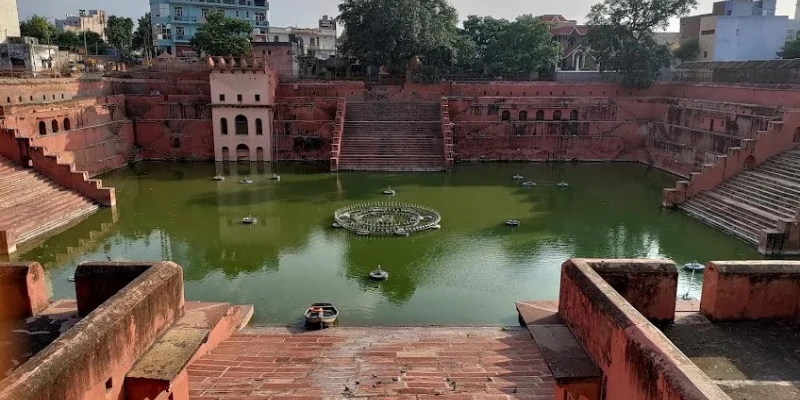
Quick answer
Potara Kund is an ancient stepped sacred tank beside Krishna Janmabhoomi in Mathura, revered in tradition as the place where the baby clothes, the potra, of the infant Krishna were washed. Built in red sandstone with steps descending to the water, it is held very holy, its water used in auspicious rites. Standing right by the birthplace, it is a tender, intimate part of the Janmabhoomi visit. Entry is free.
At a glance
| What it is | An ancient stepped sacred tank by Krishna Janmabhoomi |
|---|---|
| Name means | Potra: a baby's clothes or swaddling |
| The tradition | Baby Krishna's clothes were washed here |
| Where | Beside Krishna Janmabhoomi, Mathura |
| Built of | Red sandstone, stepped down to the water |
| Water | Held very holy, used in auspicious rites |
| Entry fee | Free |
| Distance | 4 km from Mathura Junction |
| Best time | October to March; with the Janmabhoomi |
| Mood | Tender, intimate, tied to Krishna's birth |
| Pairs with | Krishna Janmabhoomi, Bhuteshwar Mahadev |
What is Potara Kund and why does it matter?
Potara Kund is an ancient, beautiful stepped tank right beside Krishna Janmabhoomi in Mathura, and one of the most tender sites of the birthplace. Its name comes from potra, a baby's clothes or swaddling, for in the living tradition this is where the little clothes of the infant Krishna were washed, in the very first days after he was born in Kansa's prison nearby. Built of red sandstone, with broad steps descending to the water, it is held to be very holy.
Standing at the kund, so close to the birthplace, brings the newborn Krishna very near.
The kund of the baby's clothes
In the tradition, the potra, the swaddling clothes of the newborn Krishna, were washed in this kund in the days around his birth, which is why its water is revered as deeply sacred and is taken for auspicious rites. The red-sandstone steps, the still water and the reflection of the walls give the kund a quiet, gentle beauty, and pilgrims descend to take its holy water or simply to sit. It is small and intimate compared to the great temples, and that is its charm: it holds the homely, human tenderness of caring for a newborn child who was also the Lord.
A tip from Gurudutt: Visit Potara Kund as part of your Krishna Janmabhoomi darshan, since it is right beside it, and let the simple, homely meaning land: this is where a divine baby's little clothes were washed. Go down the red-sandstone steps to the water if you wish to take it reverently for your rites. It is quietest in the early morning. A guide will connect it to the prison-birth at Janmabhoomi so the whole tender story of Krishna's first days in Mathura comes together. |
Potara Kund and the birthplace
Potara Kund belongs wholly to the story of Krishna's birth at Mathura. He was born in the prison of Kansa, at the site now revered as Krishna Janmabhoomi, and here, beside it, his baby clothes were washed. So a visit naturally joins the two: the birthplace itself and the kund of the newborn's swaddling, with the guardian Shiva Bhuteshwar close by. See our Krishna Janmabhoomi guide for the birthplace and our Bhuteshwar Mahadev guide for the city's guardian Shiva.
How do you reach Potara Kund?
Potara Kund is beside Krishna Janmabhoomi in Mathura.
From | Distance | Notes |
Krishna Janmabhoomi | Beside it | Short walk |
Mathura Junction | 4 km | 15 min |
Bhuteshwar Mahadev | Close by | Short walk/ride |
Vishram Ghat | 2 km | 10 min |
Delhi | 150 km | 3-3.5 hrs |
Tips for your visit
Potara Kund is free and open through the day; reconfirm any timed access. Use the steps to the water with care, dress modestly, and prefer the calm of early morning. October to March is the pleasant season. Being right beside Krishna Janmabhoomi, it is best folded into the birthplace visit, with Bhuteshwar Mahadev close by.
What is nearby?
Potara Kund lies beside Krishna Janmabhoomi in the Mathura old city. To plan your visit, see our Krishna Janmabhoomi guide, our Bhuteshwar Mahadev guide, our Dwarkadhish temple guide and our Vishram Ghat guide.
Meet Gurudutt — Your Mathura
Vrindavan Guide
Not just a tour operator — Gurudutt was born and raised in Braj Bhoomi. 8+ years, every week, through every sacred lane of Mathura & Vrindavan.
- 🛕Born in Braj Bhoomi
- 🙏50,000+ Pilgrims Guided
- 📅Guiding Since 2018
- ⭐4.5 Google Rating
Gurudutt
Founder · Experience My India
Frequently asked questions
What is Potara Kund?
Potara Kund is an ancient stepped sacred tank beside Krishna Janmabhoomi in Mathura, revered in tradition as the place where the baby clothes, the potra, of the infant Krishna were washed. Its water is held very holy.
What does Potara Kund mean?
Potara comes from potra, meaning a baby's clothes or swaddling. The kund is so named because, in the tradition, the little clothes of the newborn Krishna were washed here, beside his birthplace.
Where is Potara Kund?
Potara Kund is in Mathura, right beside Krishna Janmabhoomi, about 4 km from Mathura Junction, in the heart of the old city where Krishna was born.
Why is Potara Kund famous?
Potara Kund is famous as the kund where, in the tradition, the baby clothes of the infant Krishna were washed in the first days after his birth. Beside the birthplace, it holds the tender, homely side of his arrival.
Is Potara Kund worth visiting?
Yes, it is a beautiful, intimate stepped kund right beside the birthplace, with a tender story. Experience My India includes it as part of the Krishna Janmabhoomi visit.
Whose clothes were washed at Potara Kund?
In the tradition, the potra, the swaddling clothes, of the newborn Krishna were washed at Potara Kund in the days around his birth in Kansa's prison nearby, which gives the kund its name and its sanctity.
Is the water of Potara Kund holy?
Yes, the water of Potara Kund is revered as deeply sacred, tied to the washing of the infant Krishna's clothes, and is taken by pilgrims for auspicious rites. Many descend the steps to take it reverently.
What does Potara Kund look like?
Potara Kund is a stepped tank built of red sandstone, with broad steps descending to still water and small shrines around it, the red walls reflected in the water, a quiet and gentle sight beside the birthplace.
Is Potara Kund near Krishna Janmabhoomi?
Yes, Potara Kund is right beside Krishna Janmabhoomi, a short walk away, so the birthplace and the kund of the newborn's clothes are visited together. Experience My India sequences them.
Is Potara Kund ancient?
Potara Kund is an ancient and long-revered sacred tank, tied in tradition to the birth of Krishna, beside the Janmabhoomi. It has been honoured by pilgrims across the generations as part of the birthplace.
What is the story of Potara Kund?
In the tradition, after Krishna was born in Kansa's prison in Mathura, his baby clothes, the potra, were washed in this kund beside the birthplace, which is why its water is held sacred and the kund bears the name Potara.
Why is Potara Kund significant to Krishna's birth?
Potara Kund is significant because it holds the homely, tender side of Krishna's birth: the washing of the newborn's clothes, the everyday care of a divine child. It complements the birthplace with this intimate human detail.
What rites are done with Potara Kund water?
The holy water of Potara Kund is taken by pilgrims for auspicious activities and rites, drawing on its sanctity from the washing of the infant Krishna's clothes. Some take a reverent dip or sprinkle it.
How does Potara Kund connect to Janmabhoomi?
Potara Kund stands beside Krishna Janmabhoomi, where Krishna was born in Kansa's prison, and holds the washing of his baby clothes, so the two together tell the full story of his first days in Mathura.
Why do pilgrims value the homely detail of Potara Kund?
Pilgrims treasure that the Lord came as a real baby whose little clothes were washed, the same loving care any newborn receives. Potara Kund holds that tenderness, bringing the infant Krishna humanly near.
Is Potara Kund part of the Janmabhoomi complex area?
Potara Kund lies right beside the Janmabhoomi in the same part of the old city, so it is treated as part of the birthplace visit, a sacred tank just steps from where Krishna was born.
Can you take a dip at Potara Kund?
Some pilgrims take a reverent dip or take the holy water at the steps. As with any kund, check the water condition on the day; a sprinkling carries the devotion where a full dip is not advisable.
What makes Potara Kund peaceful?
Its stepped red-sandstone form, the still reflecting water and its intimate scale, beside the bustle of the birthplace, give Potara Kund a quiet, gentle peace, a place to pause in the tender story of Krishna's first days.
What are the Potara Kund timings?
Potara Kund is an open sacred tank, generally accessible through the day alongside the Janmabhoomi area. Reconfirm any timed access on the day. Early morning is calmest.
What is the best time to visit Potara Kund?
October to March for pleasant weather, with early morning calmest. Janmashtami brings great devotion to the whole birthplace area, vibrant but very crowded. It pairs with the Janmabhoomi visit.
Is there an entry fee at Potara Kund?
No, Potara Kund is free to visit, with voluntary donations. It is an open sacred tank beside Krishna Janmabhoomi.
How long do you need at Potara Kund?
Allow about 15 to 20 minutes for the kund and its steps, as part of the Krishna Janmabhoomi visit. Experience My India sequences the birthplace sites together.
Is Potara Kund crowded?
It shares the busy birthplace area, busier on Janmashtami and weekends, though the kund itself is often calmer than the main temple queue. Early morning is most peaceful.
Are there security rules at Potara Kund?
As it adjoins the high-security Krishna Janmabhoomi complex, the area can have strict security and restrictions on bags, phones and cameras. Follow the rules for the birthplace. Experience My India advises on what to carry.
Is Potara Kund suitable for elderly visitors?
Yes, the kund is fairly accessible, though the steps to the water need care. Experience My India arranges assistance and the easiest approach for elderly pilgrims as part of the birthplace visit.
What is the dress code at Potara Kund?
Modest, traditional attire is expected, in keeping with the adjoining birthplace. Comfortable footwear easy to remove helps, and a calm, reverent manner suits this sacred tank.
How do you reach Potara Kund?
Potara Kund is beside Krishna Janmabhoomi in Mathura, about 4 km from Mathura Junction, reached by taxi, auto or e-rickshaw and a short walk. Experience My India arranges transport and the birthplace visit.
How far is Potara Kund from Mathura Junction?
Potara Kund is about 4 km from Mathura Junction railway station, roughly a 15 minute drive, beside Krishna Janmabhoomi.
How far is Potara Kund from Krishna Janmabhoomi?
Potara Kund is right beside Krishna Janmabhoomi, a short walk away, so the two are visited together as one part of the Mathura birthplace day. Experience My India sequences them.
What is the nearest railway station to Potara Kund?
The nearest railhead is Mathura Junction, about 4 km away. From there, taxis, autos and e-rickshaws reach the birthplace area. Experience My India arranges the transfer.
Can you reach Potara Kund by car?
Yes, Potara Kund is reachable by car or auto in Mathura, with a short walk from the birthplace area parking. Experience My India handles the drive and drop-off.
Can you combine Potara Kund with Krishna Janmabhoomi?
Yes, Potara Kund is right beside the birthplace and is naturally visited as part of the Krishna Janmabhoomi darshan. Experience My India sequences them together.
Can you combine Potara Kund with Bhuteshwar Mahadev?
Yes, Bhuteshwar Mahadev, the guardian Shiva of Mathura, is close to the birthplace area, so Potara Kund and Bhuteshwar are easily visited on the same old-city walk. Experience My India sequences them.
Can you visit Potara Kund in one day from Delhi?
Yes, Potara Kund and the Mathura birthplace fit a one-day Braj trip from Delhi, about 3 to 3.5 hours each way. Experience My India plans the day.
Do you need a guide for Potara Kund?
A guide is not essential, but a Braj-local guide connects the kund to the prison-birth at Janmabhoomi so the tender story of Krishna's first days comes together. Experience My India provides Braj-born guides.
How does Experience My India help with a Potara Kund visit?
We include Potara Kund within the Krishna Janmabhoomi visit, tell the story of the newborn's clothes, advise on the birthplace security rules, and link it to Bhuteshwar close by. Our guides are born and raised in Braj.
Is Potara Kund good for families?
Yes, the homely story of washing the baby's clothes is lovely for families, and the kund is gentle and close to the birthplace. Experience My India tailors the visit and tells the story simply for all ages.
What makes Potara Kund special?
That the baby clothes of the infant Krishna were washed here, beside his birthplace, makes Potara Kund special, a tender, intimate sacred tank holding the homely human care of a divine newborn.
Is Potara Kund good for a reflective visit?
Yes, with its still water, red-sandstone steps and gentle scale, Potara Kund is a quiet, reflective spot beside the busy birthplace, a place to pause in the story of Krishna's first days.
What is near Potara Kund?
Beside Potara Kund are Krishna Janmabhoomi and Bhuteshwar Mahadev, with Dwarkadhish, Vishram Ghat and the old-city sites close by. Together they make the Mathura day. Experience My India sequences them.
Where were Krishna's baby clothes washed?
In the tradition, the baby clothes of the infant Krishna were washed at Potara Kund, a stepped sacred tank beside Krishna Janmabhoomi in Mathura. Its water is revered as deeply holy.
What is the kund next to Krishna Janmabhoomi?
The kund beside Krishna Janmabhoomi is Potara Kund, an ancient stepped sacred tank where, in tradition, the newborn Krishna's clothes were washed. It is visited as part of the birthplace.
Why is it called Potara Kund?
It is called Potara Kund from potra, a baby's clothes or swaddling, because in the tradition the little clothes of the infant Krishna were washed here, beside his birthplace in Mathura.
What is the best time to visit Potara Kund?
October to March for pleasant weather, with early morning calmest. It is visited as part of the Krishna Janmabhoomi darshan; Janmashtami is vibrant but very crowded.
Is Potara Kund open all year?
Yes, Potara Kund is an open sacred tank beside the birthplace, accessible year-round and free. October to March is the most pleasant season, and early morning the calmest time.
Why do pilgrims visit Potara Kund?
Pilgrims visit to honour the kund where the infant Krishna's clothes were washed, to take its holy water, and to feel the tender, homely side of his birth, just beside the Janmabhoomi where he was born.
Born and raised in Braj Bhoomi. I have been guiding pilgrims through Mathura Vrindavan since 2018 — that is more than a decade of yatras, every week, through every season. Experience My India was built on one belief: a well-planned yatra is a deeply felt one. 50,000+ pilgrims have trusted us with their most sacred journeys.
Jai Shri Krishna 🙏
Watch What Our Pilgrims Truly Feel
दिल्ली से गुजरात तक — हर यात्री की कहानी, उन्हीं के शब्दों में

Real Braj Experience

Mathura Darshan Journey

Temple Darshan Review

Vrindavan Yatra Review

Braj Pilgrimage Story

Govardhan Parikrama Tale

Banke Bihari Darshan

Yamuna Aarti Experience

Iskcon Temple Review

Mathura Holi Memories

Nidhuvan Night Story

Prem Mandir Darshan

Radha Kund Holy Dip

Vrindavan Parikrama Walk

Gokul Janmabhoomi Visit

Seva Kunj Evening Darshan

Barsana Dham Journey