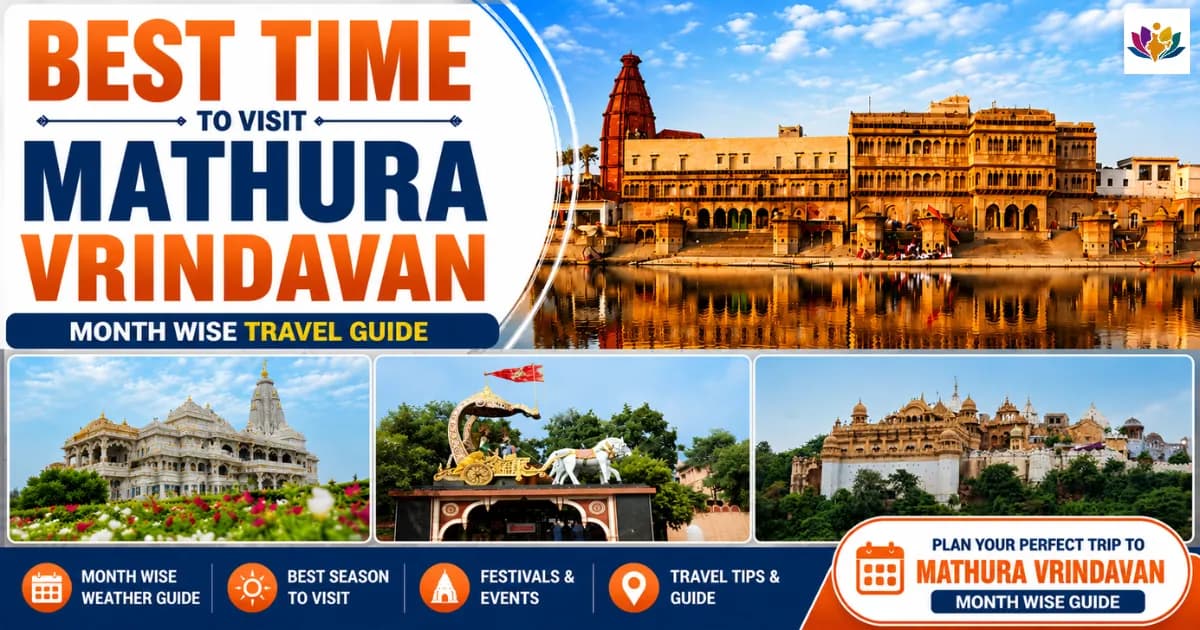
📌 QUICK ANSWER
The best time to visit Mathura Vrindavan is October to March — the ideal Mathura Vrindavan travel guide window when temperatures stay between 8°C and 28°C. October and November give the fewest crowds at the best weather. March brings Holi — the world's largest colour festival. Avoid May and June (up to 45°C). Govardhan Parikrama (21 km) is only comfortable between October and February. Experience My India runs guided tours from ₹1,999 per person — call +91-7302265809 to book.
The timing of your Mathura Vrindavan visit changes everything — from whether you can do Govardhan Parikrama barefoot to whether your cab will get stuck in festival traffic for three hours. Mathura and Vrindavan together receive more than 15 million pilgrims annually, and that foot traffic is not spread evenly across the year. Two months — August for Janmashtami and March for Holi — account for a disproportionate share.
The best time to visit Mathura Vrindavan is between October and March, with October–November being the single window that gives you comfortable weather, manageable crowds, and the full temple experience without festival disruption. But the right month for you depends on what you are coming for — and that is what this Mathura Vrindavan travel guide answers precisely.
I am Gurudutt, born in Braj Bhoomi and guiding pilgrims on this exact route since 2018. At Experience My India we have helped over 50,000 pilgrims choose the right season, the right itinerary, and the right departure time. This guide gives you a month-by-month weather table, a festival calendar, Govardhan Parikrama planning advice, and the practical realities — including the monkey situation — that most travel websites skip entirely. See our Mathura Vrindavan Tour Packages or whatsapp / Call +91 7302265809.
Best Time to Visit Mathura Vrindavan
October to March. Specifically, October and November for the ideal combination of post-monsoon fresh weather, clear roads, and calm temple lanes. February and March if you want to experience Braj Holi. August if Janmashtami is your reason for coming — but plan a full extra day for crowd delays.
Avoid May and June unless you have a medical or specific reason to be here. Temperatures in those months regularly hit 44–45°C by noon. Even local residents limit outdoor movement to before 9:00 AM and after 6:00 PM during this period.
Fix: If your travel dates fall in April–June, Experience My India restructures every itinerary around the 6:00–10:00 AM and 5:30–8:30 PM windows only — call +91-7302265809 to get a summer-specific darshan plan that works within the heat constraints.
Month-by-Month Weather, Crowd and Cost Guide
This is the table every pilgrim should look at before booking. All temperature figures are average Mathura–Vrindavan values.
Month | Avg. Temperature | Weather Feel | Crowd Level | Avg. Hotel Cost (Budget) | Best For |
January | 8°C–20°C | Cold, foggy mornings | High (peak season) | ₹800–₹2,000/night | Temple darshan, winter pilgrimage |
February | 12°C–24°C | Pleasant, clear | High (Holi buildup) | ₹1,000–₹2,500/night | Braj Holi preparation, Barsana Lathmar Holi |
March | 18°C–32°C | Warm, festive | Extremely High | ₹1,500–₹4,000/night | Holi — book 4–6 weeks ahead |
April | 24°C–38°C | Hot afternoons | Low | ₹600–₹1,200/night | Budget-conscious, peaceful darshan |
May | 30°C–44°C | Very hot | Very Low | ₹500–₹1,000/night | Not recommended; temples by 8:00 AM only |
June | 32°C–45°C | Extreme heat | Very Low | ₹500–₹900/night | Not recommended; Govardhan Parikrama impossible |
July | 28°C–38°C | Hot, humid, monsoon begins | Low–Moderate | ₹600–₹1,200/night | Spiritual seekers; Kanwar Yatra begins |
August | 26°C–35°C | Monsoon; Janmashtami | Extremely High (Janmashtami week) | ₹2,000–₹5,000/night | Janmashtami — book 6–8 weeks ahead |
September | 25°C–34°C | Post-monsoon, humid | Moderate | ₹700–₹1,500/night | Radhashtami (Barsana); quieter temple visits |
October ⭐ | 20°C–32°C | Ideal — clear, mild | Moderate | ₹800–₹1,800/night | Best overall month; post-Navratri, Annakut |
November ⭐ | 15°C–28°C | Ideal — cool, crisp | Moderate | ₹900–₹2,000/night | Second best; Chhath Puja, Govardhan Puja |
December | 10°C–22°C | Cool, foggy by end | High | ₹1,000–₹2,500/night | Winter pilgrimage season; Christmas holiday crowd |
⭐ = Experience My India's recommended peak months for first-time pilgrims.
Season-by-Season Breakdown — What Each Period Offers
Winter (October–February) — Recommended for Most Pilgrims
This is the most comfortable and most popular window for visiting Mathura Vrindavan. Temperatures stay between 8°C and 28°C. Temple darshan is pleasant on foot, and the Yamuna ghats are vivid with morning mist and evening diyas. Govardhan Parikrama (21 km) is comfortable barefoot. You can walk between Banke Bihari, Prem Mandir, ISKCON, and the ghats without the exhaustion that heat imposes in other months.
The one caveat: January fog. From mid-December through late January, dense fog affects road and train travel from Delhi. Trains from Delhi are frequently delayed by 1–4 hours. Experience My India always recommends departing from Delhi or Agra by road during this period to maintain itinerary control — call +91-7302265809 to confirm your pickup time based on fog forecasts.
Holi Season (February–March) — For the Festival Experience
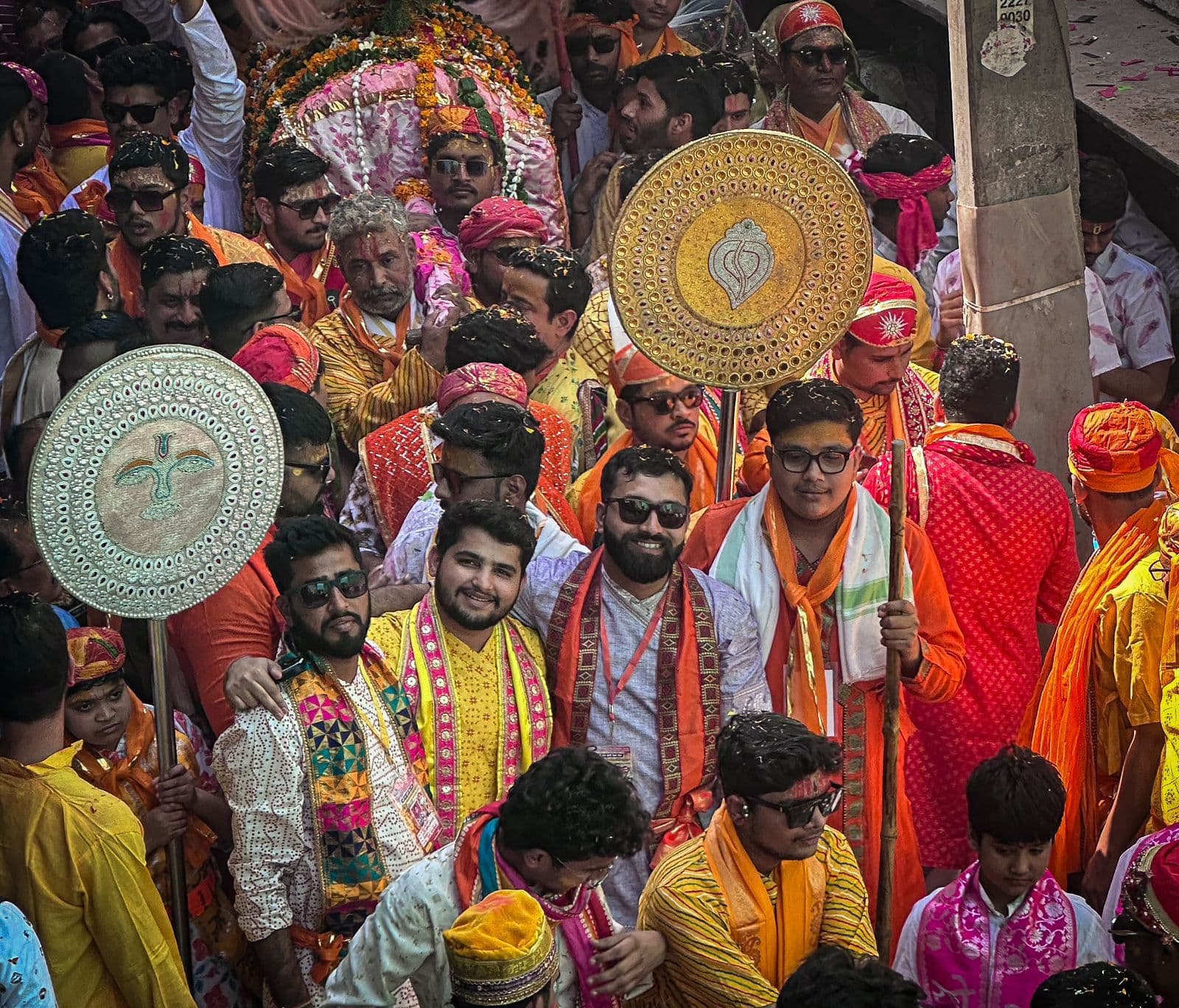
Braj Holi is not a single day. The Braj Holi calendar begins with Lathmar Holi at Barsana (approximately 42 km from Vrindavan) 2 weeks before the main Holi, then Lathmar Holi at Nandgaon, then the Phoolon wali Holi at ISKCON Vrindavan, and finally the main Holi day when the entire region plays colour simultaneously.
If you are coming for Holi, plan 3–4 days and book accommodation 6 weeks in advance. Accommodation prices in Vrindavan triple during this week. Experience My India runs a dedicated Holi Special Braj Yatra — call +91-7302265809 for the full Holi itinerary.
Summer (April–June) — For Budget Travellers Who Can Handle Heat
April still has pleasant mornings (up to 10:00 AM). May and June are genuinely difficult — 44–45°C by noon makes outdoor temple circuits painful, and the Govardhan Parikrama is not advisable. The benefit is near-empty temples and the lowest room rates of the year. If you visit in May–June, structure your darshan entirely before 9:00 AM and after 6:00 PM.
Monsoon (July–September) — Peaceful But Unpredictable
The Yamuna comes alive in monsoon, the fields around Braj turn green, and temple crowds are thin on non-festival days. The major disruption is Janmashtami in August, which brings 500,000+ pilgrims to Mathura in a single day. If you want Janmashtami, plan to arrive 2 days before and leave 2 days after to avoid being trapped in traffic.
For every season, Experience My India builds a timing-specific itinerary — summer darshan before 9:00 AM, winter fog-adjusted road departures, festival-period crowd routing. Call +91-7302265809 and tell us your dates; we will tell you exactly what to expect and how to plan around it.
Festival Calendar — When to Come for Which Festival
Festival | Usual Timing | Location | Crowd Level | Advance Booking Required |
Lathmar Holi — Barsana | 8–10 days before main Holi (Feb/Mar) | Barsana, 42 km from Vrindavan | Very High | 3–4 weeks |
Lathmar Holi — Nandgaon | 7 days before main Holi | Nandgaon, 47 km from Vrindavan | Very High | 3–4 weeks |
Phoolon wali Holi (ISKCON) | 1 week before main Holi | ISKCON Vrindavan | High | 2–3 weeks |
Main Holi | March (Phalgun Purnima) | All of Braj | Extremely High | 6 weeks |
Radhashtami | September (Bhadrapad Shukla Ashtami) | Barsana + Vrindavan | Moderate | 1–2 weeks |
Janmashtami | July/August (Shravan Ashtami) | Mathura, ISKCON Vrindavan | Extremely High | 6–8 weeks |
Annakut (Govardhan Puja) | Day after Diwali (Oct/Nov) | Govardhan, Vrindavan | High | 2–3 weeks |
Govardhan Puja | Day after Diwali | Govardhan Hill | Very High | 2–3 weeks |
Chhath Puja | October/November | Yamuna Ghats, Mathura | Moderate | 1 week |
Kartik Snan (Parikrama Month) | Full month of October/November | All Braj | High | 2 weeks |
Akshaya Tritiya | April/May | Mathura, Vrindavan | Moderate | 1 week |
Note: Exact festival dates change annually based on the Hindu lunar calendar. Experience My India maintains an updated festival calendar — call +91-7302265809 to confirm dates for your travel year.
Govardhan Parikrama — The 21 km Walk You Need to Plan For
Govardhan Hill is located approximately 22 km from Vrindavan and 26 km from Mathura city centre. The circumambulation (Parikrama) of the hill is 21 km on foot — a complete circuit that takes 5–7 hours depending on pace, crowd, and stops at sacred sites along the route.
Key stops on the Govardhan Parikrama route:
Daan Ghati Mandir (common starting point)
Manasi Ganga (sacred kund near the base of the hill)
Radha Kund (one of the holiest kunds in Braj — mandatory stop for pilgrims)
Shyam Kund (adjacent to Radha Kund)
Kusum Sarovar (historic step-well; 15 min walk from Radha Kund)
Punchari ka Lautha (Mukharvind — the "mouth" of the hill, considered most powerful darshan point)
Best time for Govardhan Parikrama:
October to February — the only months comfortable enough for the full 21 km on foot or barefoot
Pre-dawn start (4:00–5:00 AM) is strongly recommended in summer months if you choose to attempt it
Avoid May and June entirely — the unshaded path and 44°C temperatures make the Parikrama dangerous
Practical Parikrama facts:
No motor vehicles are permitted on the main Parikrama Marg
Cycle-rickshaws are available for elderly pilgrims or those who cannot complete the full circuit on foot (approximately ₹300–₹500 for the full circuit)
Multiple langars (free food stalls) operate along the route, especially on Ekadashi and Purnima
The route is accessible 24 hours, but the safest walking window is 4:00 AM to 11:00 AM in winter
Experience My India includes Govardhan Parikrama as part of our 3-day Braj Yatra package — see the 3 Days Mathura Vrindavan Tour Package for the full itinerary. Call +91-7302265809 to customise the Parikrama day to your physical ability.
For a detailed guide to the Govardhan Parikrama route and all stops, read our dedicated post: Govardhan Hill Parikrama - 21 km Complete Guide
Know Before You Plan — Monkeys, Heat, Crowds and Other Realities
Before booking your Mathura Vrindavan trip, here are the things the Experience My India team wants every pilgrim to know — the facts that save your day before it starts:
The monkeys of Vrindavan are a real, daily reality — not a rare event. Vrindavan city has a large Rhesus macaque population concentrated around the older temple areas — particularly Loi Bazaar, the lanes near Banke Bihari Temple, and the Nidhivan area. What they target specifically: spectacles and sunglasses (the single most common snatch — monkeys grab glasses with both hands and will only release them in exchange for food, typically a Mango Frooti or banana); open food packets (any carry bag containing food will be sensed immediately); cameras and mobile phones in narrow lanes. Do not wear expensive prescription glasses on a loose frame in the Loi Bazaar lanes. If a monkey takes your glasses, stay calm — offer a Mango Frooti and let a local resident handle the exchange. Do not snatch back, do not shout, do not make sudden arm movements. Experience My India briefs all guests on this before entering the bazaar area — call +91-7302265809 if you want our lane-by-lane safety guide before you arrive.
The afternoon temple closure (12:00 PM – 4:00 PM) is the most common planning mistake — almost every major temple in Mathura and Vrindavan closes for 3–4 hours in the afternoon. Plan your Delhi departure so you arrive in Vrindavan before 11:00 AM. Experience My India builds all itineraries with this closure accounted for — the afternoon window is used for travel between Mathura and Gokul or for lunch and rest before evening darshan.
January and February fog from Delhi delays trains by 1–4 hours on bad days — if you are travelling from Delhi in January, a 6:00 AM road departure is safer and more predictable than a train. The Yamuna Expressway remains driveable but requires reduced speed. Call +91-7302265809 to confirm road pickup time on fog-affected days.
Govardhan Parikrama takes 6–7 hours, not 3–4 hours — do not plan it alongside a full Vrindavan temple circuit on the same day. It is a dedicated full-day activity. The best window is 4:00 AM to 11:00 AM start in winter (October–February).
Holi accommodation in Vrindavan sells out 6 weeks before the festival — not 1–2 weeks. On the main Holi day, every dharamshala, ashram guesthouse, and budget hotel within 5 km of Vrindavan city centre is full. If you search for rooms 3 weeks before, you are already too late.
Water and hydration — Vrindavan has no large modern shopping centres. Clean bottled water is available at every temple entrance and bazaar lane but must be bought in advance. In summer, carry 1.5 litres per person per half-day of temple walking.
Dress code — every temple in Mathura and Vrindavan requires modest clothing. Shoulders and knees must be covered for both men and women. Footwear must be removed before entering temple premises; shoe storage is available (free or ₹5) outside all major temples. Cotton or linen fabrics are the most practical choice given the heat in warmer months.
Experience My India plans all Mathura Vrindavan itineraries around these exact realities — monkey zones, temple closure windows, fog-adjusted departure times, festival crowd routing, and Govardhan Parikrama timing are all built into every tour. Call +91-7302265809 before you finalise your dates — even five minutes on the phone can prevent a full day going sideways.
Ground Truth — What Nobody Tells You About Timing Your Visit
Five realities from 10+ years of guiding pilgrims through Mathura and Vrindavan that most travel guides never mention:
Janmashtami is not a one-day event — it is a 3-day disruption. Mathura roads close to private vehicles within a 5 km radius of Krishna Janmabhoomi from the day before Janmashtami through the day after. Taxis and cabs cannot reach the temples. The only way to navigate this is on foot. If you are not prepared for this, arrive 2 days before or visit 2 days after. Experience My India issues specific Janmashtami advisories to all guests who book during this period.
Holi accommodation in Vrindavan sells out 6 weeks in advance — not 1–2 weeks. On the main Holi day, every dharamshala, ashram guesthouse, and budget hotel in mathura vrindavan within 5 km of Vrindavan city centre is full. If you search for rooms 3 weeks before, you are already too late for anything near the main temples.
October is less visited than December but offers better weather. December and January are high season because school holidays drive family group travel from Delhi and NCR. October has similar or better weather (slightly warmer, no fog, post-monsoon freshness) but 30–40% lower hotel rates and thinner temple queues.
Govardhan Parikrama takes 6–7 hours, not 3–4 hours. Multiple travel blogs estimate 3–4 hours. The realistic time for a devotee doing the full 21 km with stops at Radha Kund, Kusum Sarovar, and Mukharvind — including rest breaks and langar stops — is 6–7 hours. Plan an entire day for Govardhan; do not attempt to combine it with a full Vrindavan temple circuit on the same day.
The Braj Holi calendar lasts 40 days, and Barsana Lathmar Holi is specifically 2 weeks before main Holi. Visitors who book travel for main Holi day often miss Barsana Lathmar Holi entirely — which is, for many pilgrims, the more distinctive event. The women of Barsana beat men from Nandgaon with wooden staffs (lathis) as the men sing and play colour. It is a centuries-old tradition and requires no ticket to observe. Barsana is 42 km from Vrindavan; the whole event takes a half-day round trip.
Call +91-7302265809 to speak with Gurudutt directly about current conditions in Mathura and Vrindavan on your specific travel dates.
CONCLUSION
The best time to visit Mathura Vrindavan is not a single month — it depends on what you are coming for. October to March is the standard recommendation for comfort, and it is correct. But October specifically gives you the fewest trade-offs: post-monsoon air, clear roads, affordable rooms, and calm temple queues. If your calendar allows flexibility, choose October or November. If you are coming for Holi, plan 6 weeks ahead. If Janmashtami is calling, arrive 2 days early and leave 2 days late.
And if you have not thought about Govardhan Parikrama yet — add a day. The 21 km circuit around Govardhan Hill is the most distinctively Braj experience you can have, and October to February is the only weather window where it is truly enjoyable.
Experience My India has covered every season, every festival, and every road condition on this route since 2018. Let us help you plan the right visit for your timing.
📱 Book Your Mathura Vrindavan Trip - We Reply in 30 Minutes 📞 +91-7302265809 💬 WhatsApp: +91-7302265809 Packages start from ₹1,999/ person | Rated 4.5★ / 204+ Reviews Explore all: Mathura Vrindavan Tour Package Jai Shri Krishna 🙏 |
Gurudutt — Born & Raised in Braj Bhoomi
Guiding pilgrims through Mathura & Vrindavan since 2018 · 50,000+ pilgrims served