📌 QUICK ANSWER
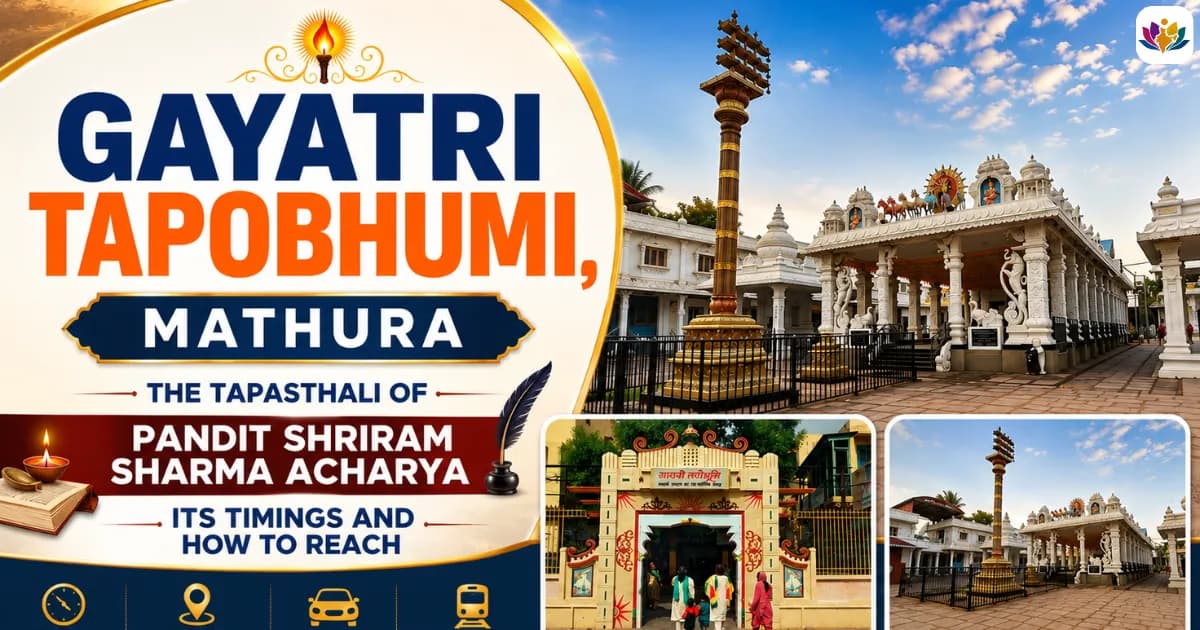
Gayatri Tapobhumi in Mathura is the sacred place of penance founded in 1953 by Pandit Shriram Sharma Acharya, the birthplace of the Gayatri Pariwar, one of India’s largest spiritual families and a great centre of yajna, meditation and the Gayatri Mantra. It is open every day from 5:30 AM to 9:00 PM, with morning aarti and mass havans and an evening aarti. Entry is free. To visit Gayatri Tapobhumi and Mathura with a Braj-born guide, call or WhatsApp +91 7302265809.
Key takeaways
Gayatri Tapobhumi is the place of penance of Pandit Shriram Sharma Acharya.
It was founded in 1953, the birthplace of the Gayatri Pariwar.
It is a great centre of yajna, meditation and the Gayatri Mantra.
Its Yagyashala holds an Akhand Agni, an ever burning sacred flame.
It is open daily from 5:30 AM to 9:00 PM, with aarti, havan and meditation.
It stands at Masani in Mathura; entry is free.
GAYATRI TAPOBHUMI: TIMINGS AND ADDRESS Open: every day, 5:30 AM to 9:00 PM Morning aarti and meditation: 5:30 AM to 6:30 AM Mass havans (yajna): 6:30 AM to 7:30 AM Evening aarti and Nadayog: 5:30 PM to 6:25 PM Address and entry: Gayatri Tapobhumi Road, Masani, Mathura, Uttar Pradesh 281001. Free. Times vary, so verify on the day. |
I am Gurudutt, born in Gokul in the Mathura district, guiding pilgrims through Braj since 2018: more than 50,000 of them. Gayatri Tapobhumi is a place quite unlike the Krishna temples for which Mathura is famous and all the more worth seeing for it: a great modern centre of penance, yajna and the Gayatri Mantra, founded by one of the towering spiritual figures of the last century and the cradle of a movement now spread across the world. For those drawn to meditation, the sacred fire and the science of spirituality, it is a deeply peaceful and uplifting place. Here is its story, its timings, its rituals and how to reach it. Add it to your Mathura trip with our Mathura Vrindavan Tour Package, message on WhatsApp at +91 7302265809, any day from 8 AM to 9 PM.
What is Gayatri Tapobhumi?
Gayatri Tapobhumi is a sacred centre of spiritual practice in Mathura, the tapasthali or place of penance of the revered Pandit Shriram Sharma Acharya, known to his followers as Gurudev. It is not a temple of Krishna but a great modern ashram and pilgrimage site devoted to the worship of Gayatri, the Vedmata or mother of the Vedas and to the practice of yajna, meditation and self refinement. It is the birthplace of the Gayatri Pariwar, the vast spiritual family that Gurudev founded, which today counts millions of members across the world. A place of sacred fire, chanting and deep calm amid the bustle of Mathura, it draws seekers rather than sightseers and it rewards them richly. The table gives the essentials at a glance.
Gayatri Tapobhumi, Mathura, at a glance.
Detail | Information |
What it is | A centre of penance, yajna and Gayatri worship |
Founded by | Pandit Shriram Sharma Acharya (Gurudev) |
Founded | 1953 (some sources 1950) |
Deity | Gayatri Mata, the Vedmata |
Home of | The Gayatri Pariwar, a global spiritual family |
Famous for | The Yagyashala and its ever burning Akhand Agni |
Area | Masani, Mathura, Uttar Pradesh |
Pin code | 281001 |
Entry | Free |
The story: Gurudev and the founding of the Tapobhumi
The story of Gayatri Tapobhumi is the story of its founder, Pandit Shriram Sharma Acharya, born in 1911, a saint, reformer, writer and visionary whom his followers call Yug Rishi, the sage of the age. From the age of fifteen he undertook an extraordinary spiritual discipline, completing twenty four Gayatri Mahapurascharans, each one the recitation of two point four million Gayatri mantras, a labour of twenty four years. On the completion of this immense penance, he established Gayatri Tapobhumi at Mathura in 1953 as the fruit and the home of his sadhana.
The founding was itself an act of devotion of rare depth. For the very foundations of the Tapobhumi, holy soil and water were gathered from two thousand four hundred pilgrimage sites across the land, worshipped and laid into the ground, so that the whole sacred geography of India was gathered into this one spot. Here Gurudev, after a fast of twenty four days on water alone, performed the prana pratishtha, the invocation of the living presence of Gayatri Mata into her idol. And here, in 1958, he held a grand thousand altar yajna, said to be the greatest since the age of the Mahabharata, from which he launched the Yug Nirman Yojna, his movement for the transformation of the age. From this ground grew the Gayatri Pariwar, now one of the largest spiritual families in the world.
The Akhand Agni and the Yagyashala
At the heart of Gayatri Tapobhumi is its Yagyashala, the hall of sacred fire and within it burns the Akhand Agni, the unbroken flame. This sacred fire is revered as having been carried from a still older flame, said to have been kept burning for some seven hundred years by a siddha yogi and it has been maintained unextinguished ever since it was established here, a living thread of fire linking the present worship to centuries of penance. To sit before the Akhand Agni as the mass havan is performed, the mantras rising with the smoke, is the central experience of a visit to the Tapobhumi and it is a profoundly moving one. Beside the fire is the idol of Gayatri Mata, in whom Gurudev invoked the living presence and the mantras he himself recited are preserved here.
What you can see and do
Gayatri Tapobhumi is a living centre of practice, not merely a monument and its day follows a rhythm of worship the visitor may share. The morning opens with the aarti and group meditation, followed by the mass havans in the Yagyashala, the daily fire rituals that are the soul of the place. Through the morning, sanskar ceremonies are performed, the Vedic rites of life such as the first tonsure and the beginning of learning, for those who book them in advance. In the evening comes the aarti with Nadayog, the yoga of sacred sound, accompanied by spiritual discourses. Around these, the peaceful grounds, the idol of Gayatri Mata and the atmosphere of chanting and calm invite quiet reflection. It is a place to sit, to meditate and to absorb, rather than to hurry through. The table gives the daily rhythm.
Gayatri Tapobhumi daily activities. Verify on the day; times may vary.
Activity | Time | What it is |
Morning aarti and meditation | 5:30 AM to 6:30 AM | Invocation and group meditation |
Mass havans (yajna) | 6:30 AM to 7:30 AM | The daily fire rituals in the Yagyashala |
Sanskar ceremonies | 6:30 AM to 8:30 AM | Vedic life rites, by prior booking |
Evening aarti and Nadayog | 5:30 PM to 6:25 PM | Sunset prayers with spiritual discourses |
Timings
Gayatri Tapobhumi is open every day of the week, from early morning to night and the rhythm of its worship runs through the day as set out above. Being a centre of daily ritual rather than a temple of fixed darshan, its main draw is to come for one of the living sessions, the morning aarti and havan or the evening aarti, rather than simply to look around. The table gives the opening hours.
Gayatri Tapobhumi opening hours. Open all week; verify on the day.
Day | Opening hours |
Monday to Sunday | 5:30 AM to 9:00 PM |
Location and how to reach Gayatri Tapobhumi
Gayatri Tapobhumi stands on the Gayatri Tapobhumi Road at Masani, in Mathura, Uttar Pradesh, pin code 281001, on the edge of the city. It is easily reached by local auto rickshaw or e rickshaw from the Mathura Junction railway station and the bus stand, both a short ride away and it lies within Mathura so it fits naturally into a day of the city’s sights. Mathura is about 150 kilometres from Delhi by the Yamuna Expressway and about 60 from Agra and Mathura Junction is a major railhead. A private car makes it easy to combine the Tapobhumi with the Janmabhoomi, the ghats and the other sights of Mathura. The table gives the essentials.
Reaching Gayatri Tapobhumi. Distances are approximate; verify on the day.
From | Distance | Notes |
Mathura Junction | A short ride | By auto or e rickshaw |
Krishna Janmabhoomi | Within Mathura | Combine on a city day |
Vrindavan | About 12 to 15 km | Easily added |
Delhi | About 150 km | Via the Yamuna Expressway |
Agra | About 60 km | On the NH44 |
It fits naturally into a day of Mathura sightseeing places and our Mathura Vrindavan taxi service drives you around the city’s sights.
When to visit
The cool months of October to March are the most comfortable for a visit and within the day the great times are the morning, for the aarti and the mass havan and the evening, for the aarti and Nadayog, when the living worship of the place is at its fullest. Gayatri Jayanti, the appearance day of Gayatri and the great yajna occasions of the Gayatri Pariwar calendar are the most special and busiest times, when devotees gather from far and wide. For a calm and reflective visit, an ordinary morning or evening is ideal. Our best time to visit Mathura Vrindavan guide has the seasons.
The honest bit
Honest words on Gayatri Tapobhumi. Entry is free and no official VIP pass exists here or anywhere in Braj; it is run by the Gayatri Pariwar with great discipline and simplicity, so simply come and take part. This is a place of practice, not a spectacle, so come for the morning or evening session, the aarti, the havan or the meditation, rather than expecting a grand temple to tour; approached in that spirit it is deeply rewarding and approached as mere sightseeing it may seem quiet. Sanskar ceremonies such as the mundan need to be booked in advance, so arrange them ahead if you wish. Dress modestly and keep a respectful silence, for people are in meditation. And it is a Gayatri centre, distinct from the Krishna temples, so know what you are coming for.
Why Experience My India is the right choice
I was born in Gokul Mahaban Bangar, in this district and I know the many faces of Mathura, the Krishna temples and also the great centres like this one that many visitors never think to see. Guiding since 2018, more than 50,000 pilgrims, 4.5 stars across 204 Google reviews, WhatsApp first, 8 AM to 9 PM daily. What a local brings to Gayatri Tapobhumi is the timing above all, bringing you for the morning havan or the evening aarti when the place is alive rather than at a dead hour; the story of Gurudev and the Gayatri Pariwar told so the place makes sense; the booking of a sanskar if you wish one; and the weaving of the Tapobhumi into a full and varied day of Mathura. One clear fare and never a charge for what is free.
Tip from Gurudutt: come to Gayatri Tapobhumi for the morning aarti and the mass havan, between about half past five and half past seven in the morning and if you can, sit and take part rather than only watch. To join the chanting of the Gayatri Mantra as the sacred fire is fed, in the very place of Gurudev’s penance, is an experience quite different from any temple darshan, calming and uplifting and it is the true heart of a visit here. A quick look around at the wrong hour misses the whole point of the place.
Related guides
Plan your Mathura visit
Tell me your dates and your group and I will build Gayatri Tapobhumi into your Mathura day, timed for the morning havan or the evening aarti, woven together with the Janmabhoomi and the ghats, with a car that drives you and a guide who knows the city, for one clear price. WhatsApp +91 7302265809, any day 8 AM to 9 PM. Packages from Rs 1,999 per person, 4.5 stars from 204 Google reviews. Born in Gokul, Mathura.
Book Your Mathura - Vrindavan Trip Today 📞 +91-7302265809 💬 WhatsApp: +91-7302265809 Packages start from ₹1,999/ person | Rated 4.5★ / 204+ Reviews Explore all: Mathura Vrindavan Tour Packages Jai Shri Krishna 🙏 |
Gurudutt — Born & Raised in Braj Bhoomi
Guiding pilgrims through Mathura & Vrindavan since 2018 · 50,000+ pilgrims served