
Ekadashi and Adhik Maas in Braj: The Year-Round and Once-in-Three-Years Devotions
Ekadashi, the eleventh tithi of each fortnight, is the great fasting day of the Vaishnavas, kept intensely in Vrindavan twice a month, and Adhik Maas, the extra lunar month that recurs about every three years, is the supreme season of the Braj Chaurasi Kos parikrama, the 84-kos circuit of the whole of Braj. Both are recurring devotions rather than single festivals; confirm the year's dates on the panchang.
Read full guide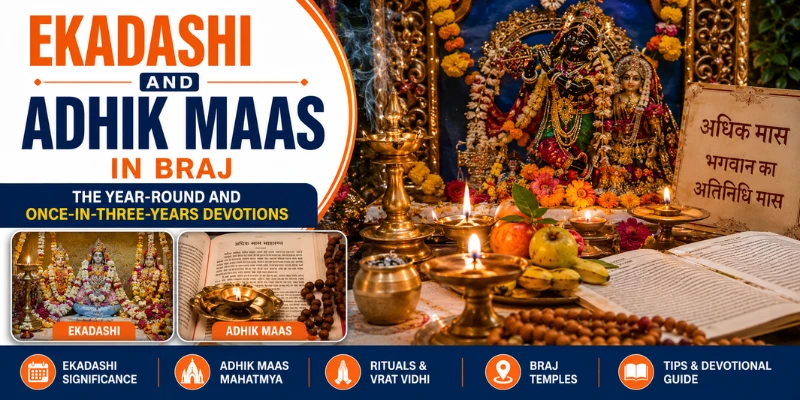
Friday, 16 Mar, 2029
Braj
Quick answer
Ekadashi, the eleventh tithi of each fortnight, is the great fasting day of the Vaishnavas, kept intensely in Vrindavan twice a month, and Adhik Maas, the extra lunar month that recurs about every three years, is the supreme season of the Braj Chaurasi Kos parikrama, the 84-kos circuit of the whole of Braj. Both are recurring devotions rather than single festivals; confirm the year's dates on the panchang.
Last updated: 24 June 2026 · written by Guru Dutt, born in Gokul · Experience My India
What Ekadashi is, and when it falls
Ekadashi is the eleventh tithi of each lunar fortnight, falling twice a month, the great fasting and devotional day of the Vaishnavas, dear above all to those who worship Krishna and Vishnu. It recurs throughout the year, so there is an Ekadashi to keep on any visit of a fortnight or more. In Vrindavan it is kept with fasting, parikrama, bhajan and special temple darshan, the town turning to devotion. Confirm the month's Ekadashi dates on the panchang.
The major Ekadashis of the year
While every Ekadashi is holy, some are great: Nirjala Ekadashi, the waterless fast of Jyeshtha, the most demanding and meritorious; Devshayani Ekadashi, when Vishnu sleeps and Chaturmas begins; Prabodhini or Devutthana Ekadashi, when he wakes and the wedding season and Tulsi Vivah begin; and Amalaki or Rangbharni Ekadashi, when Banke Bihari plays Holi. Each has its own grace and its own place in the Braj year. We tell you which Ekadashi your dates fall on and what it carries.
Keeping Ekadashi in Vrindavan
On Ekadashi, devotees fast, some without grains, some without water, keeping the day in bhajan and parikrama, and the Vrindavan temples and the Goswami seats keep special darshan. The town walks the parikrama marg and sings; it is one of the most devotional rhythms of Braj, twice a month, every month. We guide you in the fast as your tradition keeps it, never imposing it, and to the temples and the parikrama at their most devotional.
What Adhik Maas is, and why it is supreme
Adhik Maas, also called Mal Maas or Purushottam Maas, is the extra lunar month inserted about every three years to align the lunar and solar calendars, and tradition holds that Krishna, as Purushottam, took the rejected month as his own, making it supremely auspicious for devotion. What was the unwanted month became the holiest, a whole month for parikrama, daan, bhajan and the worship of Krishna. In Braj it is the supreme season of pilgrimage. Confirm the next Adhik Maas on the panchang, as it recurs about every three years.
The Braj Chaurasi Kos parikrama
Adhik Maas is above all the season of the Braj Chaurasi Kos parikrama, the great 84-kos circuit, about 250 km, of the whole of Braj, its twelve forests, its towns and its holy sites, walked by lakhs of pilgrims over weeks of devotion. It is the supreme Braj pilgrimage, the full circumambulation of Krishna's land. Few visitors can walk the entire circuit, so most keep a representative parikrama of the key sites and forests, or join an organised yatra for a stretch. We plan it honestly to your time, body and devotion, the full circuit, a section, or the principal sites.
Ekadashi and Adhik Maas at a glance
Topic | Details |
Ekadashi | The eleventh lunar day (tithi), observed twice every month as a sacred Vaishnava fasting day |
Major Ekadashis | Nirjala Ekadashi, Devshayani Ekadashi, Prabodhini Ekadashi, Amalaki Ekadashi, and other important observances |
Adhik Maas | The extra lunar month that occurs approximately once every three years and is considered highly auspicious |
Adhik Maas Pilgrimage | The revered Braj Chaurasi Kos Parikrama, covering around 84 kos (approximately 250 km) |
Where It Is Celebrated | Vrindavan, the historic Goswami temples, and the sacred twelve forests (Dwadash Van) of Braj |
Spiritual Significance | Represents both the recurring devotion of Ekadashi and the rare once-in-three-years spiritual opportunity of Adhik Maas in Braj |
⚠️ Honest cautions. The fast is a devotion, not an obligation for visitors; keep it as your tradition does, and we never impose it. The 84-kos parikrama is a major undertaking over weeks; for most, a representative parikrama or an organised section is wiser, and we plan it honestly to your body. Adhik Maas draws huge crowds to Braj; book well ahead. Give only at a temple hundi. Mind heat or monsoon by the season, and the monkeys.
Why book with Experience My India, not a faceless OTA
The Ekadashi fast and the 84-kos parikrama are devotions an aggregator cannot interpret for you; knowing which Ekadashi your dates fall on, how to keep it, and how to fit the vast Adhik Maas parikrama honestly to your body and time is a Brajwasi's knowledge. We give you the true devotion, not a generic listing.
What matters for a Braj yatra | Experience My India | A typical online travel aggregator |
Who plans and guides you | Gurudutt, born in Gokul, guiding Braj since 2018 | A listing engine; no one on the ground |
Local knowledge | Knows the Ekadashis, the parikrama, the twelve forests | Generic, often copied itinerary text |
Honesty | Fits the 84-kos parikrama to your body; never imposes the fast | Oversells or misjudges the undertaking |
Depth | Tells you which Ekadashi falls and what it carries | A name on a list |
Pricing | Transparent, all-inclusive; no hidden charges | Markups, hidden fees |
Support | Direct WhatsApp, a real person, reply within two hours | App or call-centre, slow human help |
Track record | 50,000+ pilgrims guided, 4.5 star on Google | Reviews pooled across unrelated vendors |
Plan your Ekadashi or Adhik Maas yatra on WhatsApp +91 7302265809 and a real person replies within two hours.
Festival dates follow the lunar tithi and can shift by a few days each year. Always confirm against the current panchang before booking travel.
Frequently asked questions
What is Ekadashi?
The eleventh tithi of each lunar fortnight, the great fasting and devotional day of the Vaishnavas, dear to worshippers of Krishna and Vishnu. It falls twice a month.
How often does Ekadashi fall?
Twice a month, once in each fortnight, so about twenty-four times a year. There is an Ekadashi to keep on any visit of a fortnight or more. Confirm the dates on the panchang.
Why is Ekadashi observed?
As a day of fasting, devotion and purification dear to Vishnu and Krishna, when the mind is turned to the Lord. In Vrindavan it is kept with fasting, parikrama and bhajan.
Is Ekadashi a single festival or recurring?
Recurring, twice a month, the rhythm of Vaishnava devotion, with some Ekadashis especially great. It is a devotion, not a one-date festival.
Do I have to fast on Ekadashi?
No, the fast is a devotion, not an obligation for visitors; keep it as your tradition does, or simply honour the day in the temples. We never impose it.
How is the fast kept?
Some abstain from grains, some from food, some even from water on the strictest, keeping the day in bhajan and parikrama. Forms vary by tradition; follow your own.
Can I visit the temples on Ekadashi?
Yes, the Vrindavan temples and Goswami seats keep special darshan on Ekadashi, the town turning to devotion. We sequence the temples and the parikrama.
Is Ekadashi a good day to be in Vrindavan?
Yes, it is one of the most devotional rhythms of the town, the parikrama walked and the temples full of bhajan. We plan a meaningful Ekadashi.
Which are the great Ekadashis?
Nirjala, the waterless fast of Jyeshtha; Devshayani, when Vishnu sleeps; Prabodhini, when he wakes and Tulsi Vivah begins; and Amalaki or Rangbharni, when Banke Bihari plays Holi, among others.
What is Nirjala Ekadashi?
The waterless Ekadashi of Jyeshtha, the most demanding and meritorious, kept without even water; it is held to carry the merit of all the year's Ekadashis. Keep it only as your health and tradition allow.
What is Devshayani Ekadashi?
The Ekadashi of Ashadh when Vishnu enters his four-month cosmic sleep, beginning Chaturmas, when major auspicious activities pause. It opens the holy four months.
What is Prabodhini Ekadashi?
The Kartik Ekadashi when Vishnu wakes from his sleep, ending Chaturmas and beginning the wedding season and Tulsi Vivah. It is a joyful threshold.
What is Amalaki or Rangbharni Ekadashi?
The Phalguna Ekadashi when Banke Bihari plays Holi and Vrindavan turns to colour, the same day as the flower Holi. It is one of the great Vrindavan days.
Are there other notable Ekadashis?
Yes, Mokshada (with Gita Jayanti), Putrada, Vaikuntha and others, each with its grace. We tell you which falls on your dates and what it carries.
Does each Ekadashi have its own story?
Yes, each carries its own legend and merit in the tradition; we tell the one your visit falls on. They enrich the day with meaning.
How is Ekadashi kept in Vrindavan?
With fasting, the parikrama marg walked, bhajan sung, and special darshan at the temples and Goswami seats. The town turns to devotion twice a month.
Is there a special parikrama on Ekadashi?
The Vrindavan parikrama is walked devotionally on Ekadashi; the town and the pilgrims keep it. We can walk it with you.
Which temples are best on Ekadashi?
The principal seats and the Goswami temples keep special darshan; we sequence the loveliest. The whole town is devotional.
Can I break the fast at the temple?
The fast is broken on Dwadashi, the next day, by tradition, often with temple prasad; forms vary. We guide you by your tradition.
Can families and elders keep Ekadashi?
Yes, gently and by their own form; the fast is never imposed, and the temple darshan is open to all. We plan a comfortable day.
Is Ekadashi crowded?
Busier than ordinary days with the parikrama and the devout, but not a dangerous crush except on the great Ekadashis. We plan the timing.
What is Adhik Maas?
The extra lunar month inserted about every three years to align the lunar and solar calendars, also called Mal Maas or Purushottam Maas. Tradition holds Krishna made it his own, supremely auspicious for devotion.
Why is Adhik Maas called Purushottam Maas?
Because the rejected, unwanted extra month was taken by Krishna, Purushottam, as his own, turning the lowliest month into the holiest. It is the month of the Supreme Person.
How often does Adhik Maas occur?
About every three years, to keep the lunar and solar calendars aligned. Confirm the next Adhik Maas on the panchang, as the timing varies.
Why is Adhik Maas auspicious?
Because Krishna made the rejected month his own, it is held supremely auspicious for parikrama, daan, fasting and bhajan, a whole month for devotion. In Braj it is the great pilgrimage season.
What do pilgrims do in Adhik Maas?
They come to Braj in great numbers for parikrama, above all the 84-kos circuit, for daan and bhajan and intensive devotion. The whole land turns to pilgrimage.
Is Adhik Maas a good time to visit Braj?
For intense devotion and the great parikrama, supremely so; but it draws huge crowds, so book well ahead and plan honestly. We advise by the season it falls in.
When is the next Adhik Maas?
It recurs about every three years; confirm the next on the panchang, as the timing shifts. We will tell you if your dates fall in one.
Is the whole month auspicious?
Yes, the entire Adhik Maas is held holy for devotion, with the parikrama and daan kept throughout. A visit anywhere in it shares the grace.
What is the Braj Chaurasi Kos parikrama?
The great 84-kos circuit, about 250 km, of the whole of Braj, its twelve forests, towns and holy sites, the supreme Braj pilgrimage, walked by lakhs in Adhik Maas over weeks.
How long is the 84-kos parikrama?
About 250 km, 84 kos, walked over weeks; it is a major undertaking. Few visitors walk the entire circuit, so most keep a representative parikrama or an organised section. We plan it honestly.
Can I do the full 84-kos parikrama?
Only with weeks and real preparation; it is walked by the devout over a long stretch, often in organised yatras. For most we plan a representative parikrama or the key sites. We are honest about the undertaking.
What does the parikrama cover?
The twelve forests, vans, of Braj, the towns of Mathura, Vrindavan, Govardhan, Barsana, Nandgaon, Gokul and the holy sites between, the full land of Krishna's leela. It is Braj entire.
What are the twelve forests of Braj?
The twelve sacred vans, including Vrindavan, Madhuvan, Kumudvan, Bahulavan, Kamyavan, Khadirvan, Bhandirvan, Bhadravan, Lohvan, Mahavan, Talavan and Bilvan, each tied to a leela. The Chaurasi Kos parikrama links them.
Can I do a shorter parikrama instead?
Yes, a representative parikrama of the key sites and forests, or an organised section, keeps the spirit without the full 250 km. We plan it to your body and time.
Is the parikrama organised, or do I walk alone?
Great organised yatras walk it in Adhik Maas, with arrangements over the weeks; we can connect you to a stretch or plan a representative parikrama. We never leave you to it alone.
Is the 84-kos parikrama safe?
With planning and honest pacing, yes; the risk is the distance and the season's heat or rain, not danger. We fit it to your body and arrange support. We never oversell it.
How do I reach Braj for these devotions?
Mathura Junction is the railhead; Agra and Delhi the airports. We arrange pickups and plan the temples, the Ekadashi parikrama, or the Adhik Maas circuit.
What should I carry?
For Ekadashi, modest temple cover and comfort; for the parikrama, good footwear, water, sun or rain cover by the season, and minimal valuables. We advise for your plan.
Are the crowds dangerous in Adhik Maas?
Adhik Maas draws huge crowds, but with planning it is devotional rather than dangerous; book ahead and let us plan the timing. We manage the crush.
How do I give without being cheated?
Give only at a temple hundi or a known gaushala, never to a tout; daan is central to these devotions, so we guide you to genuine channels.
Why book these devotions with you rather than an OTA?
Because the Ekadashi fast and the 84-kos parikrama are devotions an aggregator cannot interpret; knowing which Ekadashi falls, how to keep it, and how to fit the vast parikrama honestly to your body is a Brajwasi's knowledge.
Are you local to Braj and its forests?
Yes, Gurudutt is a born Brajwasi guiding since 2018, who knows the Ekadashis, the parikrama and the twelve forests. Home ground.
Will you fit the parikrama honestly to my body?
Yes, the full circuit, a section, or the key sites, fitted to your time, body and devotion. We never oversell the undertaking.
Is your pricing transparent?
Yes, all-inclusive with no hidden charges. The price quoted is the price paid.
Can I keep Ekadashi within a normal Braj trip?
Yes, if your dates include one, we plan the fast as your tradition keeps it and the temples and parikrama at their most devotional. We tell you which Ekadashi falls.
Can I join an Adhik Maas parikrama?
Yes, in an Adhik Maas we can connect you to an organised stretch or plan a representative parikrama. Tell us your dates and we advise.
Can you provide a regional-language guide?
Yes, Hindi and English as standard, with Telugu, Tamil and other support on request.
Can you tailor the parikrama for elders?
Yes, a representative parikrama or the key sites with vehicle support and rest, fitted to their body. Tell us your group.
How do I book?
Message us on WhatsApp at +91 7302265809 with your dates and group size; we reply within two hours, tell you which Ekadashi or whether Adhik Maas falls, and plan the devotion honestly. Radhe Radhe.
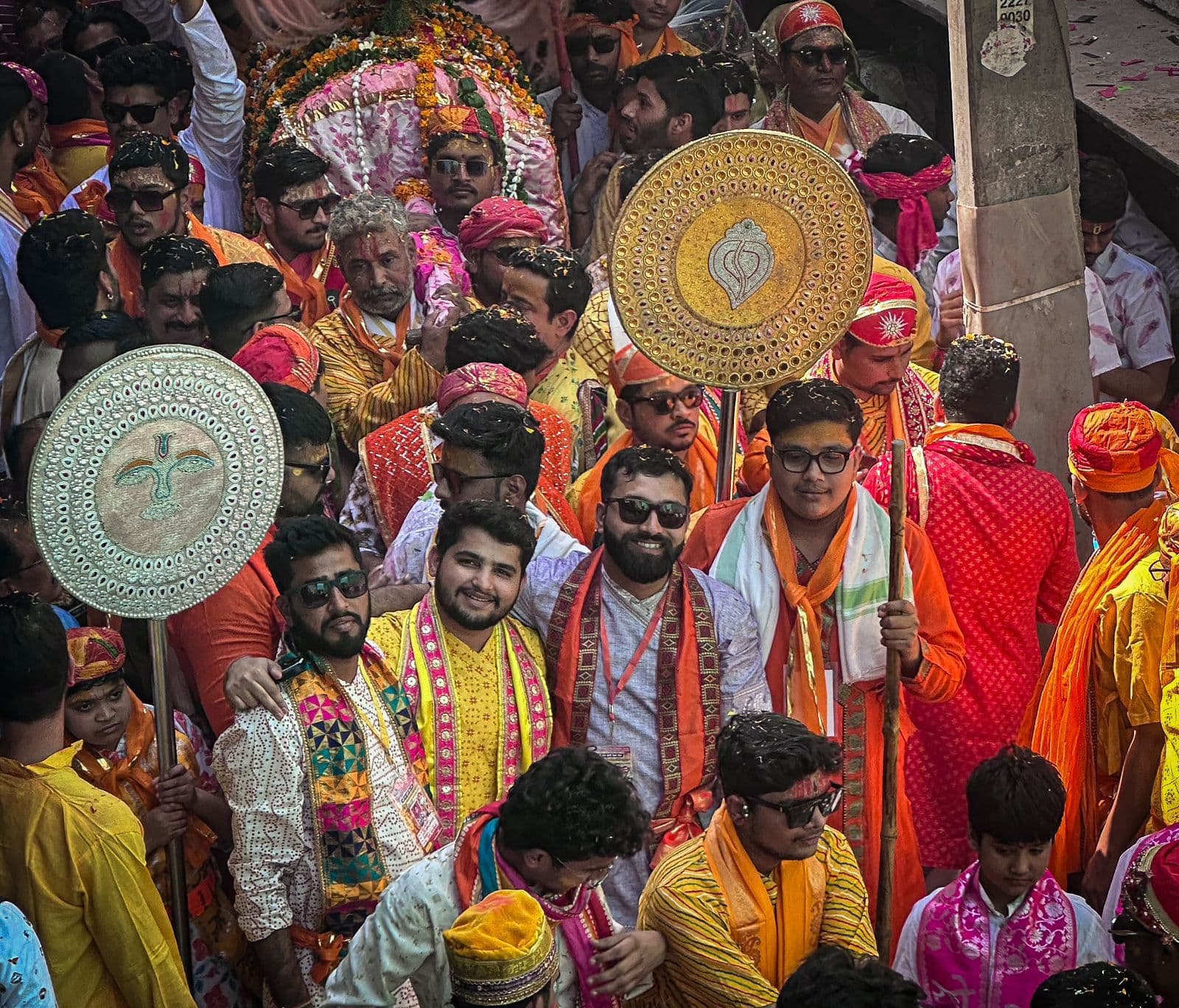
Born in Gokul, a lifelong Brajwasi, guiding Mathura–Vrindavan pilgrimages since 2018.
Jai Shri Krishna 🙏