
Radhashtami 2026 at Barsana: A Born Brajwasi's Honest Guide
Radhashtami 2026 falls on Saturday, 19 September, Radha Rani's appearance, kept at midday at Barsana, her town. Tradition gives her birth as Bhadrapada Shukla Ashtami at midday, fifteen days after Krishna's midnight birth. The heart of the day is the noon abhishek at the Shriji (Ladli Lal) Temple, the rare temple where Radha is primary and Krishna secondary.
Read full guide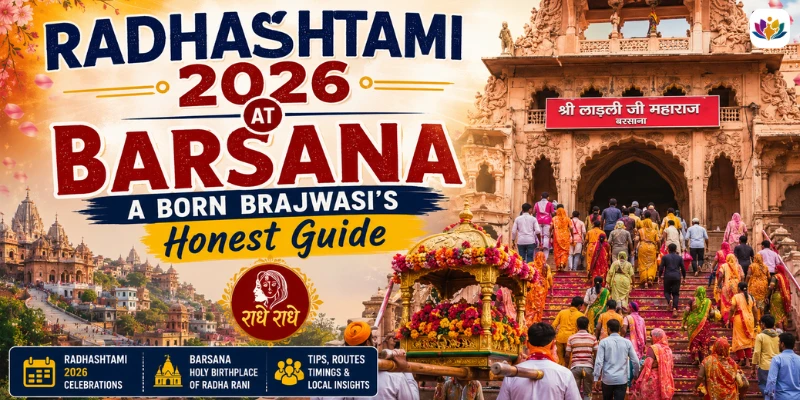
Saturday, 19 September
Barsana
Quick answer
Radhashtami 2026 falls on Saturday, 19 September, Radha Rani's appearance, kept at midday at Barsana, her town. Tradition gives her birth as Bhadrapada Shukla Ashtami at midday, fifteen days after Krishna's midnight birth. The heart of the day is the noon abhishek at the Shriji (Ladli Lal) Temple, the rare temple where Radha is primary and Krishna secondary.
Last updated: 22 June 2026 · written by Guru Dutt, born in Gokul · Experience My India
When is Radhashtami 2026, and the tithi behind it
Radhashtami 2026 falls on Saturday, 19 September. The festival is fixed by tithi, Bhadrapada Shukla Ashtami, so it moves each year on the English calendar; in 2026 it lands on the 19th, fifteen days after Janmashtami. Confirm the day's muhurat on the panchang, because the abhishek is kept at midday and the timing shifts slightly each year. Across Braj the day belongs above all to Barsana, Radha's town, with Raval and the Vrindavan Radha temples celebrating too. If you have searched other Radhashtami guides and found only a date, the real value is knowing how the day unfolds on the hill and how to reach Ladli ji without being carried by the crowd.
Why Radha's birth is kept at midday
Tradition holds Radha appeared at midday, in contrast to Krishna's midnight birth, and that she was found, not womb-born, on a lotus. This is the beautiful symmetry a Brajwasi teaches: Krishna on the waning Ashtami at midnight, Radha on the waxing Ashtami at midday, fifteen days apart, moon and sun, night and day, the same tithi-number on opposite fortnights, two halves of one whole. It is also why Radhashtami is a daytime festival with a noon abhishek, gentler on the body than the Janmashtami vigil, with no midnight crush. Her birth-nakshatra is given differently in different traditions, some naming Anuradha, with the Radha and Anu-radha echo, and an honest guide says it varies rather than picking one to sound sure.
Barsana, Radha's town on the four hills
Barsana drapes over four hilltops held to be the four faces of Brahma, and it is Radha's town, where Vrishabhanu and Kirti, her father and mother, ruled. It is one of the few places in all of Braj where Radha is primary and Krishna secondary, which is the whole spirit of the day. The town is dense with her leela: the crowning Shriji Temple on Bhanugarh hill, Maan Mandir where she sat in loving sulk, Gahvar Van her pleasure-grove, the turmeric-tinged Pili Pokhar, Vrishabhanu Kund, Mor Kutir, and Sankari Khor, the narrow gorge of the Lathmar play. On Radhashtami the whole hill-town turns to her.
The Shriji (Ladli Lal) Temple and the noon abhishek
The Shriji or Ladli Lal Temple, the crowning Radha Rani temple on Bhanugarh hill, is the heart of Radhashtami, and its midday abhishek is the moment of the day. Getting there is a steep climb, with palkis available for those who need them, and on the festival the final stretch becomes one-directional crowd by mid-morning, so the single most important piece of local knowledge is to arrive early and take the side galleries. From the central floor at midday you are in the crush; from the side galleries you have a clear line to Ladli ji in her flower decoration, the phool bangla, as the noon panchamrit abhishek is performed. We position you for that clear darshan and a calm descent, which is the difference between a blessing and a bruise.
Barsana beyond Shriji: Maan Mandir, Gahvar Van and more
Barsana rewards the pilgrim who climbs beyond the main temple. Maan Mandir on the hill marks Radha's famous loving sulk; Mor Kutir, the peacock bower; Gahvar Van, her pleasure-grove, dense and green; Pili Pokhar, the tank tinged turmeric-yellow; Vrishabhanu Kund, named for her father; and Sankari Khor, the gorge where the Lathmar play unfolds in spring. Kirti Mandir, dedicated to Radha's mother, is a quieter, contemplative stop away from the main crush. For those who want the day without the densest crowd, these are where Barsana opens up.
Raval, the other birthplace
Raval, on the Gokul side near Mahavan, is held by one strong tradition to be Radha's actual birthplace, the original home of Vrishabhanu before the family moved to Barsana, where she was found as an infant on a lotus in the kund. It is far quieter and less touristed than Barsana, a gem for the devotee who wants stillness rather than the festival crush. We present both Raval and Barsana honestly and adjudicate neither; for a group that wants to feel the day rather than survive it, an early Shriji darshan followed by a quiet afternoon at Raval is the itinerary I quietly recommend.
Radhashtami in Vrindavan: Radha Vallabh and the nine days
Vrindavan keeps Radhashtami too, above all in the Radhavallabh tradition, where Radha is supreme. At the Radha Vallabh Temple there is no Radha murti beside Krishna, only her crown, because she is understood as everywhere present, the very ground of the bhava; its Radhashtami celebrations run across several days. Seva Kunj and the Radha-centred temples of Vrindavan honour her appearance with special shringar and kirtan. For pilgrims based in Vrindavan, this is the gentler way to keep the day without the Barsana hill-climb, and it pairs naturally with a Vrindavan darshan.
Radhashtami 2026 schedule at a glance
Festival timings differ from ordinary days and are set locally; verify on the day.
When (19 September 2026) | Observance | Where |
From before dawn | Temple opens, long festival hours | Shriji (Ladli Lal), Barsana |
Mid-morning | Be at the hill base before the final climb fills | Barsana |
Midday (Madhyahna) | The panchamrit abhishek of Radha Rani, phool bangla | Shriji Temple |
Morning and afternoon | Darshan, hilltop sites | Maan Mandir, Kirti Mandir |
Afternoon | Quieter darshan, the other birthplace | Raval Dham |
Across several days | Radha-supreme celebration | Radha Vallabh, Vrindavan |
Was Radha born at Barsana or Raval?
It is genuinely contested, and an honest Brajwasi presents both without choosing. Tradition and the grand Radhashtami celebration place her birth at Barsana, where she grew up; a second strong tradition names Raval, near Mahavan, as the village of her birth, from which she was brought to Barsana as a child. Both have a real claim, and the lovely thing is you can visit both in a day. We give you the two traditions and take you to each, and leave the question where it has always rested, in the devotion of those who hold each dear.
Honest cautions
Read before you go.
The Shriji Temple is a steep hilltop climb, and by mid-morning on Radhashtami the final stretch becomes one-directional crowd. Arrive early; palkis and assistance help for elders.
The side galleries beat the main floor at the noon abhishek; the central floor at midday is the crush.
Barsana's monkeys are bold; keep glasses, phones and prasad zipped inside.
There is no official VIP darshan; decline touts, and give only at a temple hundi.
September is warm and humid; carry water and electrolytes, and pace the climb for elders.
Radha's birthplace is contested between Barsana and Raval; anyone who tells you it is settled is selling certainty that does not exist.
Why book with Experience My India, not a faceless OTA
The whole day turns on reaching the Shriji Temple early and taking the side galleries before the hill becomes one-way crowd, and on knowing that Raval offers the quiet other half of the story. That timing and that local knowledge are not in any aggregator listing. An aggregator gives a room; a Brajwasi gives the day.
What matters for a Braj yatra | Experience My India | A typical online travel aggregator |
Who plans and guides you | Gurudutt, born in Gokul, guiding Braj since 2018 | A listing engine; no one on the ground |
Local knowledge | Knows the side galleries, the climb timing, Raval | Generic, often copied itinerary text |
Honesty | Presents Barsana and Raval both, warns of touts and crush | Rarely warns; sometimes repeats the myths |
Darshan timing | Early ascent, side-gallery craft for the noon abhishek | Generic timings, frequently outdated |
Pricing | Transparent, all-inclusive, no hidden charges | Markups, dynamic pricing, hidden fees |
Support | Direct WhatsApp, a real person, reply within two hours | App or call-centre, slow human help |
Elders and families | The climb paced, palki and assistance arranged, Raval option | One-size package |
Track record | 50,000+ pilgrims guided, 4.5 star on Google | Reviews pooled across unrelated vendors |
Plan your Radhashtami yatra on WhatsApp +91 7302265809 and a real person replies within two hours.
Festival dates follow the lunar tithi and can shift by a few days each year. Always confirm against the current panchang before booking travel.
Frequently asked questions
When is Radhashtami 2026?
Radhashtami 2026 falls on Saturday, 19 September, the midday appearance of Radha Rani, kept above all at Barsana. It is fifteen days after Janmashtami. Confirm the muhurat on the panchang.
What is the tithi of Radhashtami?
Bhadrapada Shukla Ashtami, at midday, the appearance tradition gives for Radha. It is the same Ashtami number as Krishna's birth but on the waxing fortnight and at noon rather than midnight.
Why does the date change each year?
Because it is fixed by tithi, a lunar day, not a solar date, so it lands on a different English date each year. Always confirm the year's date on the panchang.
How many days do I need?
One day for Radhashtami at Barsana, but two lets you settle near the hill the day before for an unhurried festival morning, and add Raval and Vrindavan. We build the days around the climb.
How far ahead should I book?
Six to eight weeks; Barsana has few quality rooms and they fill first for the festival, and the surrounding stays stretch too. The earlier you confirm, the calmer your day.
Where should I stay?
Near Barsana for the shortest festival morning, or in Vrindavan or Mathura with an early transfer. We book to your budget and plan the early start.
Is Radhashtami a good time to visit Braj?
Yes, it is one of the most joyful days of the year and gentler than Janmashtami, with a midday rather than midnight peak. It suits Radha devotees and families well.
Is it suitable for senior citizens?
Yes, with the climb paced; we arrange palki and assistance for the Shriji ascent, an early arrival, and the quieter Raval and lower sites. Tell us their needs.
Is it good for families with children?
Yes, the flowers, the kirtan and the joy of the day delight families; we keep the climb and the crowd manageable and offer Raval for calm.
Can I pair Radhashtami with Janmashtami?
Yes, they are fifteen days apart, 4 September and 19 September 2026, a natural devotional pair. Many pilgrims keep both in one extended trip, with the fortnight across Mathura, Govardhan and Gokul.
Where is Radhashtami best celebrated?
At Barsana, Radha's town, on the crowning Shriji (Ladli Lal) Temple, the rare temple where Radha is primary and Krishna secondary. Raval and the Vrindavan Radha temples celebrate too.
What is the Shriji or Ladli Lal Temple?
It is the principal Radha Rani temple, crowning Bhanugarh hill at Barsana, where Ladli ji, the beloved Radha, is worshipped. It is the heart of Radhashtami and a steep but rewarding climb.
What happens at the noon abhishek?
At midday the panchamrit abhishek of Radha Rani is performed, with the deities in their flower decoration, the phool bangla. It is the central moment of the day, best seen from the side galleries.
Why arrive at Barsana early?
Because the Shriji Temple is a steep hilltop climb, and by mid-morning the final stretch becomes one-directional crowd. Arriving early means the side galleries, a clear darshan, and a calm descent.
Why are the side galleries better?
From the central floor at the noon abhishek you are in the crush; the side galleries give a clear line to Ladli ji. Which gallery and gate shift each year, which is where a local guide adds value.
Is the Shriji climb hard?
It is a steep staircase, tiring especially at midday. Palkis are available, and we pace the ascent and arrange assistance for elders, with an early start to beat the crowd.
What is the phool bangla?
The phool bangla is the flower decoration in which the deities are dressed on the festival, the temple and Ladli ji decked entirely in flowers, one of the most beautiful sights of the Braj year.
Is photography allowed at the Shriji Temple?
Follow temple rules, which restrict photography near the deity, especially during the abhishek. Outside, the hill-town and the decorations make beautiful respectful photographs.
What is Maan Mandir?
Maan Mandir on the Barsana hill marks Radha's famous loving sulk, her maan. It is a hilltop site, quieter than the Shriji Temple, with views over the town. We include it for those who climb beyond the main temple.
What is Gahvar Van?
Gahvar Van is Radha's pleasure-grove at Barsana, dense and green, dear to her leela. It is a contemplative stop away from the main crush, lovely for a devotee who wants stillness.
What is Sankari Khor?
Sankari Khor is the narrow gorge at Barsana where the Lathmar play unfolds in spring; on Radhashtami it is part of the sacred geography of the town. A guide can place it in Radha's story.
What is Kirti Mandir?
Kirti Mandir is dedicated to Radha's mother, Kirti, who ruled Barsana with Vrishabhanu. It is a calm, contemplative temple, the quieter side of Barsana, away from the festival crush.
What is Raval?
Raval, near Mahavan on the Gokul side, is held by one strong tradition to be Radha's actual birthplace, where she was found as an infant on a lotus. It is far quieter than Barsana, a gem for stillness.
Should I visit Raval on Radhashtami?
If you want the whole story and a calm afternoon, yes; an early Shriji darshan and a quiet afternoon at Raval is the day we quietly recommend for groups with elders or a wish for stillness.
What is Pili Pokhar?
Pili Pokhar is the turmeric-tinged tank at Barsana, tied to Radha's leela. It is one of the gentler, picturesque stops in the hill-town, away from the main climb.
Was Radha born at Barsana or Raval?
It is genuinely contested. Tradition and the grand celebration place her birth at Barsana, where she grew up; a second strong tradition names Raval as her birth-village. We present both and adjudicate neither, and we take you to both.
Why is Radha primary at Barsana?
Because Barsana is her town, draped over four hills held to be the four faces of Brahma, where her father Vrishabhanu and mother Kirti ruled. It is one of the few places in Braj where Radha is worshipped as primary and Krishna secondary.
What nakshatra was Radha born under?
This varies by tradition, and an honest guide says so; some name Anuradha, with the Radha and Anu-radha echo. What is agreed is the tithi, Bhadrapada Shukla Ashtami at midday. 29.
Was Radha born from a womb?
Tradition holds she was found, not womb-born, on a lotus, an infant of divine appearance. It is part of the leela of her coming, told as the tradition tells it.
Why is the greeting Radhe Radhe and not Krishna's name?
Because Braj greets in Radha's name first, holding her to be the way to Krishna; the theology hides in plain sight in the everyday Radhe Radhe. Use it naturally and you show you belong.
How does Radhashtami mirror Janmashtami?
Krishna on the waning Ashtami at midnight, Radha on the waxing Ashtami at midday, fifteen days apart; moon and sun, night and day, two halves of one whole. The two festivals are a deliberate pair.
Is Radhashtami celebrated in Vrindavan?
Yes, above all in the Radhavallabh tradition, where Radha is supreme; the Radha Vallabh Temple keeps it across several days. Seva Kunj and the Radha-centred temples honour her appearance with special shringar and kirtan.
What is special about Radha Vallabh on Radhashtami?
At Radha Vallabh there is no Radha murti, only her crown, because she is understood as everywhere present; its Radhashtami celebration runs several days. It is the gentler, Vrindavan-based way to keep the day.
Can I keep Radhashtami in Vrindavan instead of Barsana?
Yes, if the Barsana hill-climb is too much; the Vrindavan Radha temples, above all Radha Vallabh, honour the day deeply. We plan a Vrindavan-based Radhashtami for those who prefer it.
What is the nine-day celebration?
The Radha-supreme temples, especially Radha Vallabh, extend the Radhashtami celebration across several days of special shringar, kirtan and seva, so a visit around the date catches the festivity even beyond the 19th.
How do I reach Barsana?
Barsana lies about 45 km from Mathura, near Nandgaon, in the cow-country. Mathura Junction is the railhead; Agra and Delhi the airports. We arrange pickups, with parking moved outside the town core on the festival.
Can you pick us up from Delhi or Agra?
Yes, AC cab pickup from Delhi NCR, Agra or directly in Mathura or Vrindavan, with Delhi airport pickup for those flying in and regional-language guide support on request.
Will there be road diversions at Barsana?
Yes, on Radhashtami expect diversions and parking pushed outside the town, with the final approach on foot or e-rickshaw. We plan the pickup and approach around them.
How long does the Shriji climb take?
A steep staircase climb of some minutes at a gentle pace, longer in the festival crowd; palkis are available. We pace it for your group and start early to avoid the worst.
What weather should I expect in September?
Warm and humid; carry water and electrolytes, a cap and light cotton, and pace the climb for elders. The heat amplifies the crowd and the ascent.
Can I do Radhashtami as a day trip from Delhi?
It is a long day with the climb and the crowd; for a calm festival we prefer settling near Barsana the night before. We arrange both and advise honestly.
Is Radhashtami safe?
Broadly yes, and joyful; the main care is the steep climb and the mid-morning crush at the Shriji Temple. With early arrival, the side galleries and paced ascent, it is safe and moving. We plan around the pinch points.
How do I avoid the worst crush?
Arrive at the hill base before mid-morning, take the side galleries for the noon abhishek, and descend before the wave. The Raval afternoon avoids the crowd entirely. We time it for you.
Are Barsana's monkeys a problem?
Yes, they are bold; keep glasses, phones and prasad zipped inside, especially on the climb and at the temple. Do not try to retrieve a taken item yourself.
How do I avoid touts and fake VIP sellers?
There is no official VIP darshan; decline anyone selling one, give only at a temple hundi, and travel with a known local, which removes most of the pressure on the day.
Is it safe for solo female travellers?
Braj is broadly safe and devotional, and Radhashtami is a daytime festival. Normal sense applies in the crowd and on the climb; travelling with a known local and group is best.
Why book Radhashtami with you rather than an OTA?
Because the day turns on reaching the Shriji Temple early and taking the side galleries, and on knowing Raval offers the quiet other half. That timing and knowledge are not in any listing. A Brajwasi gives the day.
Can you arrange the climb for elders?
Yes, palki and assistance for the Shriji ascent, an early start, the side galleries, and the quieter Raval and lower sites. Tell us your group and we plan around them.
Do you have a Radhashtami package?
Yes, a dedicated two-day Radhashtami Barsana Special built around the early Shriji darshan, the noon abhishek and the optional Raval afternoon. See the money page below.
How do I book?
Message us on WhatsApp at +91 7302265809 with your dates and group size; we reply within two hours, hold your Barsana-area stay and vehicle, and plan the day. For Radhashtami, book early. Radhe Radhe.
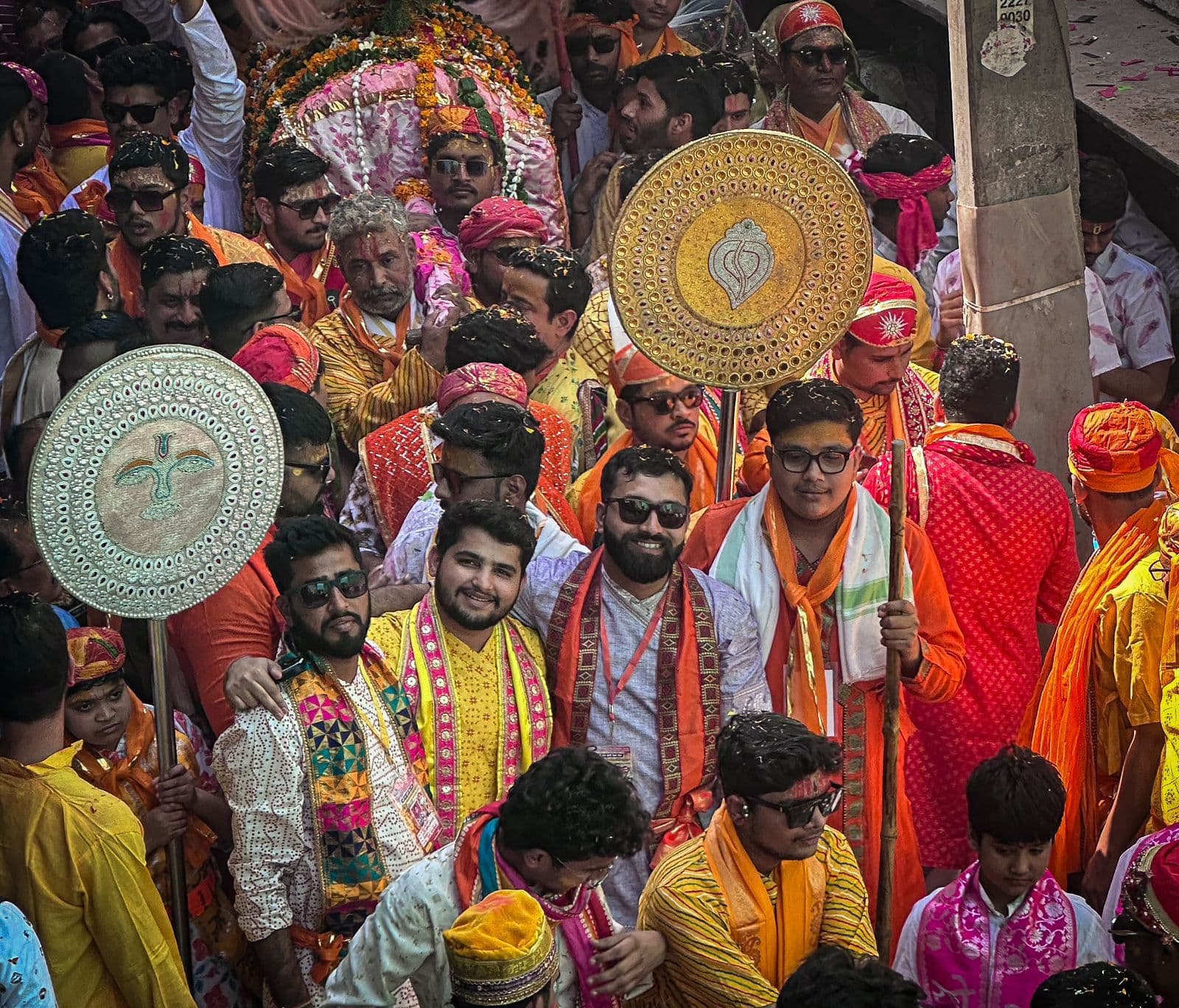
Born in Gokul, a lifelong Brajwasi, guiding Mathura–Vrindavan pilgrimages since 2018.
Jai Shri Krishna 🙏