
Pili Pokhar: The Yellow Pond of Barsana
Pili Pokhar, the yellow pond, lies in Barsana across the road from the Radha Rani temple. In the tradition its water turned golden when Radha, shy after Yashoda applied bridal turmeric to her hands wishing her as a daughter-in-law, washed her hands here. It is also called Priya Kunda. Pilgrims bathe here. Mostly free; reconfirm timings.
Read full guide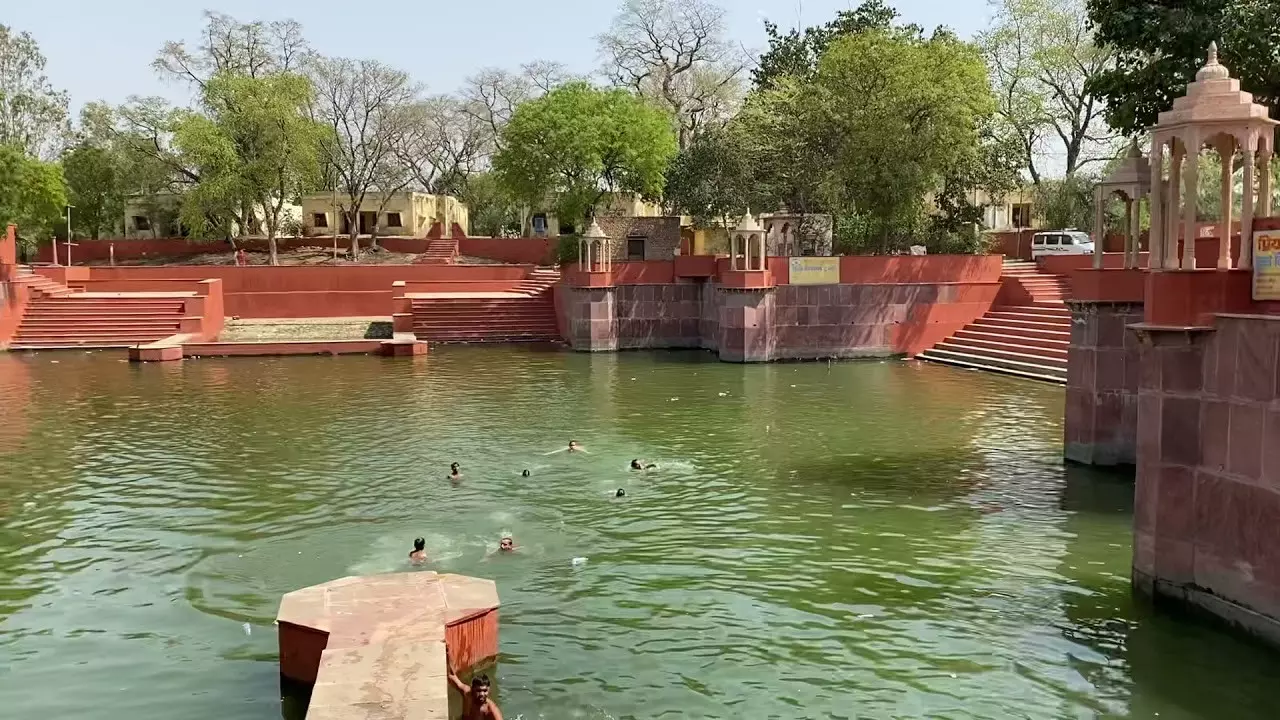
Quick answer
Pili Pokhar, the yellow pond, lies in Barsana across the road from the Radha Rani temple. In the tradition its water turned golden when Radha, shy after Yashoda applied bridal turmeric to her hands wishing her as a daughter-in-law, washed her hands here. It is also called Priya Kunda. Pilgrims bathe here. Mostly free; reconfirm timings.
At a glance
| What it is | A sacred pond, the yellow pond |
|---|---|
| Meaning | Pili, yellow; pokhar, pond |
| Also called | Priya Kunda; Piyala Sarovar |
| Where | Barsana, across from the Radha Rani temple |
| The tradition | Radha washed bridal turmeric from her hands here |
| Why it turned yellow | From the turmeric (haldi) of her hands |
| Yashoda's wish | She wished Radha as her daughter-in-law |
| Also here | Pilu trees ring the pond; a Pilu-fruit leela |
| On the route | On the Barsana parikrama |
| Entry fee | Mostly free; donations |
| Best time | October to March; Radhashtami, Holi |
What is Pili Pokhar and why visit it?
Pili Pokhar, the yellow pond, lies in the village of Barsana, the home of Radha, just across the road from the great Radha Rani temple on the hill. Its name is simply pili, yellow and pokhar, a pond and the tradition tells a tender, very human story of how it came by its golden colour. It is also known as Priya Kunda, the dear one's pond and as Piyala Sarovar and is ringed by pilu trees. To come to Pili Pokhar is to come to a spot that holds one of the sweetest, shyest moments of Radha's story.
Pilgrims bathe in its waters and it is a loved stop on the Barsana parikrama.
Where Radha washed the bridal turmeric
In the tradition, when Radha once visited Nandgaon, the home of Nanda Maharaja and Yashoda, Mother Yashoda was so charmed by her beauty and her grace that she longed to have Radha as her daughter-in-law, as Krishna's bride. Following the old custom by which a mother-in-law applies turmeric paste, haldi, to the hands of a bride, Yashoda lovingly applied turmeric to Radha's hands. On her way home to Barsana, Radha realised her hands were yellow with the turmeric and, shy at what her family and the people of Barsana might think, she hurried to this pond and washed her hands here and so its water turned golden-yellow and the pond became Pili Pokhar, the yellow pond. The Bhakti Ratnakara also remembers this as a place ringed by pilu trees, where Radha and Krishna sported with their friends on the pretext of gathering pilu fruits.
It is a story of a betrothal felt but unspoken, the bridal turmeric and a young girl's shyness, that devotees find very dear.
A tip from Gurudutt: Pili Pokhar sits right across from the Radha Rani temple, so it is one of the easiest and most rewarding stops at Barsana, a natural pause as you come down from the hill. It is a lovely place to tell the haldi story, especially to those who know the Indian wedding custom, because it lands so warmly. The pond is at its most beautiful at Radhashtami, Radha's appearance day and in the Holi season, when Barsana is radiant. Do not confuse it with the famous Radha Kund at Govardhan; this is Barsana's own yellow pond, with its own tender story. |
Pili Pokhar on the Barsana parikrama
Pili Pokhar lies in Barsana just across from the Radha Rani temple, so it is among the most accessible of the town's sacred sites, a natural part of the Barsana parikrama with Sankari Khor and the hill-temples. Out along the belt toward Nandgaon lie Prem Sarovar and Sanket, the love-sites of the wider country. See our Barsana guide and our Radha Rani Barsana temple guide for the sites nearby.
How do you reach Pili Pokhar?
Pili Pokhar lies in Barsana, by the Radha Rani temple. Distances are approximate.
From | Distance | Notes |
Radha Rani temple, Barsana | Across the road | Very close |
Sankari Khor | Nearby | On the parikrama |
Prem Sarovar | 1 km | Toward Nandgaon (approx) |
Mathura | 42-45 km | 1.5 hrs (approx) |
Delhi | 130 km | 3 hrs |
Tips for your visit
Pili Pokhar is mostly free; reconfirm any hours. It sits right across from the Radha Rani temple, an easy stop as you come down the hill. The haldi story lands warmly told on the spot. Radhashtami and the Holi season are the loveliest, busiest times. Dress modestly and carry water. October to March is the pleasant season. Do not confuse it with the Govardhan Radha Kund.
What is nearby?
Pili Pokhar, by the Radha Rani temple at Barsana, completes the love-belt. To plan your visit, see our Barsana guide, our Radha Rani Barsana temple guide, our Sankari Khor guide and our Prem Sarovar guide.
Meet Gurudutt — Your Mathura
Vrindavan Guide
Not just a tour operator — Gurudutt was born and raised in Braj Bhoomi. 8+ years, every week, through every sacred lane of Mathura & Vrindavan.
- 🛕Born in Braj Bhoomi
- 🙏50,000+ Pilgrims Guided
- 📅Guiding Since 2018
- ⭐4.5 Google Rating
Gurudutt
Founder · Experience My India
Frequently asked questions
What is Pili Pokhar?
Pili Pokhar, the yellow pond, lies in Barsana across from the Radha Rani temple. In the tradition its water turned golden when Radha washed the bridal turmeric from her hands here. It is also called Priya Kunda.
Where is Pili Pokhar?
Pili Pokhar lies in the village of Barsana, just across the road from the Radha Rani temple on the hill, on the Barsana parikrama. Distances are approximate.
What does Pili Pokhar mean?
Pili means yellow and pokhar means a pond, so Pili Pokhar is the yellow pond, named for its golden water, which in the tradition turned yellow from the turmeric Radha washed from her hands.
Why is Pili Pokhar famous?
Pili Pokhar is famous as the yellow pond of Barsana, whose water turned golden, in the tradition, when Radha washed the bridal turmeric from her hands here, a tender moment of her story. Pilgrims bathe here.
Why did Pili Pokhar turn yellow?
In the tradition Pili Pokhar turned yellow when Radha, her hands stained with the bridal turmeric Yashoda had applied wishing her as a daughter-in-law, washed her hands here on her way home to Barsana.
What is the story of Pili Pokhar?
In the tradition Yashoda, charmed by Radha and wishing her as Krishna's bride, applied bridal turmeric to her hands; on her way home Radha, shy of her yellow hands, washed them in this pond, turning its water golden, so it became Pili Pokhar.
Is Pili Pokhar also called Priya Kunda?
Yes, Pili Pokhar is also called Priya Kunda, the dear one's pond and Piyala Sarovar. It lies in Barsana, ringed by pilu trees, across from the Radha Rani temple.
Is Pili Pokhar near the Radha Rani temple?
Yes, Pili Pokhar lies just across the road from the Radha Rani temple at Barsana, one of the most accessible of the town's sacred sites, a natural stop coming down from the hill.
Is Pili Pokhar worth visiting?
Yes, for its tender haldi story and its easy place by the Radha Rani temple, it is a rewarding stop on the Barsana parikrama. Experience My India tells the story on the spot.
Can you bathe at Pili Pokhar?
Yes, pilgrims bathe in the waters of Pili Pokhar, the yellow pond of Barsana. Reconfirm the current state of the ghat and water on the day. Experience My India advises.
Why did Yashoda apply turmeric to Radha's hands?
In the tradition Mother Yashoda, charmed by Radha's beauty and grace when she visited Nandgaon, longed to have her as Krishna's bride and so, by the old custom of a mother-in-law, lovingly applied bridal turmeric to Radha's hands.
What does the haldi story of Pili Pokhar mean?
The haldi story holds a betrothal felt but unspoken: Yashoda's turmeric is a mother-in-law's loving claim of Radha as a bride for Krishna and Radha's shy washing of her hands is the maiden's tender modesty, a sweet foreshadowing of the divine union.
Why was Radha shy about her yellow hands?
In the tradition Radha, a young girl of Barsana, was shy at what her family and the people of the town might think on seeing the bridal turmeric on her hands, betraying Yashoda's wish and so she hurried to wash them at this pond.
What are the pilu trees at Pili Pokhar?
Pilu trees, sometimes called toothbrush trees, ring Pili Pokhar and the Bhakti Ratnakara remembers the pond as a place where Radha and Krishna sported with their friends on the pretext of gathering pilu fruits. Pili Pokhar is also called Piyala Sarovar for them.
What is the Pilu fruit leela at Pili Pokhar?
In the tradition, as the Bhakti Ratnakara tells, Radha and Krishna with their friends would enjoy their sporting pastimes around this pond on the pretext of gathering the pilu fruits of the trees that ring it, another of the love-pastimes the spot remembers.
Is Pili Pokhar the same as Radha Kund at Govardhan?
No, they are different. Pili Pokhar is Barsana's own yellow pond, with the haldi story; the famous Radha Kund is at Govardhan, far away, with its own pastime. Do not confuse the two.
Why is the haldi story dear to devotees?
Devotees find the haldi story dear because it is so human and tender: a mother's loving wish, a maiden's shyness, the bridal turmeric and the yellow pond, a sweet, intimate moment in the great love-story of Radha and Krishna.
How does Pili Pokhar fit Radha's story at Barsana?
Pili Pokhar is one of the tender spots of Barsana, the home of Radha, holding the moment of the bridal turmeric, set right by her temple, part of the living story of Radha that the whole town keeps.
What are the Pili Pokhar timings?
Pili Pokhar is an open sacred pond, accessible through the day; any nearby shrine keeps its own hours. Reconfirm on the day. Mornings are calmest.
What is the best time to visit Pili Pokhar?
October to March for pleasant weather. Radhashtami, Radha's appearance day and the Holi season are the loveliest, when Barsana is radiant, though busiest. Summers are very hot.
Is there an entry fee at Pili Pokhar?
No, Pili Pokhar is mostly free, with voluntary donations. It is an open sacred pond by the Radha Rani temple at Barsana.
How long do you need at Pili Pokhar?
Allow about 15 to 20 minutes for the pond and its story, as it is small and close to the Radha Rani temple. Experience My India sequences it on the Barsana parikrama.
Is Pili Pokhar crowded?
On ordinary days it is calm, busier at Radhashtami and in the Holi season when Barsana is full. Being by the Radha Rani temple, it shares the town's busy days. Mornings are calmest.
Is Pili Pokhar suitable for elderly visitors?
Yes, it is easy and accessible, right across from the Radha Rani temple, a gentle stop on the parikrama. Experience My India arranges comfortable transport and assistance for elderly pilgrims.
Is Pili Pokhar good for families?
Yes, the warm haldi story, of the bridal turmeric and Radha's shyness, is lovely for families, especially those who know the wedding custom and the pond is easy to visit. Experience My India tells it simply.
Do you need a guide for Pili Pokhar?
A guide adds much, telling the tender haldi story on the spot, where it lands warmly and the pilu-fruit pastime. Experience My India provides Braj-born guides.
How do you reach Pili Pokhar?
Pili Pokhar lies in Barsana, just across the road from the Radha Rani temple, reached easily on the parikrama. Experience My India arranges transport to Barsana and a guide.
How far is Pili Pokhar from the Radha Rani temple?
Pili Pokhar is just across the road from the Radha Rani temple at Barsana, very close, a natural stop coming down from the hill. Experience My India sequences it.
How far is Pili Pokhar from Mathura?
Pili Pokhar, at Barsana, is about 42 to 45 km from Mathura, roughly a 90 minute drive. Distances are approximate; Experience My India arranges the route.
What is the nearest railway station to Pili Pokhar?
The nearest major railhead is Mathura Junction, about 45 km away. From there, taxis reach Barsana. Experience My India arranges the transfer.
Can you reach Pili Pokhar by car?
Yes, you reach Barsana by car, then Pili Pokhar is a short step across from the Radha Rani temple. Experience My India handles the drive.
Can you visit Pili Pokhar with the Barsana parikrama?
Yes, Pili Pokhar is a natural, easy part of the Barsana parikrama, with the Radha Rani temple, Sankari Khor and the hill-sites. Experience My India sequences them.
Can you visit Pili Pokhar with Prem Sarovar and Nandgaon?
Yes, Pili Pokhar at Barsana pairs with Prem Sarovar and, along the belt, Sanket and Nandgaon, for the full love-country day. Experience My India sequences them.
Can you visit Pili Pokhar in one day from Delhi?
Yes, Pili Pokhar and the Barsana-Nandgaon belt fit a one-day trip from Delhi, about 3 hours each way. Experience My India plans the day.
How does Experience My India help with a Pili Pokhar visit?
We bring you to Pili Pokhar by the Radha Rani temple, tell the warm haldi story on the spot, the pilu-fruit pastime and fold it into the Barsana parikrama. Our guides are born and raised in Braj.
Is Pili Pokhar good for families?
Yes, the tender haldi story, the bridal turmeric and Radha's shyness, is a delight for families, especially those who know the wedding custom. Experience My India tells it simply for all ages.
What makes Pili Pokhar special?
That its golden water holds the moment of Radha's bridal turmeric, washed away in shyness, makes Pili Pokhar special, one of the most tender, human spots in the love-story of Barsana.
Is Pili Pokhar good for Radhashtami?
Yes, at Radhashtami, Radha's appearance day, Pili Pokhar and all Barsana are radiant, making it a beautiful, though busy, time to visit. Experience My India can time your visit.
Is Pili Pokhar good for a Barsana pilgrimage?
Yes, Pili Pokhar is an easy, tender stop on a Barsana pilgrimage, right by the Radha Rani temple, on the parikrama. Experience My India sequences the full circuit.
What is near Pili Pokhar?
Near Pili Pokhar are the Radha Rani temple, Maan Mandir and Sankari Khor at Barsana, with Prem Sarovar and Sanket out toward Nandgaon. Experience My India sequences them.
Why is Pili Pokhar yellow?
In the tradition Pili Pokhar, the yellow pond of Barsana, turned golden when Radha washed the bridal turmeric from her hands here, the turmeric Yashoda had applied wishing her as Krishna's bride.
What is the yellow pond of Barsana?
Pili Pokhar is the yellow pond of Barsana, across from the Radha Rani temple, whose water turned golden, in the tradition, when Radha washed the bridal turmeric from her hands there. It is also called Priya Kunda.
What is the story of Radha's turmeric?
In the tradition Yashoda, wishing Radha as Krishna's bride, applied bridal turmeric to her hands; on her way home Radha, shy of the yellow stain, washed her hands at Pili Pokhar, turning its water golden.
What does the name Pili Pokhar mean?
Pili Pokhar means the yellow pond, from pili, yellow and pokhar, a pond, named for its golden water, which the tradition says turned yellow from the turmeric Radha washed from her hands.
What is the best time to visit Pili Pokhar?
October to March for pleasant weather. Radhashtami and the Holi season, when Barsana is radiant, are the loveliest, though busiest. Summers are very hot.
Why do pilgrims visit Pili Pokhar?
Pilgrims visit Pili Pokhar to honour the yellow pond where Radha washed her bridal turmeric, in the tradition, to bathe in its waters and on the Barsana parikrama by the Radha Rani temple.
Born and raised in Braj Bhoomi. I have been guiding pilgrims through Mathura Vrindavan since 2018 — that is more than a decade of yatras, every week, through every season. Experience My India was built on one belief: a well-planned yatra is a deeply felt one. 50,000+ pilgrims have trusted us with their most sacred journeys.
Jai Shri Krishna 🙏
Watch What Our Pilgrims Truly Feel
दिल्ली से गुजरात तक — हर यात्री की कहानी, उन्हीं के शब्दों में

Real Braj Experience

Mathura Darshan Journey

Temple Darshan Review

Vrindavan Yatra Review

Braj Pilgrimage Story

Govardhan Parikrama Tale

Banke Bihari Darshan

Yamuna Aarti Experience

Iskcon Temple Review

Mathura Holi Memories

Nidhuvan Night Story

Prem Mandir Darshan

Radha Kund Holy Dip

Vrindavan Parikrama Walk

Gokul Janmabhoomi Visit

Seva Kunj Evening Darshan

Barsana Dham Journey