
Imli Tala, Vamsi Vat and Chir Ghat: Vrindavan's Yamuna-Front Leela Spots
Imli Tala, Vamsi Vat and Chir Ghat are three small, deeply loved leela-spots along the Yamuna front of old-town Vrindavan, near Kesi Ghat on the Parikrama Marg. Imli Tala is the tamarind of Radha and Krishna's separation and of Chaitanya Mahaprabhu; Vamsi Vat is the tree where the flute called the gopis to the Raas; Chir Ghat is where the cheer-haran took place. All three are free, open through the day, and best walked together as part of the Vrindavan parikrama.
Read full guide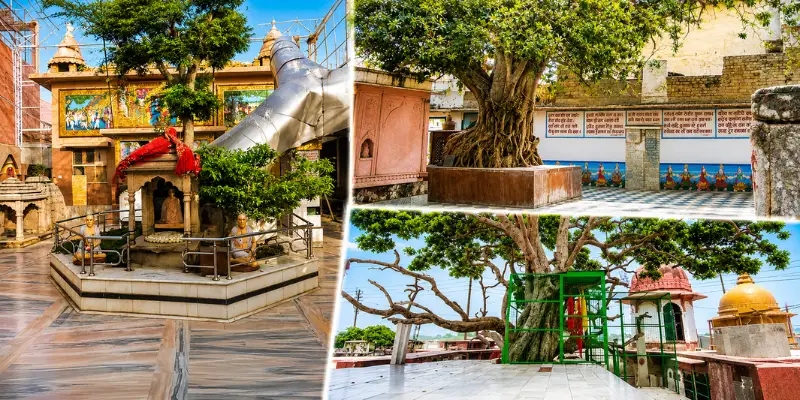
Quick answer
Imli Tala, Vamsi Vat and Chir Ghat are three small, deeply loved leela-spots along the Yamuna front of old-town Vrindavan, near Kesi Ghat on the Parikrama Marg. Imli Tala is the tamarind of Radha and Krishna's separation and of Chaitanya Mahaprabhu; Vamsi Vat is the tree where the flute called the gopis to the Raas; Chir Ghat is where the cheer-haran took place. All three are free, open through the day, and best walked together as part of the Vrindavan parikrama.
At a glance
| What this is | A short walking trail of three leela-spots on the Yamuna front |
|---|---|
| Imli Tala | The tamarind of Radha and Krishna's separation; later the seat of Chaitanya Mahaprabhu |
| Vamsi Vat | The banyan where Krishna's flute (vamsi) called the gopis to the Raas |
| Chir Ghat | Where the cheer-haran leela took place; just west of Kesi Ghat |
| Where | Parikrama Marg, near Shringar Vat and Kesi Ghat, Gotam Nagar, Vrindavan 281121 |
| On the | Vrindavan parikrama route |
| Entry fee | Free at all three |
| Timings | Open through the day; Imli Tala has a small temple (reconfirm hours) |
| Watch out | Monkeys along the ghats snatch glasses and phones |
| Nearest railway | Mathura Junction (10-13 km) |
| Best time | Early morning or evening; October to March |
Three small spots, one beautiful walk
Strung along the Yamuna front of old-town Vrindavan, within a short walk of Kesi Ghat and one another, are three of Braj's most tender leela-spots: Imli Tala, Vamsi Vat and Chir Ghat. None is a grand temple and that is exactly their charm. Each marks a single moment of the leela, a tamarind tree, a banyan, a bathing-ghat and together they make a quiet, walkable trail along the Parikrama Marg that most rushed visitors miss entirely.
We have grouped them honestly as one guide rather than stretching each tiny spot into a separate page, because the truthful way to experience them is exactly this: on foot, one after another, as part of the Vrindavan parikrama.
Imli Tala: the tamarind of separation
Imli Tala means in the shade of the tamarind tree and it marks one of the most emotional moments of the leela. In the Bhagavata tradition, during the Sharad Purnima Raas, Radha slipped away and Krishna, overcome with longing, sat beneath this tamarind chanting her name, so absorbed in separation that He found her again within His own heart. Braj remembers it as the tree where the divine couple's love deepened through viraha, the ache of parting.
Around five hundred years ago the spot gained a second great association. Chaitanya Mahaprabhu, staying nearby at Akrura Ghat, came daily to sit under the Imli Tala and chant the holy names and tradition holds that in the intensity of his devotion his dark complexion turned golden. A deity of Chaitanya was installed beneath the tree and Sanatan Goswami is remembered as having established deities of Nityananda and Chaitanya here. It is a major Gaudiya site and unlike the crowded temples it stays peaceful, a place to sit and chant. One honest note: the Yamuna has shifted its course over the centuries and now flows further off than it once did.
Vamsi Vat: where the flute called the gopis
A little along the bank stands Vamsi Vat, the banyan of the flute. Vamsi means flute and vat means banyan and tradition holds that it was here, beneath this tree on the Yamuna, that Krishna played the notes that drew the gopis from their homes into the night for the Raas. It is a small, simple spot, but for those who know the leela it is one of the most evocative, the very place where the call of the flute, the heart of all Braj bhakti, is remembered to have sounded.
Chir Ghat: the cheer-haran
Just west of Kesi Ghat lies Chir Ghat, where the cheer-haran leela is remembered. Cheer means clothes or garments. In the Bhagavata tradition, the young gopis bathing in the Yamuna had set their clothes on the bank and Krishna gathered them up into a kadamba tree, asking the gopis to come and receive them. Devotees read the leela not as mischief but as a teaching on surrender, the setting aside of every covering before the divine. It is a quiet ghat today, a stop on the parikrama rather than a busy shrine.
A tip from Gurudutt: Walk these three at first light, before the day heats up and the crowds reach Kesi Ghat. Start at Imli Tala and just sit a while under the tamarind, it is the one spot in this stretch where you can actually be still and chant. Then drift along the bank to Vamsi Vat and Chir Ghat. The whole trail takes under two hours at an easy pace and it is the part of Vrindavan that stays with people long after the big temples blur together. Keep your phone and glasses gripped: the monkeys along these ghats are quick. |
Visiting all three together
All three sit on or just off the Parikrama Marg on the Yamuna front, within a short walk of Kesi Ghat and the old-town temples and all are free and open through the day. Imli Tala has a small temple and ashram, with basic rooms for those who wish to stay near the river to chant; reconfirm its darshan hours locally, as they shift. The honest caveat for the whole stretch is the Yamuna itself: revered as a goddess and, in the lean months, badly polluted, so take any dip with care.
Spot | The leela | Note |
Imli Tala | Krishna's separation from Radha; seat of Chaitanya | Small temple and ashram; Chaitanya deity under the tree |
Vamsi Vat | The flute that called the gopis to the Raas | Small open leela-spot on the bank |
Chir Ghat | The cheer-haran, just west of Kesi Ghat | Quiet ghat; a parikrama stop |
How do you reach them?
The three spots are in old-town Vrindavan on the Yamuna front, reached on foot or by rickshaw within the lanes, near Shringar Vat and Kesi Ghat.
From | Distance | Time |
Kesi Ghat / old town | Short walk | Walkable |
Banke Bihari Temple | Short rickshaw ride | 5-15 min |
Mathura Junction | 10-13 km | 30-40 min |
Delhi (Yamuna Expressway) | 150 km | 3-3.5 hrs |
What is nearby?
This trail folds naturally into the old-town Yamuna front. Kesi Ghat with its evening aarti is alongside and Nidhivan, Gopeshwar Mahadev and the Banke Bihari Temple are a short walk away. To plan a full day, see our Kesi Ghat guide, our Nidhivan and Seva Kunj guide and our roundup of the best places to visit in Mathura and Vrindavan.
Meet Gurudutt — Your Mathura
Vrindavan Guide
Not just a tour operator — Gurudutt was born and raised in Braj Bhoomi. 8+ years, every week, through every sacred lane of Mathura & Vrindavan.
- 🛕Born in Braj Bhoomi
- 🙏50,000+ Pilgrims Guided
- 📅Guiding Since 2018
- ⭐4.5 Google Rating
Gurudutt
Founder · Experience My India
Frequently asked questions
What is Imli Tala famous for?
Imli Tala is famous as the tamarind tree on the Yamuna where, in tradition, Krishna sat in separation from Radha during the Raas and where Chaitanya Mahaprabhu later sat daily to chant the holy names. It is a beloved, peaceful Gaudiya site in old-town Vrindavan.
What does Imli Tala mean?
Imli Tala means in the shade of the tamarind tree, from imli, tamarind and tala, the base of the tree. The name marks the ancient tamarind under which the leela is remembered.
What is the story of Imli Tala?
In the Bhagavata tradition, during the Sharad Purnima Raas, Radha slipped away and Krishna, aching with longing, sat beneath this tamarind chanting her name until He found her within His heart. Braj remembers it as the tree where their love deepened through separation.
Why is Chaitanya Mahaprabhu connected to Imli Tala?
Around five hundred years ago, Chaitanya Mahaprabhu stayed nearby at Akrura Ghat and came daily to sit under the Imli Tala chanting the holy names and tradition holds his dark complexion turned golden in devotion. A deity of Chaitanya stands under the tree today.
What are the Imli Tala timings?
Imli Tala is an open riverside spot and its small temple keeps morning and evening darshan, with some sources showing roughly 5:30 AM to noon and 4:00 to 8:00 PM. As these shift, reconfirm locally on the day.
Is there an entry fee at Imli Tala?
No, Imli Tala is free to visit, like the other leela-spots on this stretch. Donations are voluntary.
Can you stay at Imli Tala?
Imli Tala has a small, simple ashram with basic rooms for pilgrims who wish to stay by the river to chant. Facilities are modest, so check the room and current rates on arrival.
Has the Yamuna moved away from Imli Tala?
Yes, honestly the Yamuna has shifted its course over the centuries and the river now flows further from Imli Tala than it once did. The sanctity of the spot remains, even though the water is no longer at its feet.
What is Vamsi Vat?
Vamsi Vat is the banyan tree on the Yamuna bank in Vrindavan where, in tradition, Krishna played his flute and called the gopis into the night for the Raas. It is a small, evocative leela-spot rather than a grand temple.
What does Vamsi Vat mean?
Vamsi means flute and vat means banyan, so Vamsi Vat is the banyan of the flute, named for the music Krishna is remembered to have played here to summon the gopis.
What is the story of Vamsi Vat?
Tradition holds that beneath this banyan on the Yamuna, Krishna played the notes that drew the gopis from their homes into the night for the Raas. For those who know the leela, it is where the call of the flute, the heart of Braj bhakti, sounded.
Where is Vamsi Vat located?
Vamsi Vat is on the Yamuna front of old-town Vrindavan, along the Parikrama Marg near Kesi Ghat and the other leela-spots, easily reached on foot from Kesi Ghat.
Is Vamsi Vat worth visiting?
Yes, for those drawn to the leela. It is a simple spot, but it marks the very call of Krishna's flute and walked together with Imli Tala and Chir Ghat it adds real depth to a Vrindavan visit. Experience My India includes it in the old-town walk.
What is Chir Ghat famous for?
Chir Ghat is famous as the spot, just west of Kesi Ghat, where the cheer-haran leela is remembered, Krishna gathering the bathing gopis' clothes into a kadamba tree. It is a quiet parikrama ghat today.
What does Chir Ghat mean?
Cheer or chir, means clothes or garments, so Chir Ghat is the ghat of the garments, named for the cheer-haran leela in which Krishna took the gopis' clothes as they bathed in the Yamuna.
What is the cheer-haran leela?
In the Bhagavata tradition, the young gopis bathing in the Yamuna had left their clothes on the bank and Krishna gathered them into a kadamba tree, asking the gopis to come and receive them. It is a well-known episode of the leela tied to this ghat.
What does the cheer-haran teach?
Devotees read the cheer-haran not as mischief but as a teaching on surrender, the setting aside of every covering and reserve before the divine. We share this as the traditional understanding held in Braj.
Where is Chir Ghat located?
Chir Ghat is on the Yamuna in old-town Vrindavan, just west of Kesi Ghat, so the two are a short walk apart and naturally visited together along the Parikrama Marg.
Is there a kadamba tree at Chir Ghat?
The cheer-haran leela is associated with a kadamba tree on the bank and the ghat keeps that memory. As with many leela-spots, the present trees and shrine mark the site rather than being the originals from five thousand years ago.
How do you visit Imli Tala, Vamsi Vat and Chir Ghat together?
Walk them as a short trail along the Yamuna front and Parikrama Marg, starting at Imli Tala, then Vamsi Vat and Chir Ghat, all within a short stroll of Kesi Ghat. The loop takes under two hours at an easy pace. Experience My India guides it on foot.
Are these spots part of the Vrindavan parikrama?
Yes, all three sit on or just off the Parikrama Marg on the Yamuna front and are natural stops on the Vrindavan parikrama, the circuit of the town's holy sites. Walking them this way is the traditional experience.
Are Imli Tala, Vamsi Vat and Chir Ghat free?
Yes, all three are free to visit. They are open riverside leela-spots, with only Imli Tala holding a small temple and ashram. Donations are voluntary.
What is the best time to visit these leela-spots?
Early morning is best, quiet, cool and uncrowded, ideally between October and March. Evening is lovely too, paired with the Kesi Ghat aarti. Avoid the harsh midday sun along the open bank.
Are there monkeys at these ghats?
Yes, the monkeys along the Vrindavan ghats are bold and quick and they snatch glasses, phones and prasad. Keep belongings gripped and nothing loose in your hands as you walk this stretch.
Is the Yamuna clean at these spots?
Honestly, the Yamuna is revered as a goddess and is also badly polluted for much of the year, with low fresh flow in the lean months and at Imli Tala the river has shifted course. Take any dip with care and do not swallow the water.
Do you need a guide for these leela-spots?
A guide is not essential, but these small spots are easy to miss in the lanes and their stories are the whole point. A Braj-local guide finds them, tells the leela and links them with Kesi Ghat and Nidhivan. Experience My India handles the walk.
How does Experience My India help with these spots?
We walk you through this Yamuna-front trail in the calm early hours, tell the leela of each spot, keep you mindful of the monkeys and fold it into the old-town circuit with Kesi Ghat and Nidhivan. Our guides are born and raised in Braj.
Born and raised in Braj Bhoomi. I have been guiding pilgrims through Mathura Vrindavan since 2018 — that is more than a decade of yatras, every week, through every season. Experience My India was built on one belief: a well-planned yatra is a deeply felt one. 50,000+ pilgrims have trusted us with their most sacred journeys.
Jai Shri Krishna 🙏
Watch What Our Pilgrims Truly Feel
दिल्ली से गुजरात तक — हर यात्री की कहानी, उन्हीं के शब्दों में

Real Braj Experience

Mathura Darshan Journey

Temple Darshan Review

Vrindavan Yatra Review

Braj Pilgrimage Story

Govardhan Parikrama Tale

Banke Bihari Darshan

Yamuna Aarti Experience

Iskcon Temple Review

Mathura Holi Memories

Nidhuvan Night Story

Prem Mandir Darshan

Radha Kund Holy Dip

Vrindavan Parikrama Walk

Gokul Janmabhoomi Visit

Seva Kunj Evening Darshan

Barsana Dham Journey