📌 QUICK ANSWER
Banshivat in Vrindavan is the Maharaas Sthali, the sacred banyan tree, the vat, beneath which Krishna played his banshi, his flute, to call the gopis for the Maharaas, the great divine dance, on this the original site named in the scriptures. Here the deity Radha Gopinath appeared from the roots of the vat, and Chaitanya Mahaprabhu, Vallabhacharya and the Rasik saints all worshipped here. Darshan is free. To visit Banshivat and Vrindavan with a Braj-born guide, call or WhatsApp +91 7302265809.
Key takeaways
Banshivat is the Maharaas Sthali, where Krishna played his flute for the Maharaas.
The name means the vat, the banyan, of the banshi, the flute.
It is the original site of the Maharaas as named in the scriptures.
The deity Radha Gopinath appeared from the roots of the vat tree.
Chaitanya Mahaprabhu and Vallabhacharya both worshipped here.
It lies in the heart of Vrindavan, near the Yamuna; darshan is free.
I am Gurudutt, born in Gokul in the Mathura district, guiding pilgrims through Braj since 2018: more than 50,000 of them. Of all the sacred spots of Vrindavan, Banshivat is among the most profound, for it is the Maharaas Sthali, the very ground where Krishna played his flute and danced the great Maharaas with the gopis, the dance at the heart of all the leelas of love. It is an ancient and deeply revered place, dear to the Nimbark, the Gaudiya and the Pushti traditions alike. Here is its story, its sacred sites, and how to reach it, told by someone from this land. See it on our Mathura Vrindavan Tour Package, message on WhatsApp at +91 7302265809, any day from 8 AM to 9 PM.
What is Banshivat?
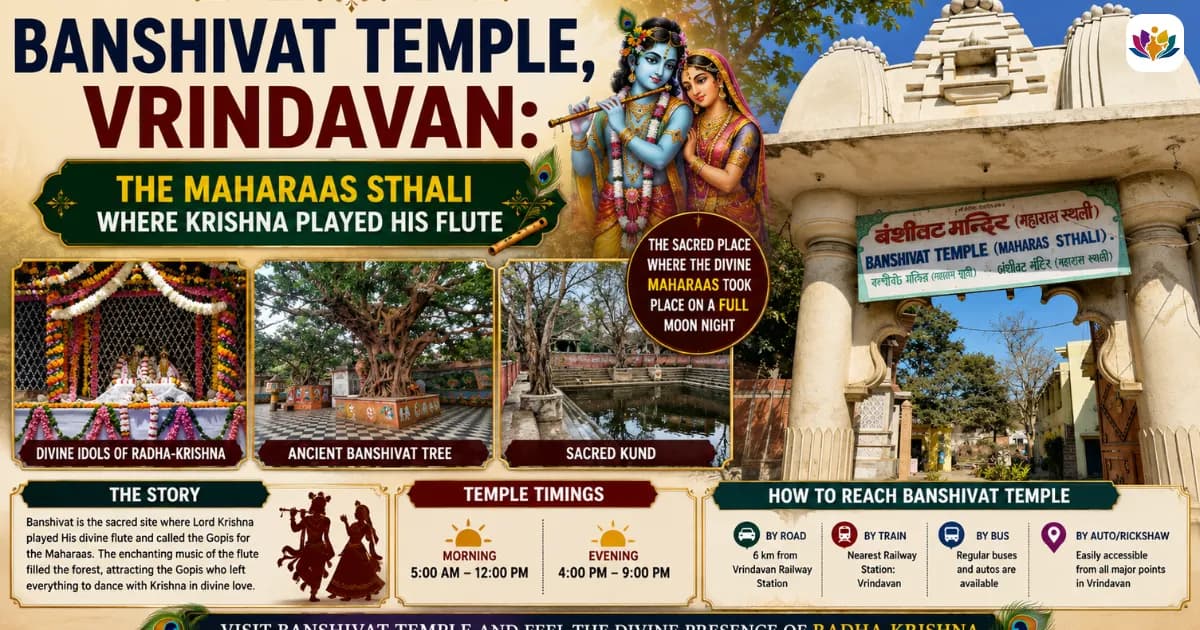
Banshivat, written also Banshi Vat, is one of the most sacred sites in the heart of Vrindavan, and its name tells its meaning: banshi, the flute, and vat, the banyan tree, so Banshivat is the banyan of the flute, the sacred vat tree beneath which Krishna stood and played his banshi. It is revered above all as the Maharaas Sthali, the site of the Maharaas, for it was here, tradition and the scriptures tell, that Krishna played upon his flute a music so enchanting that it drew the gopis from their homes through the night, and here beneath the vat he danced with them the great Maharaas, the divine circular dance of pure love in which he multiplied himself so that each gopi had Krishna at her side. The place stands in the heart of Vrindavan, near the parikrama path and the Yamuna, spread over about thirty thousand square feet, and it is one of the holiest spots in all the town. The table gives the essentials at a glance.
Banshivat, Vrindavan, at a glance.
Detail | Information |
What it is | The Maharaas Sthali, the sacred vat of the flute |
Name meaning | Banshi, flute; vat, banyan tree |
Famous for | The site where Krishna danced the Maharaas |
The deity | Radha Gopinath, appeared from the vat’s roots |
Worshipped by | The Nimbark, Gaudiya and Pushti traditions |
Where | The heart of Vrindavan, near the Yamuna |
Entry | Free |
The Maharaas: the dance of Banshivat
The glory of Banshivat is the Maharaas, and it is worth telling why this dance is so central to the love of Braj. On the full moon night of autumn, the Sharad Purnima, Krishna played upon his flute at this spot, and the sound, sweeter than any music of the world, called the gopis, the cowherd women, from their homes and their duties and their sleeping households, drawing them irresistibly to him in the forest by the Yamuna. There beneath the vat he danced with them the Maharaas, and in the wonder of that dance, so that no gopi should feel apart from him, Krishna multiplied his own form, becoming as many as the gopis, so that each one danced with Krishna at her side, and each believed him hers alone. The Maharaas is understood by the saints as the highest of all the leelas, the play of the soul’s union with God in pure selfless love, and Banshivat is the ground where it was danced. To stand here is to stand at the very heart of the devotion of Vrindavan.
The appearance of Radha Gopinath
Banshivat holds another wonder, dear especially to the Gaudiya tradition. When Chaitanya Mahaprabhu, the great saint of Bengal, came to Vrindavan, it is said that he came first of all to Banshivat, so holy did he hold it, and before he left he entrusted the place to his disciples Madhu Pandit Goswami and Parmanand Goswami. One day, as Madhu Pandit was sweeping the sacred ground, he found a flute at the root of the vat tree, and digging deeper, the beautiful deity of Radha Gopinath appeared from the earth beneath the tree. This self manifested deity was worshipped here with great love, until, in the troubled reign of Aurangzeb, it was carried away to Jaipur for safety, where Radha Gopinath is worshipped to this day. Parmanand Goswami then established the deity of Radha Ras Bihari at Banshivat, who is still served here. The place is remembered in the Chaitanya Charitamrit and is precious to the followers of Mahaprabhu.
The temple and the sacred Charan
Within the sacred enclosure of Banshivat there are two temples. The smaller is the Charan Mandir at the centre, which enshrines the sacred Charan, the holy footprints of Radha and Krishna, established in 1820 by the great sage Girdhari Sharn Dev, to whom, tradition tells, Radha Ras Bihari gave their footprints in reward for his loving service, and these Charan are served by the mahants to this day. The larger temple, built by a king of Lucknow around the turn of the twentieth century, is where the deities of Radha Krishna receive their daily sewa. Behind the Charan in the small temple hangs a Pichvai, a sacred cloth painting, depicting the Maharaas leela, painted, it is believed, by the saint Bhatt Dev. The place was founded by Shri Nivasacharya of the Nimbark sampradaya, and it is mentioned in every Nimbark text, making it a site of the first importance to that tradition.
The birthplace of the staged Raas Leela
Banshivat holds a special place in the living tradition of Braj as the birthplace of the Raas Leela as it is performed on stage, the beloved devotional theatre in which young brahmin boys enact the pastimes of Radha and Krishna. In the fifteenth century a sage of the Nimbark sampradaya, Ghamand Dev Acharya, who lived near Govardhan, first brought the Raas Leela to the stage, and it was here at Banshivat, as the original site of the true Maharaas, that the very first staged raas was played. So pleased was Radha Ras Bihari at this that, tradition tells, the Lord gave the sage his own crown, blessing him to spread the Raas Leela across the world for all the Rasik devotees. To this day every Ras Acharya sings a pad in honour of Banshivat at the beginning of the raas, remembering the ground where it all began.
Banshivat and the great traditions
Few places in Vrindavan are dear to so many of the great devotional traditions at once, and this is part of what makes Banshivat so revered. To the Nimbark sampradaya it is a founding site, established by Shri Nivasacharya and named in every Nimbark book. To the Gaudiya tradition of Chaitanya Mahaprabhu it is the place he came to first, where Radha Gopinath appeared. And to the Pushti Marg of Vallabhacharya it is precious too, for when Shri Vallabhacharya came to Vrindavan seeking the purest place to hold his Bhagavat Katha, he chose Banshivat above all others, and some say his first darshan of Shrinathji was granted here. That so many streams of devotion converge upon this one sacred vat shows how deeply the ground of the Maharaas is honoured across all of Sanatan Dharma.
Timings and darshan
Banshivat keeps the darshan pattern usual to the temples of Vrindavan, opening in the morning and again in the evening, with a break through the middle of the day, and the deities of Radha Ras Bihari and the sacred Charan receive their daily sewa within. Because the published hours vary and shift with the season and the festivals, I do not fix exact clock times here that might mislead you; ask on the day, or let us confirm the current darshan hours for you before your visit, so that you come when the temple is open and the aarti may be seen. The Sharad Purnima, the autumn full moon of the Maharaas itself, and Janmashtami and the month of Kartik are the most special times of all here.
Location and how to reach Banshivat
Banshivat lies in the heart of Vrindavan, in the Mathura district of Uttar Pradesh, close to the Yamuna and the parikrama path, in the old temple quarter of the town near the Gopinath Bazar. Vrindavan is about twelve to fifteen kilometres from Mathura, the nearest railway junction, and about a hundred and eighty kilometres from Delhi, the nearest airport, by the Yamuna Expressway. Two ways reach Banshivat: the easier, by the renovated parikrama path from the Chhatikara and ISKCON side, reaching the rear of the large temple; or through the old town by the Rangji Mandir and Gopinath Bazar, by small roads best taken by rickshaw or on foot. Being in the heart of old Vrindavan, it is best combined with the nearby temples on foot or by a small vehicle. The table gives the distances.
Reaching Banshivat, Vrindavan. Distances are approximate; verify on the day.
From | Distance | Time |
Vrindavan town centre | In the heart of Vrindavan | A short walk or rickshaw |
Mathura | About 12 to 15 km | About 30 to 40 minutes |
Agra | About 70 to 75 km | About 1.5 to 2 hours |
Delhi | About 180 km | About 3.5 to 4 hours |
It pairs naturally with the other places to visit in Vrindavan, and our Mathura Vrindavan taxi service brings you to Vrindavan and its old temple quarter.
Nearby temples in Vrindavan
Banshivat sits among the great old temples of Vrindavan, and is best woven into a walk of the heart of the town. Nearby stand the historic Gopinath temple and the Radha Gopinath sites, the great seven Goswami temples of the town including the Radha Damodar and the Radha Raman, the Nidhivan of the Maharaas mystery, and the parikrama path along the Yamuna with its ghats. The famous Banke Bihari and the Rangji temples are close by too. Seen together, these make the heart of Vrindavan a profound day of the love of Radha and Krishna, with Banshivat, the Maharaas Sthali, among its holiest points. Our Vrindavan parikrama guide covers the sacred round, and the three day Mathura Vrindavan pilgrimage tour takes in Vrindavan with the whole of Braj.
When to visit
The cool months of October to March are the most comfortable for a visit, and within the day the morning and the evening darshan and aarti are the loveliest times. For Banshivat above all, the Sharad Purnima, the autumn full moon that is the very night of the Maharaas, is the most special and beautiful time, when the story of the place is most alive; and Janmashtami and the devotional month of Kartik are wonderful too. The peak summer of May and June is very hot in the old town lanes, so the cool season is kindest. Our best time to visit Mathura Vrindavan guide is the seasons.
The honest bit
Honest words on Banshivat. Darshan is free, and no official VIP pass exists here or anywhere in Braj. This is an ancient and profound place, the ground of the Maharaas, in the old temple heart of Vrindavan, not a grand modern monument, so come in reverence for what it is, and its depth will reach you. It lies in the narrow old lanes best reached on foot or by rickshaw from the town side, or by the renovated parikrama path from the ISKCON side; a large car cannot enter the old quarter. The deity Radha Gopinath who appeared here is now in Jaipur, and it is Radha Ras Bihari and the sacred Charan who are served here today, so come to understand what you will see. Confirm the darshan hours before you come, walk the old town with a quiet heart, and Banshivat, the birthplace of the Maharaas, will move you as few places can.
Why Experience My India is the right choice
I was born in Gokul Mahaban Bangar, and the sacred heart of Vrindavan, Banshivat among its holiest points, is part of my own devotional home ground. Guiding since 2018, more than 50,000 pilgrims, 4.5 stars across 204 Google reviews, WhatsApp first, 8 AM to 9 PM daily. What a local brings to Banshivat is the story of the Maharaas and the appearance of Radha Gopinath told on the very ground; the knowledge of the confirmed darshan hours so you never arrive to a closed door; the way through the old lanes to the temple; and the pairing of Banshivat with the other treasures of old Vrindavan in the right order. One clear fare, and never a charge for free darshan.
Tip from Gurudutt: come to Banshivat with the story of the Maharaas in your heart, and stand a while beneath the vat in the old enclosure, remembering that here Krishna’s flute called the gopis through the autumn night and here he danced the great dance of divine love. This is not a place for a hurried photograph but for a quiet remembrance of the deepest of all the leelas. Come, if you can, near the Sharad Purnima, the full moon of the Maharaas itself, and the ground of the dance will speak to you across the ages.
Related guides
Plan your Vrindavan visit
Tell me your dates and your group, and I will build Banshivat and the sacred heart of Vrindavan into your Braj trip, the darshan hours confirmed, the old temples walked in the right order, with a guide and a car to the edge of the old town, for one clear price. WhatsApp +91 7302265809, any day 8 AM to 9 PM. Packages from Rs 5,999 per person, 4.5 stars from 204 Google reviews. Born in Gokul, Mathura.
Book Your Mathura - Vrindavan Trip Today 📞 +91-7302265809 💬 WhatsApp: +91-7302265809 Packages start from ₹1,999/ person | Rated 4.5★ / 204+ Reviews Explore all: Mathura Vrindavan Tour Packages Jai Shri Krishna 🙏 |
Gurudutt — Born & Raised in Braj Bhoomi
Guiding pilgrims through Mathura & Vrindavan since 2018 · 50,000+ pilgrims served