📌 QUICK ANSWER
the Vrindavan Parikrama is the sacred circumambulation of Vrindavan, a clockwise walk of about 10 km on the outer Parikrama Marg (the inner city route is about 8 to 8.5 km). It takes roughly 2.5 to 4 hours on foot with darshan stops. The best days are Ekadashi (twice a month) and the holy month of Kartik (October to November). Entry is free; it is a public sacred route, walking barefoot and chanting, ideally started before dawn. To walk it with a local guide, call or WhatsApp +91 7302265809.
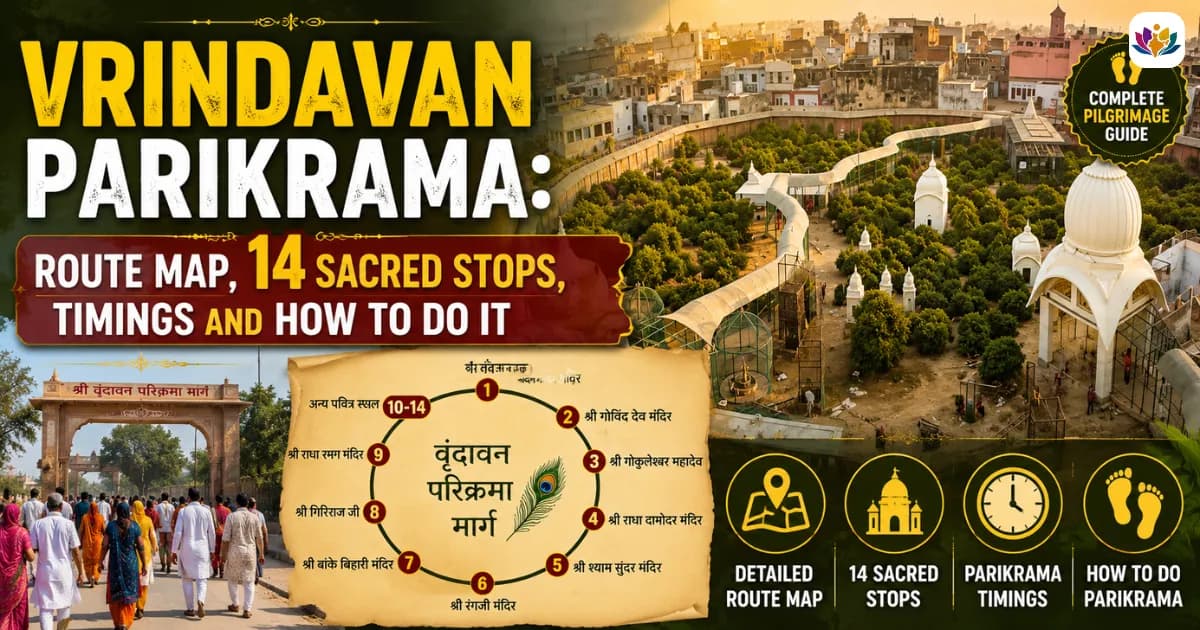
The Vrindavan Parikrama is the sacred circumambulation of the holy town of Vrindavan, a roughly 10 km clockwise walk that circles the whole dham, passing the ghats where Krishna played, the ancient temples of the Goswamis and the mysterious groves of his leelas. Walking barefoot and chanting before dawn, it is one of the most powerful spiritual experiences in all of Braj. Here, from one born in Gokul who has walked this route hundreds of times with pilgrims, is the complete Vrindavan Parikrama guide: the full route map with all 14 sacred stops, the timings, a step-by-step how-to, the best time and practical tips. Plan your visit with our Mathura Vrindavan tour packages.
Key takeaways
The Vrindavan Parikrama is a clockwise walk of about 10 km around the holy town.
The outer Parikrama Marg is about 10 km; the inner city route about 8 to 8.5 km.
It takes roughly 2.5 to 4 hours on foot, with darshan stops along the way.
It begins and ends at Kesi Ghat, passing 14 major sacred sites.
The best days are Ekadashi and the holy month of Kartik; they start before dawn.
Entry is free; it is walked barefoot and chanting, as a meditation, not exercise.
I am Gurudutt, born in Gokul in the Mathura district, guiding pilgrims through Braj since 2018, more than 50,000 of them and I have walked the Vrindavan Parikrama countless times. This guide gives you everything: the landmark-by-landmark route map, the story and darshan timing of each stop, exactly how to do the parikrama, when to come and how to prepare. Here is the complete guide to the Vrindavan Parikrama.
Vrindavan Parikrama route map: all 14 sacred stops
The parikrama is walked clockwise from Kesi Ghat, following the outer Parikrama Marg around the town. Here is the full route, landmark by landmark, with the significance of each stop and its darshan timing. Distances are approximate and measured from the start.
Km | Sacred site | Significance | Darshan timing |
0 | The traditional start, where Krishna slew the Keshi demon; take a Yamuna bath before you begin | Aarti 6:00 to 7:00 PM | |
0.5 | Cheer Ghat | Site of the Cheer-harana leela, where Krishna took the gopis' clothes; an ancient Kadamba tree | Open all day |
1 | Where Krishna danced upon the Kaliya serpent; one of the most powerful leela sites | Open all day | |
1.5 | Imli Tala Ghat | The ancient tamarind tree where Krishna played his flute for the gopis; a meditative spot | Open all day |
2 | Madan Mohan (Pani Ghat) | The gopi water-carrying ghat; the Madan Mohan temple (1542), Vrindavan's oldest | 6 AM to 12, 5 to 8 PM |
3 | A great Goswami temple (1590); the Radha Govinda deity | 5:30 AM to 12, 5 to 9 PM | |
4 | Where Srila Prabhupada lived; Jiva Goswami's samadhi; a historic Gaudiya centre | 6 AM to 12, 5 to 8 PM | |
5 | The most beloved temple of Vrindavan; the unique curtain (parda) darshan | 7:45 AM to 12, 5:30 to 9 PM | |
5.5 | The self-manifested deity (1542); unbroken worship for over 480 years | 6 AM to 12, 5 to 9 PM | |
6 | The sacred grove of Krishna's nightly Raas Leela; closes at sunset | 8 AM to sunset (closes early) | |
7 | The international temple; Krishna-Balaram and Radha-Shyamasundar; a world-class complex | 4:30 AM to 1, 4 to 8:30 PM | |
8 | The marble temple (2012); gardens and the evening light show at 7:15 PM | 5:30 AM to 12, 4:30 to 8:30 PM | |
9 | A famous landmark near the Kesi Ghat area; almost back to the start | Open all day | |
10 | Kesi Ghat (completion) | Return to the start; complete with the evening Yamuna aarti | Aarti 6:00 to 7:00 PM |
The Vrindavan Parikrama route map, all 14 stops clockwise from Kesi Ghat. Distances approximate; timings shift by season, so confirm on the day.
How to do the Vrindavan Parikrama: step by step
The parikrama is simple to do and its power lies in walking it with devotion. Here is how, step by step.
Step 1: Prepare at Kesi Ghat. Arrive at Kesi Ghat, take a sacred bath in the Yamuna or perform achamana (purification) and offer a handful of Yamuna water to the sun. Begin with a prayer to Radha and Krishna, stating your sankalp, your intention to complete the parikrama.
Step 2: Walk clockwise, always. Begin walking in a clockwise direction (pradakshina), the sacred direction of circumambulation, following the outer Parikrama Marg. Most sections have clear signage.
Step 3: Walk slowly and chant. Walk at a steady, comfortable pace, chanting the Hare Krishna mahamantra or 'Radhe Radhe' with each step. The purpose is not exercise but meditation and devotion; there is no rush.
Step 4: Stop at each sacred site. At each temple and leela site, pause for darshan and to recall its story. You need not enter every temple; a moment of reverent acknowledgment is enough to receive the benefit.
Step 5: Complete the full circuit. The parikrama is complete when you return to your starting point. A full circuit without shortcuts receives the full benefit; rest if you must, but do not break the clockwise direction.
Step 6: Offer completion prayers. Return to Kesi Ghat, offer final prayers and, if time permits, attend the Yamuna aarti at 6:00 to 7:00 PM, a deeply moving way to complete the walk. We can arrange your pooja and seva at the ghat.
The best time for the Vrindavan Parikrama
The parikrama can be walked any day of the year, but some times are especially sacred or comfortable. Here is the full calendar.
Period | Significance | Crowd | What is special |
Kartik month (Oct to Nov) | The most sacred | Very high | Deep Daan daily, Dev Deepawali, all temples decorated |
Ekadashi (twice monthly) | The most meritorious | High | Thousands walk the parikrama; extraordinary energy |
Janmashtami week (Aug) | The most festive | Extreme | Citywide celebrations; intense spiritual atmosphere |
October to March | The best weather | Moderate to high | Pleasant for the full parikrama; ideal conditions |
November to February | The winter sweet spot | Moderate | Cool, clear mornings; the best for photography |
April to June | Challenging | Low | Very hot; only the early morning (4:30 to 7 AM) is manageable |
July to September (monsoon) | Lush but wet | Moderate | Jhulan Yatra and Janmashtami; beautiful, but heavy rain possible |
The best time for the Vrindavan Parikrama. Ekadashi and Kartik are the most sacred; October to March the most comfortable.
For the seasons in full, see our best time to visit Mathura Vrindavan guide and the Mathura Vrindavan festivals calendar for the great days.
Practical tips for the Vrindavan Parikrama
Start before sunrise: a pre-dawn start (4:30 to 5 AM) is the most powerful and the coolest; thousands walk in the dark, chanting, an extraordinary atmosphere.
Footwear: barefoot is most meritorious, but the route mixes paved and unpaved sections, so comfortable flat sandals are practical for first-timers.
Carry water: at least 1 litre per person and 2 in summer, as the outer Marg has few shops; coconut water is sold at some points.
Follow the outer route: the outer Parikrama Marg is the traditional way; the inner city lanes are shorter but far more crowded, so first-timers should keep to the outer ring.
Chant throughout: japa on a mala or even silent mental chanting, turns the walk from exercise into meditation.
Avoid peak hours: the outer Marg is quiet except on Ekadashi and festivals, but the inner lanes near Banke Bihari are very crowded from 9 AM, so plan your temple stops early.
Ekadashi planning: on Ekadashi, thousands walk; arrive by 4 AM for the pre-dawn procession of chanting devotees, one of the most powerful experiences in Braj.
Hire a local guide: a guide who knows every sacred story at every site ensures you miss nothing; ours have walked this route hundreds of times.
For getting to the start and around Braj, see our Mathura Vrindavan taxi service and for a stay near the route, our Mathura Vrindavan hotels desk can help.
The inner and outer routes
There are two ways to walk the Vrindavan Parikrama. The outer Parikrama Marg, about 10 km, is the traditional ring road around the town, quieter and easier to follow and best for first-timers and for the full experience. The inner city route, about 8 to 8.5 km, threads through the old lanes and the market, passing closer to some temples but far more crowded and uneven underfoot. Both are complete parikramas; we usually recommend the outer Marg and weave in the key inner-town temples as darshan stops.
The honest bit
Honest words from one born in Braj. The Vrindavan Parikrama is one of the great spiritual walks of India, but be realistic: it is about 10 km on mixed paved and rough ground, two and a half to four hours on foot, so it takes reasonable fitness and in summer only the pre-dawn hours are bearable. Temple timings along the route shift with the season and festivals and some, like Nidhivan, close at sunset, so confirm them and plan your stops. The outer Marg is calm, but the inner lanes near Banke Bihari get very crowded from mid-morning. Walk it barefoot if you can, but sandals are wise for first-timers. Above all, walk it slowly, chanting, as a meditation rather than a task and do not shortcut the circle. Done this way, before dawn, the parikrama is unforgettable.
Why Experience My India is the right choice
I was born in Gokul in the Mathura district and I have walked the Vrindavan Parikrama hundreds of times with pilgrims. Guiding since 2018, more than 50,000 pilgrims, 4.5 stars on Google, WhatsApp first, 8 AM to 9 PM daily. We meet you at Kesi Ghat before dawn, walk the route with you, tell the sacred story at every stop, time your temple darshans around the crowds and closures, arrange your Yamuna bath and any seva and have a car follow by road so you never carry your things, with no touts. One clear fare and never a charge for free darshan.
Tip from Gurudutt: walk the parikrama before sunrise, especially on an Ekadashi. To set out from Kesi Ghat in the dark, among thousands of devotees walking barefoot and chanting Radhe Radhe, as the first light rises over the Yamuna and the old temples and to complete the circle at the evening aarti, is to feel the living devotion of Vrindavan as nothing else can give you. That dawn walk is the true Vrindavan Parikrama.
Related guides
Explore more Braj guides
Jugal Kishore Mandir, Vrindavan: one of the oldest of the dham
Gopeshwar Mahadev, Vrindavan: the guardian Shiva worshipped as a gopi
Plan your Vrindavan Parikrama
Tell me your dates and I will arrange your Vrindavan Parikrama, a guide to walk the route with you, the sacred stories at every stop, the darshan timed around the crowds, a car following by road and any seva, for one clear price. Our Mathura Vrindavan same-day tour by car can include the parikrama and the town's temples. WhatsApp +91 7302265809, any day 8 AM to 9 PM. Packages from ₹1,999 per person, 4.5 stars on Google. Born in Gokul, Mathura.
Book Your Mathura - Vrindavan Trip Today 📞 +91-7302265809 💬 WhatsApp: +91-7302265809 Packages start from ₹1,999/ person | Rated 4.5★ / 204+ Reviews Explore all: Mathura Vrindavan Tour Packages Jai Shri Krishna 🙏 |
Gurudutt — Born & Raised in Braj Bhoomi
Guiding pilgrims through Mathura & Vrindavan since 2018 · 50,000+ pilgrims served