📌 QUICK ANSWER
Govardhan is a small municipal town and a sacred low hill in Mathura district, Uttar Pradesh, in the Braj region linked to Krishna. The hill, worshipped as Giriraj, is a long sandstone ridge revered as non-different from Krishna himself, which is why pilgrims walk around it and never climb it. At Experience My India, we are Braj locals, born here, and darshan of the hill is free. To plan a visit, call or WhatsApp +91 7302265809.
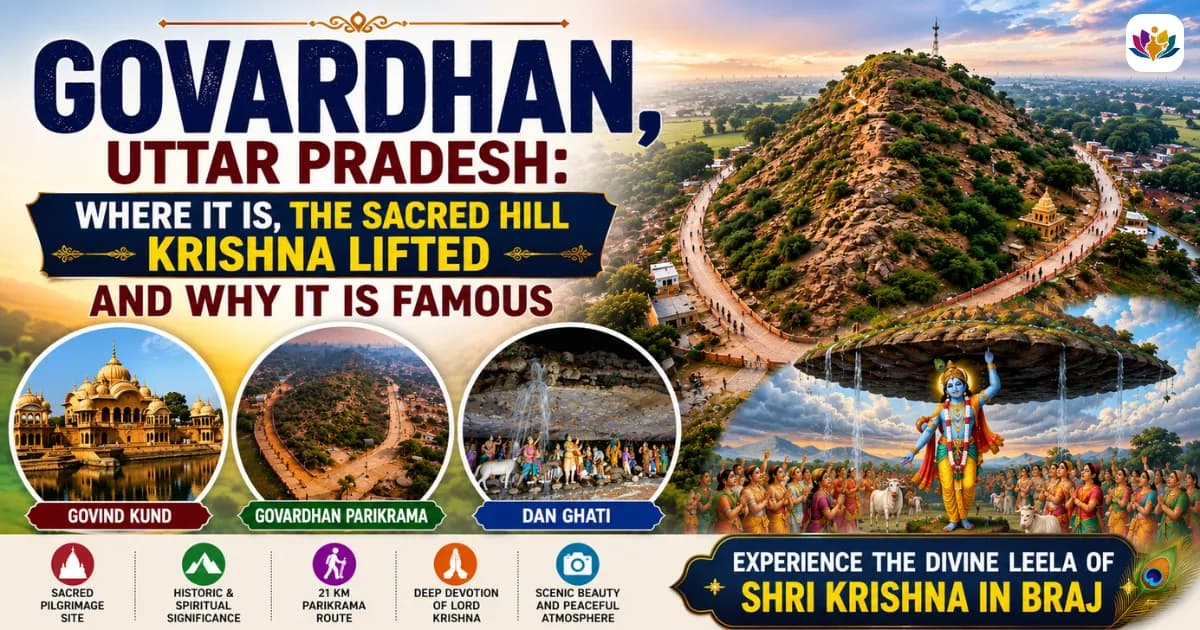
I was born a short drive from here, in Gokul, and I have been walking people around this hill since 2018. So let me answer the plain question first, the one most people actually type. When someone asks where Govardhan is, or in which state, the honest answer is short: it is a town and a sacred hill in Mathura district, Uttar Pradesh, in the heart of Braj, the land of Krishna's childhood. It is a modest municipal town of roughly twenty thousand people, but its entire fame rests on one thing, the hill, the Giriraj, which draws pilgrims from across India and the world. This guide explains the place, the hill, its story and its meaning, and where it sits in relation to Mathura and Vrindavan, so you understand it before you ever set foot on the path.
Is Govardhan a town or a hill?
It is both, and the confusion is fair. Govardhan is the name of a small town, and it is also the name of the hill that the town grew around. When a devotee says “I am going to Govardhan,” they usually mean the hill and the parikrama around it, not the market or the bus stand. When an official form asks for Govardhan, it means the municipal town in Mathura district. On this page, when I say Govardhan I mean the sacred hill and the place around it together, because for a pilgrim they are one thing.
The town is real and ordinary in the way Braj towns are: narrow lanes, prasad shops, monkeys near the temple gates, dust and bells. The hill is what makes it a tirtha, a crossing place between the ordinary and the sacred. Understanding that split saves you from disappointment. People sometimes arrive expecting a tall green mountain with a viewpoint. That is not what Govardhan is, and I will explain why below. See our mathura vrindavan tour package.
Where is Govardhan and in which state?
Govardhan is in Uttar Pradesh, in Mathura district, in western UP, close to the Rajasthan border. It sits inside the Braj region, the cluster of Krishna towns that includes Mathura, Vrindavan, Gokul, Barsana and Nandgaon. In orientation terms it lies roughly twenty two kilometres west of Mathura city and a similar distance from Vrindavan, so most pilgrims reach it as part of a wider Braj circuit rather than as a standalone trip.
Govardhan at a glance (verify on the day for anything time sensitive)
Detail | Answer |
Type of place | Municipal town and sacred hill |
State | Uttar Pradesh |
District | Mathura |
Region | Braj (land of Krishna) |
PIN code | 281502 |
Other name of the hill | Giriraj, Giriraj Parvat, Govardhan Hill |
Roughly from Mathura city | About 22 km west |
Roughly from Vrindavan | About 22 km |
Entry or darshan cost | Free |
If you are coming from Delhi, Govardhan is generally reached down the Yamuna Expressway toward Mathura and then across, which most day visitors do as a combined Braj run. For the exact door to door drive and where the hill sits on the route, I keep a separate Mathura to Govardhan distance guide, because that is a routing question and deserves its own page rather than a paragraph here.
What exactly is the Govardhan hill, the Giriraj Parvat?
Here is where honesty matters, because most pages copy each other and the numbers wander. The Govardhan hill is a long, low ridge of sandstone that runs across the land rather than rising up from it. It is not tall. It is spread out. Sources differ on the exact figures, so I will give you the honest range rather than a false precision: the ridge is commonly described as around eight kilometres long, and its height above the surrounding plain is usually given as modest, on the order of tens of feet rather than a proper mountain. What is not in dispute is that it is sandstone, that it is low, and that it stretches for several kilometres through the town of Govardhan and the area of Radha Kund.
There is a well known story that explains why the hill looks so humble. Older Brajwasis will tell you that Govardhan was once enormous, almost beyond measure, and that because of a curse by the sage Pulastya it began to shrink, a little each day, as small as a sesame seed at a time, until it reached the low ridge you see now. Whether you take that as literal history or as a way of teaching humility, it stays with you when you walk the path. Something ancient, slowly becoming quieter.
The two names people use for the same hill
Name | What it means | How it is used |
Govardhan | Go (cow) and vardhan (nourishing), the nourisher of cows | The town, the hill and the whole tirtha |
Giriraj / Giriraj Parvat | Giri (mountain) and raj (king), the king of mountains | The devotional name for the hill as a divine personality |
So when you see “Govardhan Parvat” and “Giriraj” written as if they were two places, they are not. They are two names for the same sacred hill, used interchangeably, along with Govardhan Hill and Giriraj Parvat. All of them point at the same low sandstone ridge in Mathura district that is revered as non-different from Krishna.
🪔 Tip from Gurudutt: do not come to Govardhan to sightsee in the ordinary way. It is not a place you look at from a viewpoint. It is a place you walk around. The heart of any visit is the parikrama, the circling of the hill, not a single temple or photo spot. Once you understand that, you plan the day completely differently. |
Why is Govardhan so famous, and what is its significance?
The fame rests on one story that almost everyone in India has heard in some form. The people of Braj once prepared their yearly worship of Indra, the god of rain. Krishna, still a boy, told them to honour the hill and the cows and the land that actually fed them instead. Indra, in anger, sent a storm to drown Braj. Krishna lifted the entire Govardhan hill on the little finger of his left hand and held it up like an umbrella for seven days and nights, and the whole community, with their cattle, sheltered underneath until the rain gave up. That act is why Govardhan is worshipped, and it is what pilgrims commemorate every year at Govardhan Puja, the day after Diwali, when the hill is honoured with a mountain of food offerings.
The deeper significance, the part that changes how you behave when you arrive, is this: the Bhagavata tradition holds that Krishna himself declared the hill to be non-different from him. The hill is not a monument that reminds you of Krishna. In the devotee's understanding it is Krishna, in the form of a hill. That single idea explains almost everything you will notice on the ground. People do not merely look at the hill. They greet it, they bow to it, some pick up small stones from it and carry them home and worship them as they would a deity.
Three plain facts about this place, phrased so you can carry them: Govardhan is worshipped as Giriraj Maharaj, an incarnation of Krishna, not as ordinary ground. Its story is the lifting of the hill to shelter Braj from Indra's storm. And its central practice is not climbing but circling, the parikrama, walked by pilgrims from across the world every single day.
Why do pilgrims circle Govardhan and never climb it?
Because you do not climb a deity. Since the hill is worshipped as non-different from Krishna, standing on top of it is understood as standing on the Lord himself, which no devotee wants to do. So instead of climbing, pilgrims walk around it, keeping the hill on their right, on the traditional route that rings the ridge. This is the single most important courtesy to observe here. Treat the hill as sacred, keep to the paths around it, and do not climb or stand on the rock.
The circling itself is a whole practice, with a length and a rhythm and sacred stops along the way, and many people walk it barefoot, some measuring their length on the ground the entire distance. Because that is a different question, how long the route is, where it starts, what you pass, how long it takes, I keep it on a dedicated Govardhan Parikrama guide rather than crowding this page. If your real question is “how do I walk it,” go there. If your question is “what is this place and why,” you are in the right spot.
What will I actually see when I reach Govardhan?
The town itself, the low ridge running through it, and a scatter of sacred sites strung along and around the parikrama route. You pass kunds, the sacred water tanks, and small temples, and the market lanes with their prasad and their monkeys. Near the town are the famous kunds of the area, Radha Kund and the sandstone tank of Kusum Sarovar, and the still water of Manasi Ganga, each with its own story. There is the main Giriraj temple at Daan Ghati where the deity is dressed to show Krishna holding the hill on his finger. I keep the temple darshan details, the aarti and the timings, on the temple's own page, because a place page should not pretend to be a timings page.
What you will not see is a dramatic peak. If you go expecting alpine scenery you will be underwhelmed. If you understand that this modest ridge is, for a billion people, Krishna in the form of a hill, then modesty is the whole point. That is the honest expectation to travel with.
🪔 Tip from Gurudutt: go early, before the crowd builds. Walk the first stretch just after dawn, when the bells start and the light is soft, and you feel what people must have felt here long ago. The middle of the day in Braj is hot, loud and crowded. The morning is when Govardhan speaks quietly. |
A born Brajwasi's honest take, and who this place is not for
I will tell you what I tell friends. Govardhan is not a monument to tick off in an hour. It rewards slowness and it rewards faith or at least curiosity about faith. If you come as a devotee, it can be the most moving day of your Braj trip, more than any single temple, because the whole hill is the deity and the whole walk is the darshan. If you come as a traveller who loves history and place, you will find a genuinely old, layered, living pilgrimage landscape that is monitored today by the National Green Tribunal precisely because people fought to protect it from quarrying.
Who is it not for? If your idea of a good day is a viewpoint, a cafe and a two hour visit, Govardhan will frustrate you. It asks for a half day at least, some walking, some heat, and some willingness to move at the pace of pilgrims rather than tourists. That is the honest “not for you if,” and I would rather you know it now than feel let down on the day.
Most visitors fold Govardhan into a wider Braj circuit, and that is genuinely the sensible way to see it. A well planned mathura vrindavan tour package puts Govardhan in its right place, on a route with Mathura, Vrindavan, Barsana and Nandgaon, so the day flows instead of being rushed. If you specifically want the hill at the centre of the day, our same day Govardhan Barsana tour from Delhi is built around exactly this, Govardhan and the villages of Radha, with a local guide and an air conditioned cab, and it starts and ends in one day from Delhi.
Whatever you choose, come with the right idea in your head: a low hill, a king of mountains, worshiped not for its height but for who it is. Walk around it, keep it on your right, and let Braj slow your mind down.
Book Your Mathura - Vrindavan Trip Today 📞 +91-7302265809 💬 WhatsApp: +91-7302265809 Packages start from ₹1,999/ person | Rated 4.5★ / 204+ Reviews Explore all: Mathura Vrindavan Tour Packages Jai Shri Krishna 🙏 |
Gurudutt — Born & Raised in Braj Bhoomi
Guiding pilgrims through Mathura & Vrindavan since 2018 · 50,000+ pilgrims served