📌 QUICK ANSWER
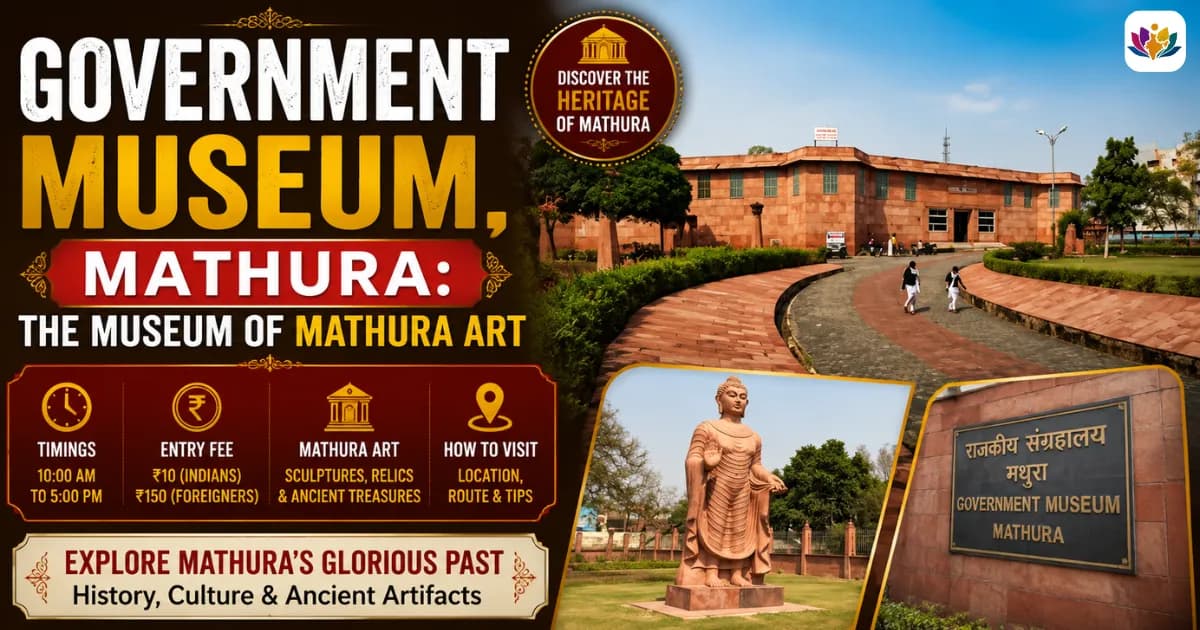
The Government Museum, Mathura, founded in 1874, is a famous archaeological museum holding the great sculptures of the Mathura school of art, of the Kushan and Gupta ages, including the celebrated statue of the emperor Kanishka and the ancient yakshas. It is open Tuesday to Saturday from 10:30 AM to 4:30 PM and closed on Monday and Sunday. Entry is a few rupees. To visit the Government Museum and Mathura with a Braj-born guide, call or WhatsApp +91 7302265809.
Key takeaways
The Government Museum, Mathura holds the famous sculptures of the Mathura school.
It was founded in 1874 by the Collector Sir F. S. Growse.
It is renowned for Kushan and Gupta art in Mathura’s red sandstone.
Its treasures include the statue of the emperor Kanishka and the yakshas.
It is open Tuesday to Saturday and closed on Monday and Sunday.
Entry is a few rupees; it is in Dampier Nagar, Mathura.
GOVERNMENT MUSEUM, MATHURA: TIMINGS, FEES AND LOCATION Open: Tuesday to Saturday, 10:30 AM to 4:30 PM Closed: Monday and Sunday Entry fee: Rs 5 adults, Rs 2 children, Rs 25 foreigners; Rs 20 camera Location: Dampier Nagar, Choubey Para, Mathura 281001. Times and fees vary, so verify on the day. |
I am Gurudutt, born in Gokul in the Mathura district, guiding pilgrims and travellers through Braj since 2018: more than 50,000 of them. Mathura is known the world over as the birthplace of Krishna, but it is also one of the great ancient cities of India and its Government Museum holds one of the finest collections of ancient Indian art in the land, the celebrated sculptures of the Mathura school. For any visitor with an eye for history and art, it is among the treasures of the city, too often missed by those who come only for the temples. Here is everything you need: its story, its great collection, its timings and fees, its location and how to visit, told by someone from this land. Plan your visit with our Mathura Vrindavan Tour Package, message on WhatsApp at +91 7302265809, any day from 8 AM to 9 PM.
What is the Government Museum, Mathura?
The Government Museum, Mathura, often simply called the Mathura Museum, is an archaeological museum in the city of Mathura, one of the leading museums of Uttar Pradesh and one of the most important collections of ancient art in India. It was founded in 1874 by Sir F. S. Growse, then the Collector of the Mathura district and a great lover of its antiquities, was known first as the Curzon Museum of Archaeology, then the Archaeology Museum and at last the Government Museum. It houses a great treasure of pottery, sculptures, paintings, terracottas and coins, gathered chiefly from Mathura and its region, including many of the discoveries of the noted archaeologists of the colonial age, Alexander Cunningham, Growse himself and Fuhrer. Above all it is world famous for its sculptures of the Mathura school of art, the great and distinctive school of ancient Indian sculpture that flourished here. So important is it that the Government of India issued a postage stamp on its centenary in 1974. The table gives the essentials at a glance.
The Government Museum, Mathura, at a glance.
Detail | Information |
What it is | An archaeological museum of ancient art |
Founded | 1874, by Sir F. S. Growse |
Famous for | The sculptures of the Mathura school of art |
The great ages | The Kushan and Gupta empires |
Chief treasures | The Kanishka statue, the yakshas, Buddhas, Jain art |
Holdings | Sculptures, terracottas, coins, pottery, paintings |
Location | Dampier Nagar, Mathura |
Open | Tuesday to Saturday; closed Monday and Sunday |
The Mathura school of art
To understand the museum one must know the Mathura school of art, for it is the glory of the collection. The Mathura school was one of the very greatest schools of ancient Indian sculpture, which flourished in and around Mathura from about the third century before Christ to the twelfth century after, reaching its height under the great Kushan and Gupta empires in the early centuries of our era. It is famous above all for its use of the distinctive spotted red sandstone of the region, quarried nearby at Sikri and for its own noble and sensuous style; and it holds a special place in the history of art, for it was here, along with Gandhara, that some of the earliest images of the Buddha in human form were made. The school produced not only Buddhist images but Hindu and Jain sculptures too, for Mathura was a great centre of all three faiths and its yakshas, its Buddhas and Bodhisattvas, its Tirthankaras and its gods are among the masterpieces of Indian art. The Government Museum holds the greatest single collection of this Mathura school, gathered from the ancient sites of the city and its region, which is why it is so treasured. Our Mathura tourism guide covers the ancient city and its story.
The great treasures of the museum
The museum holds many famous masterpieces and to know a few enriches a visit. Most celebrated of all is the standing statue of the emperor Kanishka, the great Kushan ruler of the first and second centuries, shown in his royal coat and boots, headless now but a powerful and iconic image, one of the most famous ancient sculptures in India. Nearly as renowned are the great early yakshas, the colossal folk deities of ancient India, above all the mighty Parkham Yaksha of about 150 before Christ and the Mudgarpani Yaksha, among the earliest large stone sculptures of the land; and the graceful and sensuous Bhutesvara Yakshis, the tree goddesses on their railing pillars. There are noble standing Buddhas and seated Bodhisattvas of the Mathura school, in the spotted red sandstone; a wealth of Jain art, the Tirthankaras, the Ayagapatas or votive tablets and the god Naigamesha; Hindu images of Vishnu and the goddesses; ancient terracottas, coins and pottery reaching back to prehistory; and much more. The table gives some of the chief treasures to seek out.
Some of the chief treasures of the Government Museum, Mathura.
Treasure | What it is |
Statue of Kanishka | The iconic image of the great Kushan emperor |
Parkham Yaksha | A colossal folk deity, about 150 BCE |
Mudgarpani Yaksha | An early great yaksha, about 100 BCE |
Bhutesvara Yakshis | The graceful tree goddesses on railing pillars |
Standing Buddhas | Noble Buddhas of the Mathura school |
Jain Tirthankaras | Tirthankaras, Ayagapatas and Jain art |
Terracottas and coins | Ancient objects reaching back to prehistory |
Timings and entry fees
The Government Museum keeps regular hours through the working week and it is important to plan around its closed days, for unlike the temples it is shut on two days. It is open from Tuesday to Saturday, from the middle morning to the late afternoon and it is closed on Monday and on Sunday, as well as on certain public holidays; so take care not to come on a Monday or a Sunday, a mistake many make. The entry fee is very modest, a few rupees for Indian visitors and a little more for foreign visitors, with a small extra fee to carry a camera. As times and fees may change and the museum may close on holidays, treat the details in the box and table as the guide and confirm on the day of your visit. The table gives the timings and fees.
Government Museum, Mathura timings and fees. Verify on the day; these may change.
Detail | Information |
Open days | Tuesday to Saturday |
Hours | 10:30 AM to 4:30 PM |
Closed | Monday and Sunday and some holidays |
Adult entry | Rs 5 per person |
Child entry | Rs 2 per person |
Foreigner entry | Rs 25 per person |
Camera fee | Rs 20 |
Location and how to reach the museum
The Government Museum stands in the Dampier Nagar area, at Choubey Para, in the city of Mathura, in the Mathura district of Uttar Pradesh, in the heart of the city and easily reached. It is about three to four kilometres from Mathura Junction, the nearest railway station, well connected across the country, about an hour from Agra and three to four hours from Delhi by the Yamuna Expressway; the nearest airport is Agra, about sixty kilometres or Delhi, about a hundred and fifty. Within the city it is easily reached by car, auto rickshaw or e- rickshaw and is close to the other sights of Mathura. The table gives the distances.
Reaching the Government Museum, Mathura. Distances are approximate; verify on the day.
From | Distance | Time |
Mathura Junction | About 3 to 4 km | About 15 minutes |
Krishna Janmabhoomi | About 2 to 3 km | About 10 to 15 minutes |
Vishram Ghat | About 3 km | About 15 minutes |
Vrindavan | About 12 to 15 km | About 30 to 40 minutes |
Agra | About 60 km | About 1.5 hours |
It pairs naturally with the other Mathura sightseeing places and our Mathura Vrindavan taxi service brings you to Mathura and its sights.
The museum with the sights of Mathura
The Government Museum is best seen as part of a day in Mathura, the ancient city, along with its holy and historic places, which lie close by. The great Krishna Janmabhoomi, the sacred birthplace of the Lord, is only two or three kilometres away and the Vishram Ghat with its evening aarti a little further; the Dwarkadhish temple, the Gita Mandir of the Birlas and the guardian Shiva temples are all in the city. A visit that joins the museum, for the ancient art and history, with the temples and ghats, for the living devotion, gives the fullest picture of Mathura, both the birthplace of Krishna and one of the oldest and greatest cities of India. Our Krishna Janmabhoomi, Mathura guide covers the birthplace and the three day Mathura Vrindavan pilgrimage tour takes in Mathura with the whole of Braj.
When to visit
The cool months of October to March are the most comfortable for a visit to Mathura and its museum, pleasant for walking the galleries and the city alike. Remember always the museum’s closed days, the Monday and the Sunday and plan your visit for a Tuesday to Saturday; and note that it may close on certain public holidays. The middle of the day, when the temples take their midday break, can be a good time to see the museum, making the most of the day. The peak summer of May and June is very hot, though the galleries give some shelter from the heat. Our best time to visit Mathura Vrindavan guide is the seasons.
The honest bit
Honest words on the Government Museum, from one born in Braj. Unlike the temples of Braj, where darshan is always free, the museum is a ticketed place, though the fee is very modest, only a few rupees, with a little more for foreign visitors and a small charge for a camera; this is normal and fair for a government museum. The one thing to watch and the commonest mistake, is the closed days: the museum is shut on Monday and Sunday, so do not come on those days, as many disappointed visitors do; plan for a Tuesday to Saturday. Give yourself an hour or two to see the collection properly, for it is rich and rewarding and deserves more than a hurried glance. The museum is a place of quiet history and art rather than of devotion, a different pleasure from the temples and a wonderful one for those who love the ancient past. Plan around the closed days, carry a little cash for the modest ticket and the Government Museum will show you the deep and glorious antiquity of Mathura that the temple crowds never see.
Why Experience My India is the right choice
I was born in Gokul Mahaban Bangar and Mathura, my district town, with its temples and its ancient treasures alike, is my own home ground. Guiding since 2018, more than 50,000 pilgrims and travellers, 4.5 stars across 204 Google reviews, WhatsApp first, 8 AM to 9 PM daily. What a local brings to the Government Museum is the planning of the visit around its closed days, so you do not arrive to a locked door, the telling of the story of the Mathura school and its masterpieces on the ground, so the sculptures come alive and the pairing of the museum with the Janmabhoomi and the other sights of the city in the right order. One clear fare and honest guidance always.
Tip from Gurudutt: above all, do not come to the Government Museum on a Monday or a Sunday, for it is closed and many visitors have arrived at a locked gate; plan it for a Tuesday to Saturday. And do not rush it: give it an hour or two and seek out the great treasures, the headless statue of the emperor Kanishka in his royal coat, the colossal ancient yakshas, the graceful yakshis and the noble red sandstone Buddhas of the Mathura school. To stand before these masterpieces, some over two thousand years old and to know that they were carved here in Mathura, is to feel the deep antiquity of this city that is so much older even than its famous temples. It is a side of Mathura I love to share with those who care for history.
Related guides
Plan your Mathura visit
Tell me your dates and your group and I will build the Government Museum and the treasures of Mathura into your Braj trip, the visit planned around the museum’s open days, the ancient art and the living temples seen in the right order, with a car and a guide born on this soil, for one clear price. WhatsApp +91 7302265809, any day 8 AM to 9 PM. Packages from Rs 5,999 per person, 4.5 stars from 204 Google reviews. Born in Gokul, Mathura.
Book Your Mathura - Vrindavan Trip Today 📞 +91-7302265809 💬 WhatsApp: +91-7302265809 Packages start from ₹1,999/ person | Rated 4.5★ / 204+ Reviews Explore all: Mathura Vrindavan Tour Packages Jai Shri Krishna 🙏 |
Gurudutt — Born & Raised in Braj Bhoomi
Guiding pilgrims through Mathura & Vrindavan since 2018 · 50,000+ pilgrims served