📌 QUICK ANSWER
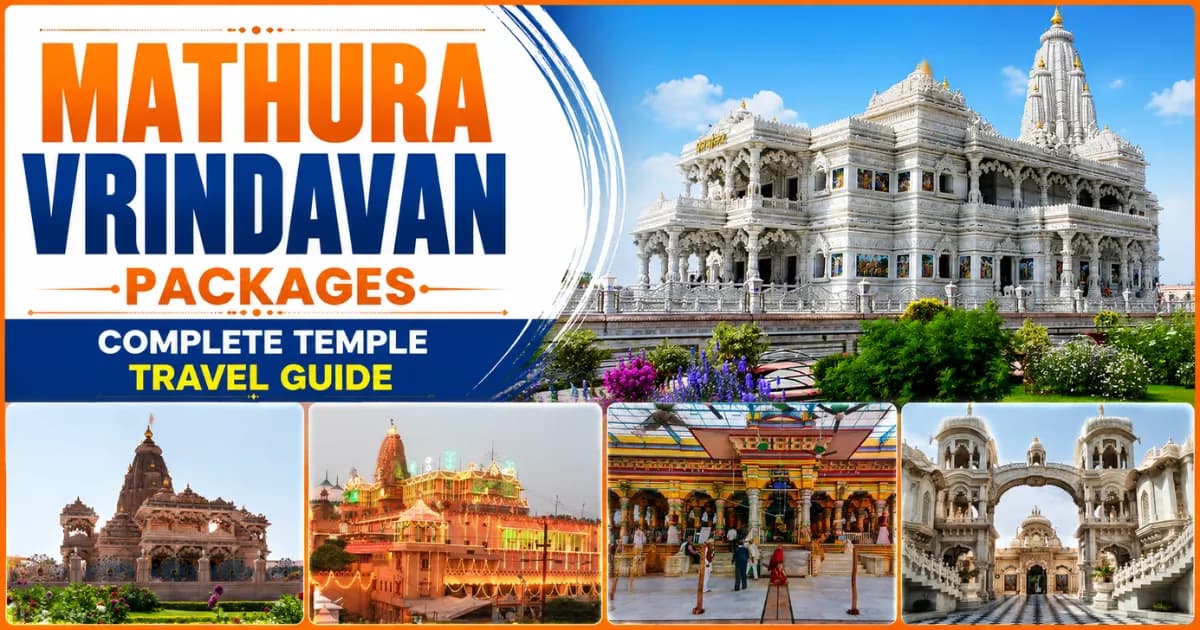
Vrindavan has thousands of temples, but the essential list is: Banke Bihari, Prem Mandir, ISKCON, Radha Raman, Radha Vallabh, Govind Dev Ji, Madan Mohan, Rangaji and Nidhivan. In nearby Mathura: Krishna Janmabhoomi, Dwarkadhish and Vishram Ghat. Most highlights cluster within a few kilometres.
Vrindavan's temples do not work like tourist sites. They are living places of worship with afternoon closures (12:00 PM–4:00 PM for most), strict photography rules, and different queue patterns at different hours. A pilgrim who arrives at Banke Bihari at 2:00 PM finds it shut. Someone who carries a phone inside Krishna Janmabhoomi has it confiscated. And a group that tries to cover 8 temples in 6 hours ends up rushing through all of them and connecting deeply with none.
The city's inner lanes - particularly around Banke Bihari and Loi Bazaar - are less than 4 metres wide in places, shared by pilgrims, e-rickshaws, and cows. What Google Maps shows as a 10-minute walk between two temples regularly takes 25–30 minutes with temple shoe-counter queues and lane congestion factored in. At Experience My India, every itinerary is built around darshan flow rather than map distance. Call +91-7302265809 before finalising your temple visit plan - even five minutes on the phone prevents the most common mistakes.
Fix: Build your day in two blocks: a morning block (7:00 AM–12:00 PM) and an evening block (4:30 PM–9:00 PM). Use the 12:00–4:30 PM window for lunch, Yamuna Ghat walks, and travel between Mathura and Vrindavan. This structure alone eliminates the three most common timing mistakes.
The Essential Vrindavan Temple List - With Facts for Each Temple
Below is the complete list of major temples in Vrindavan with the specific, verifiable details that distinguish each one.
1. Banke Bihari Temple
Founded by Swami Haridas in the mid-1800s, Banke Bihari Temple is the most visited temple in Vrindavan - and among the most visited in all of India. The presiding deity is Lord Krishna in the Tribhanga (three-bend) posture, known here as Banke Bihari ("the one who stands in the bent posture and lives in Nidhivan").
The temple has two features found nowhere else in Braj: first, no bells or conch shells are ever sounded - a tradition rooted in the founding story of Swami Haridas, who believed the sudden sound would disturb the meditative atmosphere. Second, the curtain (parda) before the deity opens and closes every 2–3 minutes, rather than remaining open for continuous darshan. This practice is said to protect devotees from the intensity of Krishna's gaze. Photography and videography are strictly prohibited inside - enforcement is active, and phones are expected to remain in pockets from the entrance itself.
Summer timings: 7:45 AM–12:00 PM and 5:30 PM–9:30 PM. Winter timings: 8:30 AM–1:00 PM and 4:30 PM–8:30 PM.
2. Prem Mandir
Prem Mandir (Temple of Love) was built by Jagadguru Kripalu Maharaj and completed in 2012. The temple complex spans 54 acres and is built entirely of white Italian marble. It is one of the largest temple complexes in Vrindavan city.
The main sanctum enshrines Radha-Krishna, with a secondary shrine to Sita-Ram. The outer walls and interior pavilions are carved with scenes from the Ramayana and Bhagavatam. The temple's defining feature is its evening light show - coloured LEDs illuminate the marble exterior in changing patterns from 7:00 PM (summer) and 6:30 PM (winter). Photography is permitted in the outdoor garden areas but not inside the sanctum. Entry is free.
Timings: 5:30 AM–12:00 PM and 4:30 PM–8:30 PM.
3. ISKCON Krishna Balaram Mandir
The ISKCON Vrindavan temple, formally called Sri Krishna Balaram Mandir, was established in 1975 under the direction of Srila A.C. Bhaktivedanta Swami Prabhupada and inaugurated in his presence. It is the primary centre of the International Society for Krishna Consciousness in India.
The temple houses three pairs of deities: Radha-Shyamasundar (the original deities), Krishna-Balaram (the central altar), and Gaura-Nitai. The 4:30 AM Mangala Aarti is open to all visitors and draws hundreds of international devotees. The temple complex includes a guesthouse, a canteen serving ISKCON pedas made from the temple's own gau-shala milk, a cultural museum about Srila Prabhupada's life, and a large garden. Photography is permitted in garden areas but restricted during aarti inside the sanctum.
Timings: 4:30 AM–1:00 PM and 4:00 PM–8:30 PM.
4. Radha Raman Temple
Radha Raman Temple was established in 1542 by Gopal Bhatt Goswami, one of the Six Goswamis of Vrindavan who were direct disciples of Sri Chaitanya Mahaprabhu. The presiding deity, Radha Raman Ji, is among the rarest in Vrindavan - a self-manifested (svayam-prakash) deity that appeared from a shaligrama shila (sacred stone from the Gandaki River) in the presence of Gopal Bhatt Goswami on the full moon of Vaishakha month.
The akhand jyoti (perpetual flame) inside this temple has reportedly been burning continuously since 1542 - making it one of the oldest uninterrupted ritual fires in North India. Photography is absolutely prohibited; temple staff confiscate phones that are visibly raised. The deity of Radha Raman Ji has no separate Radha idol - a crown placed to the left of the deity represents Radharani's presence.
Timings: 7:30 AM–12:00 PM and 5:00 PM–9:00 PM (summer); 8:00 AM–12:00 PM and 4:30 PM–8:30 PM (winter).
5. Radha Vallabh Temple
Founded in 1585 by Hit Harivansh Goswami, Radha Vallabh Temple represents a distinct sampradaya (tradition) within Vaishnavism - one in which Radharani is the supreme deity, not a consort. The presiding deity is Radha Vallabh Ji (Krishna), but the worship is conducted entirely for Radha's pleasure. A crown placed beside the deity signifies Radharani's presence - as in Radha Raman, no separate Radha idol is installed.
The temple is one of the older structures in Vrindavan still in active worship on the site of its original founding. It is generally quieter and less crowded than Banke Bihari, making it a more contemplative darshan experience. Photography is prohibited inside.
Timings: 7:30 AM–11:30 AM and 5:00 PM–8:30 PM (summer); 8:00 AM–12:00 PM and 4:30 PM–8:00 PM (winter).
6. Govind Dev Ji Temple
Govind Dev Ji Temple was built in 1590 by Raja Man Singh of Amber (Jaipur) using red sandstone - the same stone used in the construction of Agra Fort and Fatehpur Sikri under Akbar. The original structure had seven storeys and was, at its time of construction, one of the tallest buildings in Braj. Emperor Aurangzeb ordered the top four storeys demolished in the 17th century; the remaining three-storey structure is what stands today.
The temple is historically significant as the original home of the Govind Dev Ji deity - whose murti was later moved to Jaipur's City Palace (where it still resides and is worshipped). The Vrindavan temple today houses a different form of Govind Dev Ji in its sanctum.
Timings: 5:30 AM–12:00 PM and 5:30 PM–8:30 PM.
7. Madan Mohan Temple
Madan Mohan Temple is among the oldest standing temple structures in Vrindavan. It was established in the early 16th century by Sanatana Goswami, the elder of the Six Goswamis, who placed the Madan Mohan deity on a small hillock (now called Dwadashaditya Tila) overlooking the Yamuna. The current brick structure dates to the 1580s, built with support from a Karori Seth (revenue officer) of Akbar's time after Sanatana Goswami's passing.
The Madan Mohan deity from this temple was also later moved to Karauli, Rajasthan, for protection during the Mughal period. The temple now houses a new Madan Mohan deity. It is located on the Vrindavan Parikrama route and is a mandatory stop on the 11 km circumambulation of the city.
Timings: 8:00 AM–12:00 PM and 4:00 PM–8:30 PM.
8. Rangaji Temple (Sri Ranganatha)
Rangaji Temple is the only major temple in Vrindavan built in the South-Indian Dravidian architectural style - making it architecturally unique in all of Braj. It was built in 1851 by a Marwari merchant family with origins in South India, dedicated to Sri Ranganatha (Vishnu reclining on Adishesha), which is an unusual deity for North India.
The temple has a 60-foot gopuram (entrance tower) decorated with stucco figures - a style more commonly associated with Tamil Nadu temples like Srirangam or Madurai Meenakshi. The complex also includes a gold flag-post and a large chariot used during the temple's annual Brahmotsavam festival. The festival's chariot procession through Vrindavan's lanes draws pilgrims from across India.
Timings: 7:00 AM–12:00 PM and 4:00 PM–8:00 PM.
9. Nidhivan
Nidhivan is not a temple in the conventional sense - it is a sacred grove of intertwined tulsi plants that the Vaishnava tradition identifies as the site of Lord Krishna's Raas Lila (divine dance) with the gopis. The grove contains over 16,000 plants, each of which is considered a gopi-form.
The grove is associated with Swami Haridas (guru of the legendary court musician Tansen) and with the discovery of the Banke Bihari deity through Haridas's devotional singing here. The strict rule of Nidhivan: no human or animal - including pigeons and monkeys - is permitted inside after sunset. Temple priests conduct a closing ritual daily before dark, sealing the gates. The grove is accessible from 5:00 AM until evening closure (approximately 7:00 PM in summer, 6:00 PM in winter). Photography is heavily restricted inside; visitors frequently report cameras and phones being asked to be put away by the caretaker priests.
10. Shahji Temple
Shahji Temple was built in 1876 by Seth Shah Kundan Lal of Lucknow - a gem merchant - and is considered one of the most architecturally elaborate temples in Vrindavan from the 19th century. It is known for two features: the Belgian-glass chandeliers that hang inside the sanctum (unusual in any North Indian temple of this era) and the spiral white marble pillars (called chiknaye khambhe - smooth, twisting columns) of which 12 stand in the inner prayer hall. The presiding deity is Chhote Radha Raman Ji.
Timings: 8:00 AM–12:00 PM and 5:00 PM–8:30 PM. Rarely crowded - a good option for pilgrims who want quieter darshan after the main circuit.
Additional Temples Worth Noting
Jaipur Temple (Radha Madhav Ji): Built by the royal family of Jaipur. Known for white marble architecture and the evening arati conducted with elaborate floral decorations. Located near ISKCON road.
Pagal Baba Temple (Shri Ram Janaki Temple): Recognisable by the many-storeyed structure visible across Vrindavan. Multi-deity temple complex with significant local following.
Seva Kunj (Nidhuban): An ancient grove adjacent to Nidhivan, considered equally sacred. The central pavilion (kunj) is associated with the divine Raas Lila. Accessible only in daylight.
Radha Damodar Temple: Established in 1542 by Jiva Goswami, another of the Six Goswamis. Contains one of the most important Vaishnava libraries in Vrindavan and the samadhi (tomb) of Srila Prabhupada's guru, Srila Bhaktisiddhanta Sarasvati.
Major Temples in Mathura - The Companion List
Mathura is 12 km from Vrindavan - approximately 30–40 minutes by auto-rickshaw or e-rickshaw. Most pilgrims combine both cities on the same day. The following are the primary temples and sacred sites in Mathura city.
Site | What It Is | Key Fact | Entry |
Krishna Janmabhoomi (Shri Krishna Janmasthan) | Birthplace complex of Lord Krishna | Mobile phones and all electronics must be deposited in the cloak room before entry - no exceptions | Free darshan; paid ₹100 premium section |
Dwarkadhish Temple | Primary active Pushti Marg temple in Mathura | Built in 1814 by Seth Gokuldas Parikh. Deities of Dwarka-Naresh Krishna and Radharani installed by Vallabhacharya sampradaya. Elaborate sewa timings. | Free |
Vishram Ghat | Sacred ghat on the Yamuna, not a temple | The traditional spot where Lord Krishna rested (vishram = rest) after defeating Kansa. Yamuna aarti held daily at sunrise and sunset. Boat rides available - ₹50 per person. | Free |
Gita Mandir | Temple established by Birla group | Large temple complex housing a pillar inscribed with the complete Bhagavad Gita text. Located 3 km from the city centre. | Free |
Birla Temple (Lakshmi Narayan Mandir) | Modern Birla-built temple | White marble; dedicated to Lakshmi-Narayan. Well-maintained with clean grounds. | Free |
Kans Qila | Historic fort associated with King Kansa | Archaeological remains with a view of the Yamuna. More historical-interest than active pilgrimage. | Small fee |
Note: At Krishna Janmabhoomi, the cloak room queue adds 15–25 minutes to your visit. Do not arrive at 11:30 AM expecting to complete darshan before the 12:00 PM closure - factor in 45–60 minutes minimum including security and the cloak room.
Fix: Experience My India structures the Mathura circuit as follows - Vishram Ghat at sunrise (6:00–6:30 AM), then Krishna Janmabhoomi (7:00–9:00 AM before the queue peak), then Dwarkadhish (9:30–11:00 AM), then travel to Vrindavan for the afternoon. This sequence respects the queue patterns at each site. Call +91-7302265809 to receive the full Mathura morning itinerary.
How to Group the Temples for an Efficient Visit
The temples of Vrindavan fall into three natural geographic clusters. Understanding these clusters eliminates most of the backtracking that first-time visitors experience.
Old Vrindavan (Walking Zone) Temples: Banke Bihari, Radha Raman, Radha Vallabh, Nidhivan, Seva Kunj, Radha Damodar
These temples are within walking distance of one another in the old city lanes. The walking circuit covers approximately 1.5–2 km but takes 2–3 hours because of narrow lanes, shoe counters, and queue time. Private vehicles cannot enter most of these lanes - e-rickshaw or walking only. This cluster is best done in the morning darshan block (7:00–11:30 AM).
New Vrindavan (E-Rickshaw or Short Drive) Temples: Prem Mandir, ISKCON Krishna Balaram, Rangaji, Shahji Temple
These temples are on or near the wider roads of Vrindavan and are accessible by e-rickshaw or private vehicle. Prem Mandir and ISKCON together take 2–3 hours. This cluster works well in the evening block (4:30–9:00 PM), with Prem Mandir's light show as the natural conclusion.
Govardhan Area (Day Trip or Add-On) Temples: Govind Dev Ji, Madan Mohan (these are also in old Vrindavan and fit Cluster A); Govardhan Hill - Daan Ghati, Manasi Ganga, Radha Kund (22 km from Vrindavan - best as a dedicated half or full day)
Recommended Sequence for a Single Day in Vrindavan: 6:30–7:00 AM - Nidhivan (morning, before the day's heat) 7:00–9:30 AM - Banke Bihari + Radha Raman + Radha Vallabh (walking circuit, morning block) 9:30–11:30 AM - Madan Mohan + Govind Dev Ji (e-rickshaw, 10 minutes) 12:00–4:00 PM - Lunch, rest, Keshi Ghat walk (afternoon closure) 4:30–6:30 PM - ISKCON + Rangaji (e-rickshaw) 6:30–8:30 PM - Prem Mandir light show
For a guide who knows exactly which temple lanes are walkable on which days, which shoe counter moves fastest, and which queue at Banke Bihari to use for the shortest wait, explore Experience My India's Mathura Vrindavan Same Day Tour By Car - or call +91-7302265809 to plan the sequence for your group.
Ground Truth - What Nobody Tells You Before Your First Temple Circuit
After guiding 50,000+ pilgrims through this circuit since 2018, here are the five realities that most online guides skip:
Shoe counters add 15–20 minutes to every temple visit - and they are mandatory. The shoe counter outside Banke Bihari is the busiest single bottleneck in all of Vrindavan. On festival days, it adds 30–40 minutes per temple visit. When planning 4–5 temples in a morning, factor this time in - ten temples in one day means 2–3 hours of shoe counter time alone, leaving almost nothing for actual darshan.
Banke Bihari's photography ban is enforced, not aspirational. Temple guards are posted specifically to watch for raised phones. Visitors who raise their phone inside - even briefly - are asked to leave. There is no warning system. Experience My India briefs every guest on this before entering the Loi Bazaar lane, not at the gate.
The Radha Raman flame has burned since 1542 - but the original deity is not here. Like Govind Dev Ji and Madan Mohan, the original Radha Raman deity was moved from Vrindavan to Jaipur during the Mughal period for safekeeping. The current deity in Vrindavan is a pratibhu murti (representative form), but the worship lineage is unbroken. Knowing this history changes how you understand the temple.
Nidhivan after dark is not a dramatic risk - it is a real rule. The grove is sealed by temple priests before sunset every single day. No exception is made for tourists, researchers, or even local Vrindavan residents. The rule is followed because of strong local tradition, not just signage. Experience My India schedules all Nidhivan visits in the early morning (before 8:00 AM) to give maximum time inside without any pressure from the closing routine.
The Rangaji Brahmotsavam festival chariot is one of the most photographed events in Vrindavan - and almost no general-interest travel guide mentions it. The 10-day festival happens once a year (usually in February or March by the Vaishnava calendar), and the chariot procession through Vrindavan's main roads draws thousands. If your travel dates overlap with Brahmotsavam, Experience My India will reroute your temple sequence to incorporate it - call +91-7302265809 to check your dates.
KNOW BEFORE YOU PLAN
Before booking your Vrindavan temple circuit, here are the things the Experience My India team wants every pilgrim to know - the practical facts that turn a frustrating visit into a smooth one:
Vrindavan's inner lanes prohibit private vehicles - once your cab drops you at the city boundary, travel is on foot or by e-rickshaw only. Plan your temple sequence with this in mind; trying to jump between Cluster A (old Vrindavan) and Cluster B (new Vrindavan) more than once in a day adds unnecessary transit time. Experience My India pre-coordinates all e-rickshaws for tour groups so no time is lost negotiating at the roadside.
All major temples close between 12:00 PM and 4:00 PM (some until 4:30 or 5:00 PM) - arriving at Banke Bihari at 1:30 PM means standing outside for 3–4 hours. Plan to complete your Cluster A temples before noon, rest during the closure, and resume the Cluster B circuit after 4:30 PM.
Electronics are banned inside Krishna Janmabhoomi in Mathura - this includes mobile phones, smartwatches, and cameras. The cloak room has its own queue (15–25 minutes). If you are planning Mathura on the same day as Vrindavan, schedule Krishna Janmabhoomi in the early morning (7:00–9:00 AM) so the cloak room wait does not eat into your Vrindavan afternoon.
Monkeys in the Loi Bazaar and Nidhivan areas actively snatch spectacles, open food bags, and occasionally mobile phones - this is a daily occurrence, not an occasional one. Keep prescription glasses on a strap or in a zipped case, and keep all food inside sealed bags. If a monkey takes something, remain calm and offer a Mango Frooti - do not chase or shout.
Shoe counters are outside every temple, not inside - remove footwear before you reach the counter, not at it. Wearing easy-slip sandals rather than lace-up shoes saves 3–5 minutes per temple, which adds up over a 6-temple day.
Dress code is mandatory, not advisory - shorts, sleeveless tops, and short dresses are turned away at temple entrances. Light cotton kurta or salwar kameez is practical for the walking distances and summer heat. Traditional clothing is available near the city boundary for ₹150–₹300 if you arrive unprepared.
The Prem Mandir light show is specifically 7:00 PM in summer and 6:30 PM in winter - many pilgrims arrive too early or too late. Arriving at Prem Mandir by 6:45 PM (summer) or 6:15 PM (winter) secures a good garden position before the lights begin.
Experience My India plans every Vrindavan temple circuit around these exact realities - temple cluster routing, e-rickshaw coordination, shoe counter timing, photography rules, and monkey zones are all built into every tour schedule. Call +91-7302265809 before you finalise your visit - even five minutes on the phone can prevent a full day going sideways.
CONCLUSION
The vrindavan temple list is not just a catalogue - it is a route map. Knowing that Radha Raman was founded in 1542 and that its flame has burned uninterrupted since then, or that Govind Dev Ji lost four of its seven storeys to Aurangzeb's orders, or that Rangaji has a gopuram more at home in Tamil Nadu than North India - these are the facts that transform a temple visit from a tick on a list into an experience that stays with you.
If you would rather navigate this list with a guide who has walked every lane of Vrindavan for over a decade - who knows which morning to avoid Banke Bihari because of a festival crowd surge, and which shoe counter moves fastest before 9:00 AM - that is exactly what Experience My India is here for. We have done this 50,000+ times since 2015.
📲 Plan Your Vrindavan Temple Tour with Experience My India. 👉 WhatsApp Us Now
Same Day Temple Tour: From ₹1,999 per group · 2-Day Package: From ₹4,999 per person Rated 4.5★ by 204+ pilgrims on Google.
Explore all packages: Mathura Vrindavan Tour Packages
Jai Shri Krishna 🙏
Gurudutt — Born & Raised in Braj Bhoomi
Guiding pilgrims through Mathura & Vrindavan since 2018 · 50,000+ pilgrims served