📌 QUICK ANSWER
Tatiya Sthan is an ashram of the Haridasi sampradaya in Vrindavan with no electricity, no photography and no mobile phones, open daily in a late morning and an evening session, where the traditional samaj gayan is sung in the early evening. Entry is free. Because there is no electricity, the evening session carries on past sunset by lamplight, and that is the hour worth coming for. Come in silence, walk barefoot on the white sand, and understand you are a guest in someone's life, not a visitor to an attraction. To book, call or WhatsApp +91 7302265809.
Key takeaways
Open daily in two sessions, late morning and evening. Entry is free and nothing is sold here.
Samaj gayan, the traditional devotional singing, is held daily in the early evening.
No electricity, no bulbs, no fans. Lamps are lit after sunset, as they always have been.
No photography inside, and no mobile phones. This is not negotiable, and it is the whole point.
It is the ashram of the Haridasi sampradaya, the lineage of Swami Haridas, who revealed Banke Bihari.
I am Gurudutt, born in Gokul, in the heart of Braj, guiding pilgrims since 2018. There is a place in Vrindavan that most visitors never find, and a good number of those who do find it should not have come, because they arrived with a camera and a loud voice. Tatiya Sthan is not a sight. It is a living ashram where men have given up the world to sing to Radha and Krishna, and they have kept it exactly as it was while the town around them filled with wires and horns and hoardings. I will tell you what it is, and I will tell you how to behave there, because the second matters more than the first. Plan your Braj yatra with our Mathura Vrindavan tour packages or message WhatsApp +91 7302265809.
What Tatiya Sthan is
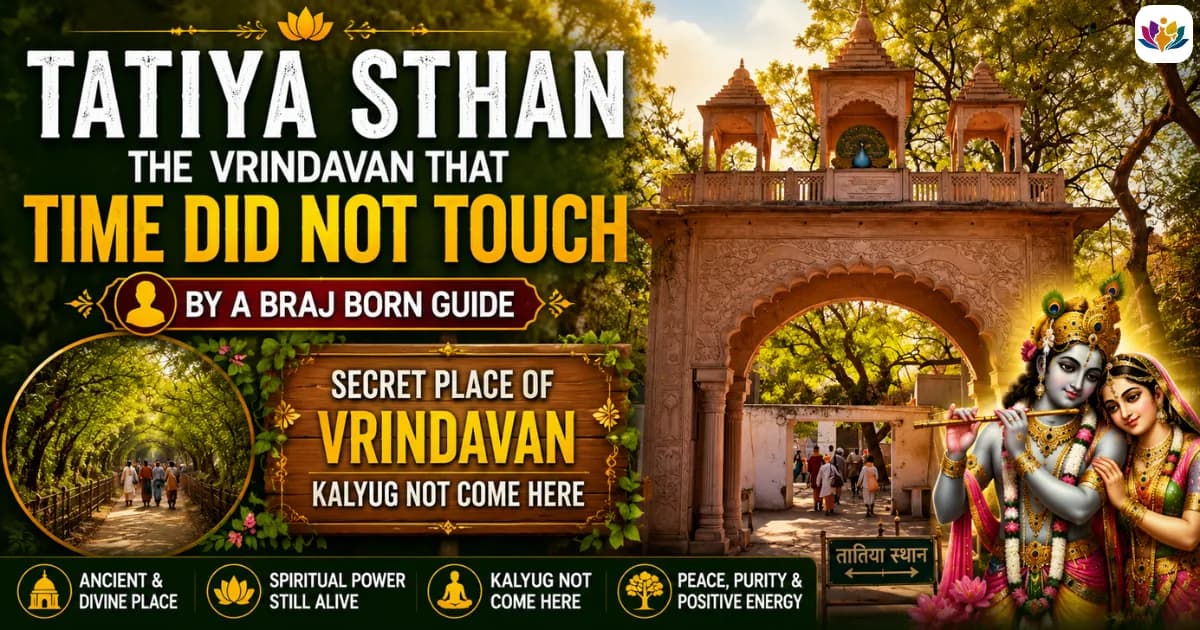
Tatiya Sthan is an ashram of the Haridasi sampradaya, hidden in the lanes of Vrindavan, where renunciate sadhus live and sing. It has no electricity. Not a bulb, not a fan, not a camera on the wall. When the sun goes down, lamps are lit, as they have been for centuries. The ground is white sand, walked barefoot. The trees are the old trees of Braj, neem and peepal and kadamb. The presiding deity is Shri Radhika Mohini Bihari Ji, and the place is also known as Mohini Nikunj. Devotees say Kali Yuga never entered here, and when you stand in it, you understand why they say so. For the wider devotional order of Braj that this belongs to, see our mathura vrindavan darshan guide.
Why it is called Tatiya Sthan
The name is beautifully plain. Swami Lalit Kishori Dev Ji, the seventh acharya of the Haridasi lineage, left Nidhivan to meditate alone under a peepal tree in what was then wild jungle at the edge of Vrindavan. His disciples, Choube Ji Gokulchand and Shyam Ji Choube, feared for him among the wild animals, and so they built a fence of bamboo around him while he sat in meditation. In the Braj dialect, bamboo sticks are called tatiya. So the place became Tatiya Sthan, the place of the bamboo fence: named not for a temple or a king or a miracle, but for the simple act of some devotees putting up a fence to keep their guru safe. That is the character of the place, and it has never changed.
The lineage: Swami Haridas and the eight acharyas
Tatiya Sthan belongs to the sampradaya of Swami Haridas, the first acharya, one of the towering figures of Braj. He was the guru of Tansen, and Akbar himself is said to have come to Vrindavan to hear him sing. The lineage runs through eight acharyas: Swami Haridas, then Vitthal Vipul Dev, Biharini Dev, Saras Dev, Narhari Dev, Rasik Dev, Lalit Kishori Dev, and finally Lalit Mohini Dev. Swami Lalit Kishori Dev Ji, the seventh, established this place, composed a great body of devotional verse, and his samadhi is here. This is not a museum of that lineage. It is the lineage, still living, still singing, in the same sand.
The connection to Banke Bihari and Nidhivan
Here is what makes Tatiya Sthan matter to every pilgrim, even those who never visit it. Swami Haridas did his bhajan at Nidhivan, and it was to him that Radha and Krishna are said to have appeared and merged into a single form: the deity now worshipped as Banke Bihari, before whom hundreds of thousands press each year. So the crowds at Banke Bihari, the queues, the crush, all of it flows from the devotion of the man whose lineage still sings quietly in this sandy grove that almost nobody visits. Our nidhivan vrindavan timings guide covers the grove where he sang, and our banke bihari temple timing guide covers the temple that came from it. Tatiya Sthan is the third point of that triangle, and the quietest.
No electricity, no phones, no photographs
Understand these rules before you go, because they are the soul of the place and not an inconvenience to be worked around. There is no electricity in the ashram: no lights, no fans, no electrical anything, by deliberate and unbroken choice, on the principle that the divine is served by simplicity rather than by machines. During aarti, the fan over the deity is worked by hand, pulled with a rope, as it was three hundred years ago. Mobile phones are not permitted. Photography inside is not permitted, at all. You may photograph outside if you wish; inside, you put the camera away and you use your eyes. I have watched visitors argue about this at the entrance, and I have been ashamed for them. If you cannot spend twenty minutes somewhere without photographing it, that is a fact about you, not about the ashram.
What you will actually find inside
White sand underfoot, and you walk it barefoot. Old trees, the ones dear to Krishna: neem, peepal, kadamb, jamun. Simple huts where sadhus live. The deity, Shri Radhika Mohini Bihari Ji. The samadhi of Swami Lalit Kishori Dev Ji. Monkeys, plenty of them, so guard your glasses. Silence, mostly, or the sound of bhajan. Men who have given away everything, faces marked with sandalwood, moving slowly about their day, who are not performing for you and will not notice you much. Water drawn from a well. No shop, no ticket counter, no donation pressure, no guide with a microphone. It is the plainest place in Vrindavan and, for many who find it, the one they remember longest.
Samaj gayan, not aarti
This is the detail that tells you what kind of place this is, and it is also the reason to time your visit properly. At Tatiya Sthan, the devotees do not perform aarti and puja in the way you will see at the great temples. Instead they sit together and hold samaj gayan: the traditional collective devotional singing of Braj, in which they sing the pads composed by the acharyas of their own lineage, verses written by Swami Haridas and Lalit Kishori and the rest. It happens daily, in the early evening, at the start of the evening session, as set out in the table below. It is not a performance and it is not for you. It is the sampradaya doing what it has always done, as it has done for centuries, whether or not anyone comes to listen. If you are permitted to sit and listen, sit down, be quiet, and understand that you have been given something. Do not record it. Do not photograph it. Just listen.
Radha Ashtami at Tatiya Sthan
The great day here is Radha Ashtami, and there is a beautiful reason. The appearance day of Swami Haridas himself is celebrated on Radha Ashtami, and so while all Braj turns toward Barsana for Radha Rani's appearance, this quiet ashram fills with devotees celebrating both. On that day, the sacred relics of Swami Haridas, his kharaun and his utensils, are brought out for darshan, and pilgrims come from across the country to see them. It is the one day in the year when Tatiya Sthan is not hidden. Radha Ashtami 2026 falls on Saturday 19 September, and our radha ashtami 2026 guide covers the festival across Braj.
Location, timings and entry
Tatiya Sthan is at Goda Vihar, Vrindavan, Uttar Pradesh 281121, near the parikrama marg. It sits in the old lanes, so a car cannot reach the door and you finish on foot or by e rickshaw. Entry is completely free, as it is everywhere in Braj, and nothing is sold to you here.
Detail | Information |
Address | Goda Vihar, Vrindavan, Uttar Pradesh 281121 |
Morning session | 10:30 AM to 12:30 PM |
Evening session | 5:00 PM to 8:00 PM |
Open on | All seven days, Monday to Sunday |
Samaj gayan | Daily, in the early evening, roughly 5:00 PM to 6:30 PM |
After sunset | The ashram goes dark and is lit by lamps |
Entry fee | Free. Nothing is sold here. |
Photography | Not permitted inside. Permitted outside only. |
Mobile phones | Not permitted inside. |
Timings can vary on festival days and by season. Confirm locally before you go. Note that the ashram has no electricity, so the later part of the evening session is by lamplight.
How to behave: the rules that matter
Leave your camera in your bag and your phone switched off. This is not a photo opportunity.
Do not talk. The advice given by everyone who knows this place is: sit, be silent, and simply feel it.
Remove your footwear and walk the sand barefoot. It is part of the place, not a rule to endure.
Do not disturb the sadhus. They are living their lives, not staffing an attraction.
Do not treat the samaj gayan as a performance. Sit, listen, and do not record it.
Guard your glasses and belongings from the monkeys, who are numerous and quick.
Give nothing under pressure, because nobody will pressure you. There is no ticket and no tout here.
Should you go at all?
I will answer this more honestly than is good for my business. If you are coming to Vrindavan for two days and want to see the famous temples, do not squeeze Tatiya Sthan in. It will mean nothing to you at a jog, and your presence will cost the sadhus something. But if you have three days or more, and if the crowds have tired you, and if some part of you came to Braj looking for something quieter than a queue, then go, and go in the evening for the samaj gayan rather than at midday. Sit on the sand under the peepal, say nothing, and stay as the lamps are lit. It is free, it asks nothing of you, and it will give you more than a photograph ever could. Our mathura vrindavan itinerary guide shows where it fits in a longer plan.
Why Experience My India is the right choice
I was born in Gokul Mahaban Bangar and I have guided Braj since 2018: more than 50,000 pilgrims, 4.5 stars across 204 Google reviews. We are WhatsApp first, 8 AM to 9 PM daily. For a place like this, what a guide owes you is not access but preparation: we tell you the rules before you arrive, we bring you at the hour when you can actually sit and be still, and we will tell you honestly if your trip is too short for it to mean anything. We take pilgrims to Tatiya Sthan; we do not take tourists there. To see options, visit our Mathura Vrindavan Tours page, and to plan a slower trip, our how to plan a mathura vrindavan trip guide.
Tip from Gurudutt: come for the evening session, arrive as the samaj gayan begins, and do not leave when it ends. Stay on. Because there is no electricity here, you will sit on the white sand and watch the daylight drain out of the grove, and then the lamps will be lit, one by one, and the singing and the darkness and the flames will be the only things in the world. Every other visitor will have gone home for their dinner. I have seen people weep at that hour who did not know they were the weeping kind.
Ready to see the Vrindavan most visitors miss?
Tell me your dates and days, and I will build you a trip with room in it for the quiet places, not only the famous ones. Browse our Mathura Vrindavan Tour Package or WhatsApp +91 7302265809 · 8 AM to 9 PM daily · 4.5 stars from 204 Google reviews · Born in Gokul, Mathura.
Related guides
Book Your Mathura - Vrindavan Trip Today 📞 +91-7302265809 💬 WhatsApp: +91-7302265809 Packages start from ₹1,999/ person | Rated 4.5★ / 204+ Reviews Explore all: Mathura Vrindavan Tour Package Jai Shri Krishna 🙏 |
Gurudutt — Born & Raised in Braj Bhoomi
Guiding pilgrims through Mathura & Vrindavan since 2018 · 50,000+ pilgrims served