📌 QUICK ANSWER
The Shri Krishna Ashtakam ('Bhaje Vrajaika Mandanam') is a beloved Sanskrit hymn of eight verses (with a ninth, closing verse) praising Lord Krishna as the ornament of Vraja, the destroyer of sins, the flute-playing lord of the Vrindavan groves, the lifter of Govardhan and the thief of hearts. Each verse ends with 'namami' ('I bow'). The full lyrics are given below in Hindi and English, with meanings. To chant it in Krishna's own Braj, call or WhatsApp +91 7302265809.
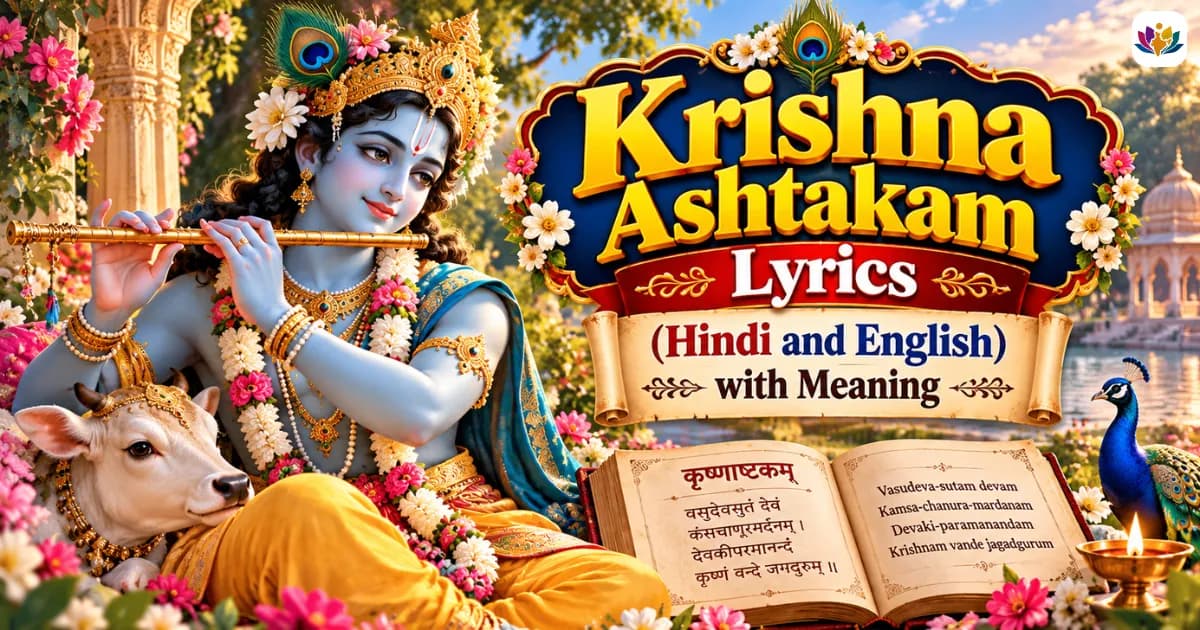
The Shri Krishna Ashtakam, beginning 'Bhaje Vrajaika Mandanam', is one of the most beautiful Sanskrit hymns to Lord Krishna, a garland of eight verses (ashtakam) that adore him as the very ornament of Vraja, the flute-player of the groves, the thief of hearts and the beloved of Braj. Rich in the imagery of Vrindavan, it is a joy to chant. Here, from one born in Braj, are the full Krishna Ashtakam lyrics in Hindi (Devanagari) and English, with the meaning of each verse. Plan your visit with our Mathura Vrindavan tour packages.
Key takeaways
The Krishna Ashtakam ('Bhaje Vrajaika Mandanam') is a Sanskrit hymn of eight verses to Krishna.
It adores Krishna as the ornament of Vraja and the flute-playing lord of the Vrindavan groves.
Its imagery is deeply of Braj: the kunj (groves), the gopis, the cows, Govardhan, the Yamuna.
Each verse ends with 'namami', 'I bow (to Krishna)'.
A ninth, closing verse (phala-shruti) gives the blessing of reciting it.
The full lyrics are given below in Hindi (Devanagari) and English, with meanings.
I am Gurudutt, born in Gokul in the Mathura district, in the very Vraja this hymn adores. Guiding pilgrims since 2018, more than 50,000 of them, I love the Krishna Ashtakam, for every verse sings of my own land, the groves, the cows, the flute, the lord of the kunj. Here are its full lyrics, in Hindi and English, with the meaning of each verse, so you may chant it and know him better.
About the Krishna Ashtakam
The Krishna Ashtakam, 'the eight verses (ashtakam) to Krishna', is a classical Sanskrit stotra, traditionally attributed to Adi Shankaracharya, beginning with the words 'Bhaje Vrajaika Mandanam', 'I worship the sole ornament of Vraja'. (There are a few different hymns called Krishna Ashtakam; this is the beloved 'Bhaje Vrajaika Mandanam' one.) What makes it so dear is that it is steeped in the imagery of Braj: it adores Krishna not as a distant god but as the enchanting cowherd boy of Vrindavan, with his peacock-feather crown and his flute, moving among the groves and the gopis and the cows. Each verse builds a loving portrait and ends with 'namami', 'I bow to him'. To chant it is to bow, again and again, to the beautiful Lord of Vraja.
Krishna Ashtakam lyrics with meaning
Here are all the verses of the Krishna Ashtakam, each in Hindi (Devanagari), then English transliteration, then its meaning.
भजे व्रजैकमण्डनं समस्तपापखण्डनं स्वभक्तचित्तरंजनं सदैव नन्दनन्दनम् | सुपिच्छगुच्छमस्तकं सुनादवेणुहस्तकं अनंगरंगसागरं नमामि कृष्णनागरम् || १ || Bhaje vrajaika-maṇḍanaṁ samasta-pāpa-khandaṇaṁ Svabhakta-chitta-ranjanaṁ sadaiva nandanandanaṁ | Supiccha-gucchamastakaṁ sunāda-veṇu-hastakaṁ Ananga-raṅga-sāgaraṁ namāmi kṛiṣṇa-nāgaram || 1 || Meaning: I worship the sole ornament of Vraja, the destroyer of all sins, who ever delights the hearts of his devotees, the eternal son of Nanda; who wears a cluster of lovely peacock feathers on his head and holds the sweet-sounding flute in his hand, an ocean of the play of love, I bow to Krishna, the charming one. |
मनोजगर्वमोचनं विशाललोललोचनं विधूतगोपशोचनं नमामि पद्मलोचनम् | करारविन्दभूधरं स्मितावलोकसुन्दरं महेन्द्रमानदारणं नमामि कृष्णावारणम् || २ || Manoja-garva-mochanaṁ viśāla-lola-lochanaṁ Vidhūta-gopa-śochanaṁ namāmi padma-lochanam | Karāra-vinda-bhūdharaṁ smitāva-loka-sundaraṁ Mahendra-māna-dāraṇaṁ namāmi kṛiṣṇā-vāraṇam || 2 || Meaning: I bow to the lotus-eyed Lord who shatters the pride of Cupid, with large, restless eyes, who dispels the sorrows of the cowherds; who lifted the hill (Govardhan) on his lotus hand, beautiful with his smiling glance, who broke the pride of Indra, I bow to Krishna, the noble protector. |
कदम्बसूनकुण्डलं सुचारुगण्डमण्डलं व्रजांगनैकवल्लभं नमामि कृष्णदुर्लभम् | यशोदया समोदया सगोपया सनन्दया युतं सुखैकदायकं नमामि गोपनायकम् || ३ || Kadamba-sūna-kuṇḍalaṁ suchāru-ghaṇḍa-maṇḍalaṁ Vrajāṅga-naika-vallabhaṁ namāmi kṛiṣṇa-durlabham | Yaśodayā samodayā sagopayā sanandayā Yutaṁ sukhaika-dāyakaṁ namāmi gopa-nāyakam || 3 || Meaning: I bow to Krishna, so hard to attain, with earrings of kadamba flowers and lovely cheeks, the one beloved of the women of Vraja; who, amid the joyful Yashoda, the gopis and Nanda, is the giver of all happiness, I bow to the leader of the cowherds. |
सदैव पादपंकजं मदीय मानसे निजं दधानमुक्तमालकं नमामि नन्दबालकम् | समस्तदोषशोषणं समस्तलोकपोषणं समस्तगोपमानसं नमामि नन्दलालसम् || ४ || Sadaiva pāda-pankajaṁ madīya mānase nijaṁ Dadhāna-mukta-mālaṁ namāmi nanda-bālakam | Samasta-doṣa-śoṣaṇaṁ samasta-lokapoṣaṇaṁ Samasta-gopa-mānaṁ namāmi nanda-lālasam || 4 || Meaning: I bow to the child of Nanda, whose lotus feet I ever hold as my own within my mind, who wears a garland of pearls; who dries up all faults and nourishes all the worlds, who dwells in the minds of all the cowherds, I bow to the beloved darling of Nanda. |
भुवो भरावतारकं भवाब्धिकर्णधारकं यशोमतीकिशोरकं नमामि चित्तचोरकम् | दृगन्तकान्तभंगिनं सदा सदालिसंगिनं दिने दिने नवं नवं नमामि नन्दसम्भवम् || ५ || Bhuvo bharāvatārakaṁ bhavābdhi-karna-dhārakaṁ Yaśomatī kishorakaṁ namāmi chittachorakam | Dṛganta-kānta bhaṅginaṁ sadā sadāli-sanginaṁ Dine dine navaṁ navaṁ namāmi nanda-saṁbhavam || 5 || Meaning: I bow to the thief of hearts, who descends to relieve the earth of its burden, the helmsman across the ocean of worldly existence, the youth of Yashoda; whose sidelong glances are charming, ever in the company of his beloved friends, appearing newer and newer day by day, I bow to the one born in Nanda's home. |
गुणाकरं सुखाकरं कृपाकरं कृपापरं सुरद्विषन्निकन्दनं नमामि गोपनन्दनम् | नवीनगोपनागरं नवीनकेलिलम्पटं नमामि मेघसुन्दरं तडित्प्रभालसत्पटम् || ६ || Guṇākaraṁ sukhākaraṁ kṛpākaraṁ kṛpāparaṁ Sura-dviṣanni-kaṁdanaṁ namāmi gopa-nandanaṁ | Navīna-gopa-nāgaraṁ navīna-keḷi-laṁpaṭaṁ Namāmi megha-sundaraṁ taḍitpra-bhāla-satpaṭam || 6 || Meaning: I bow to the delight of the cowherds, a mine of virtues, a source of joy, a source of compassion, supremely merciful, the destroyer of the enemies of the gods; the ever-fresh charming lover of the cowherd-maidens, ever eager for new play, I bow to the one beautiful as a rain-cloud, whose garment shines like lightning. |
समस्तगोपनन्दनं हृदम्बुजैकमोदनं नमामि कुंजमध्यगं प्रसन्नभानुशोभनम् | निकामकामदायकं दृगन्तचारुसायकं रसालवेणुगायकं नमामि कुंजनायकम् || ७ || Samasta-gopa-nandanaṁ hṛdam-bujaika-modanaṁ Namāmi kunja-madhyagaṁ prasanna-bhānu-śobhanam | Nikāma-kāma-dāyakaṁ dṛganta-chāru-sāyakaṁ Rasāla-veṇu-gāyakaṁ namāmi kunja-nāyakam || 7 || Meaning: I bow to the delight of all the cowherds, the one joy of the lotus of the heart, who moves in the midst of the groves, radiant as the bright sun; who grants every desired boon, whose sidelong glance is a lovely arrow, who makes sweet music on the flute, I bow to the lord of the groves (kunj). |
विदग्धगोपिकामनोमनोज्ञतल्पशायिनं नमामि कुंजकानने प्रव्रद्धवन्हिपायिनम् | किशोरकान्तिरंजितं दृअगंजनं सुशोभितं गजेन्द्रमोक्षकारिणं नमामि श्रीविहारिणम् || ८ || Vidagdha-gopikā-mano-mano-jñatalpa-śāyiṇaṁ Namāmi kunja-kānane pravṛddha-vaṁhi-pāyinam | Kiśora-kānti-rañjitaṁ dṛgajan̄janaṁ suśobhitaṁ Gajendra-mokṣa-kāriṇaṁ namāmi śrī-vihāri-ṇam || 8 || Meaning: I bow to the one who reclines upon the lovely couch of the minds of the clever gopis, who, in the forest groves, swallowed the raging forest-fire to save his companions; radiant with the lustre of youth, beautiful with collyrium in his eyes, who granted liberation to Gajendra, I bow to Shri Vihari, the Lord of divine play. |
यदा तदा यथा तथा तथैव कृष्णसत्कथा मया सदैव गीयतां तथा कृपा विधीयताम् | प्रमाणिकाष्टकद्वयं जपत्यधीत्य यः पुमान भवेत्स नन्दनन्दने भवे भवे सुभक्तिमान || ९ || Yadā tadā yathā tathā tathaiva kṛiṣṇa-satkathā Mayā sadaiva gīyatāṁ tathā kṛpā vidhīyatām | Pramāṇi-kāṣṭaka-dvayaṁ japatya-dhītya yaḥ pumān Bhavetsa nandanandane bhave bhave subhaktimān || 9 || Meaning: Whenever and however it may be, may I always sing the holy stories of Krishna; grant me, O Lord, such grace. Whoever recites or studies this blessed ashtakam becomes, birth after birth, a true devotee of the son of Nanda. |
The meaning and beauty of the Krishna Ashtakam
The Krishna Ashtakam is a garland of loving images. Verse by verse it gazes at Krishna, the peacock-feather crown and the flute, the lotus eyes and the smiling glance, the kadamba earrings and the pearl garland and sets each before the Lord with a bow, 'namami'. But it never forgets who he is and where he is: this is Krishna of Vraja, the ornament of Braj, moving among the groves (kunj), the cows and the cowherds, lifting Govardhan, charming the gopis, playing his flute by the Yamuna. It weaves his great deeds (lifting the hill, humbling Indra, freeing Gajendra, swallowing the forest-fire) with his tender beauty, until the devotee sees him whole: mighty and sweet, cosmic and intimate, the Lord of all and the boy of Braj. The closing verse asks only one grace: that the devotee may always sing of Krishna and promises that whoever recites this hymn will love him, birth after birth.
The Krishna Ashtakam and Braj
No hymn is more of Braj than this one, for its very first words name Krishna the 'ornament of Vraja' and its imagery is the living landscape of this land. When it calls him the lord of the kunj (the groves), it means the groves of Vrindavan, where he danced; when it praises the hill he lifted, it means Govardhan; when it calls him the son of Nanda, it recalls his home at Gokul and Nandgaon; and its 'Shri Vihari', the Lord of play, is the very spirit of the beloved Banke Bihari of Vrindavan. So to chant the Krishna Ashtakam in Braj is to sing of the ornament of Vraja in Vraja itself, amid the very groves and hills it adores. We can arrange your pooja and seva at these holy places.
How and when to chant the Krishna Ashtakam
The Krishna Ashtakam may be chanted at any time, softly or aloud, alone or with others, as a daily devotion or a loving prayer. Many recite it in the morning or evening before Krishna or on his special days like Janmashtami. As the closing verse promises, whoever recites it with devotion becomes a lover of Krishna, birth after birth. There is no strict rule; the feeling is what matters and it is especially blessed to chant in Braj, the Vraja of its very first word.
The honest bit
Honest words from one born in Braj. There are, in fact, more than one Sanskrit hymn called 'Krishna Ashtakam'; this is the beloved 'Bhaje Vrajaika Mandanam' one, traditionally attributed to Adi Shankaracharya and the most Braj-centred of them. As with all old devotional texts, there are small variations between sources in a word, a spelling or the exact transliteration, so if another version differs slightly, do not worry, the devotion is the same. The meanings here are given in plain words to open the heart of each verse, not as a rigid translation; the Sanskrit is dense and layered and every phrase holds more than one line can carry. Chant it not to parse every word but to bow, with each 'namami', to the beautiful Lord of Vraja; and if you can, chant it here, in his own land, where every image of the hymn stands before your eyes.
Why Experience My India is the right choice
I was born in Gokul in the Mathura district, in the Vraja this hymn adores. Guiding since 2018, more than 50,000 pilgrims, 4.5 stars on Google, WhatsApp first, 8 AM to 9 PM daily. We take you through Braj to the very places the Krishna Ashtakam sings of, the groves, Govardhan, the Yamuna, the temples of Krishna, tell you the meaning on the ground, help you chant at the holy spots and arrange your seva, with no touts. One clear fare and never a charge for free darshan.
Tip from Gurudutt: learn the Krishna Ashtakam and then come and chant it where it belongs, in Vraja. Sing 'Bhaje Vrajaika Mandanam', 'I worship the ornament of Vraja', while standing in that very Vraja; bow with 'namami' before the flute-playing Lord of the kunj in the groves of Vrindavan; and feel the hill of Govardhan, which the hymn praises, rise before you. When the words of the hymn and the land they sing of become one, the stotra stops being a recitation and becomes a darshan; and that, to me, is the sweetest way to adore Krishna, the ornament of my own Braj.
Related guides
Barsana and Nandgaon: the twin villages of Radha and Krishna
Vrindavan and Govardhan: the temple town and the sacred hill
Explore more Braj guides
Plan your visit to the land of Vraja
Tell me your dates and I will plan your journey through Braj, the Vraja of the hymn, with a car, a guide born on this soil and your seva arranged, for one clear price. Our Mathura Vrindavan tour packages from Delhi and the NCR and our Mathura tour packages cover the heart of Braj. WhatsApp +91 7302265809, any day 8 AM to 9 PM. Packages from ₹1,999 per person, 4.5 stars on Google. Born in Gokul, Mathura.
Book Your Mathura - Vrindavan Trip Today 📞 +91-7302265809 💬 WhatsApp: +91-7302265809 Packages start from ₹1,999/ person | Rated 4.5★ / 204+ Reviews Explore all: Mathura Vrindavan Tour Packages Jai Shri Krishna 🙏 |
Gurudutt — Born & Raised in Braj Bhoomi
Guiding pilgrims through Mathura & Vrindavan since 2018 · 50,000+ pilgrims served