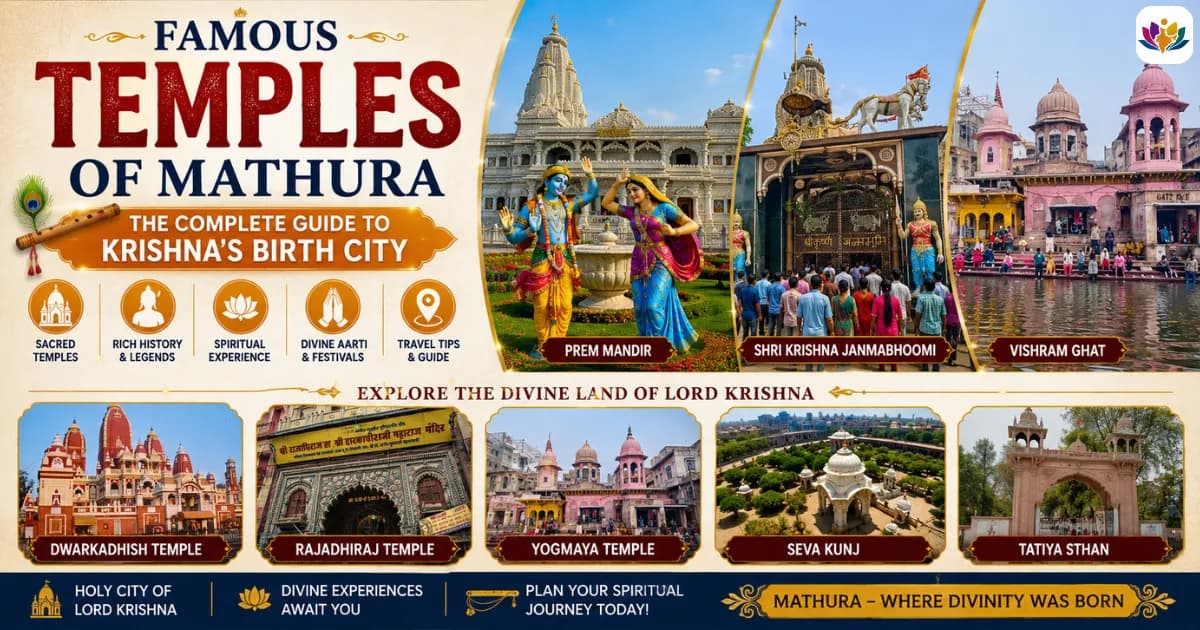
📌 QUICK ANSWER
The most famous temples of Mathura are the Krishna Janmabhoomi, marking Krishna’s birthplace; the Dwarkadhish Temple beside Vishram Ghat; the Gita Mandir with the whole Bhagavad Gita carved on its pillar; and the ancient guardian Shiva temples of the city, led by Bhuteshwar Mahadev. Nearby Gokul and Baldeo add the shrines of Krishna’s infancy and his brother Balarama. Entry to every one of them is free. Most open in the morning, close at midday and reopen in the evening. To see Mathura’s temples with a Braj-born guide, call or WhatsApp +91 7302265809.
Key takeaways
The Krishna Janmabhoomi is the first temple of Mathura, his birthplace.
Dwarkadhish, built in 1814, is the busiest living temple of the city.
Gita Mandir carries all 700 verses of the Bhagavad Gita on its pillar.
Mathura is a Shiva city too, guarded by ancient Mahadev temples.
Nearby Gokul and Baldeo hold the infancy and Balarama shrines.
Entry to every temple is free, with a midday closure at most.
I am Gurudutt, born in Gokul in the Mathura district, guiding pilgrims through Braj since 2018: more than 50,000 of them. Mathura is where the whole story of Krishna begins, and its temples are not a single style or age but a layering of five thousand years: the birthplace itself, grand nineteenth-century havelis of worship, ancient Shiva shrines that guard the city, and the tender infancy sites just downriver at Gokul. This guide sets out the famous temples of Mathura, what each truly is, and how to see them well. To visit them with a local, Plan the temple circuit with our Mathura Vrindavan Tour Package. message us on WhatsApp at +91 7302265809, any day from 8 AM to 9 PM.
One thing most lists get wrong
Before the list, an honest note. Many articles about the famous temples of Mathura quietly fill the list with Vrindavan temples, Banke Bihari, Rangji, Jugal Kishore, because Vrindavan sits inside the Mathura district. That is technically true and practically confusing, since Vrindavan is a separate town about twelve to fifteen kilometres north with its own character and its own great temples. This guide keeps to Mathura city and the sites immediately around it. For the Vrindavan temples, see our famous temples of Mathura and Vrindavan hub, which has a detailed guide for each.
The famous temples of Mathura at a glance
The famous temples of Mathura city and its immediate surroundings. Entry is free at all of them.
Temple | Dedicated to | Why it is famous |
Krishna Janmabhoomi | Krishna | Built around the prison cell of his birth |
Dwarkadhish Temple | Krishna as king of Dwarka | Mathura’s busiest temple, beside Vishram Ghat |
Gita Mandir (Birla Mandir) | Lakshmi Narayan | The Gita Stambh, carved with all 700 verses |
Bhuteshwar Mahadev | Shiva | Guardian Shiva of the city, a Shakti Peeth site |
Rangeshwar Mahadev | Shiva | Guardian Shiva near the old Rangbhoomi arena |
Adi Varaha Temple | Vishnu as Varaha | Ancient shrine of the rare red Lal Varaha |
Yamuna Dharamraj Temple | Yamuna and Yamraj | The sister and brother of the Bhai Dooj story |
Dauji Temple, Baldeo | Balarama | The great Balarama temple of Braj |
1. Shri Krishna Janmabhoomi: where it all begins
No temple in Mathura matters more. The Krishna Janmabhoomi, also called Shri Krishna Janmasthan, is built around the prison cell where, in the tradition, Devaki and Vasudeva were held by the tyrant Kansa and where Krishna was born at midnight. The garbha griha is a plain, low chamber, and it is the most moving darshan in the city precisely because it is so bare. Security is strict: phones, cameras and bags must be left at the counter outside, so it is easiest to leave them in your car. Beside it lies Potara Kund, the ancient stepped tank where, in the tradition, the infant Krishna’s baby clothes were washed; see our Potara Kund guide.
2. Dwarkadhish Temple: the beating heart of the old city
The Dwarkadhish Temple is Mathura’s most thronged living temple, built in 1814 by Seth Gokul Das Parikh, a treasurer of the Gwalior state, and run in the Pushtimarg tradition. Here Krishna is worshipped not as the cowherd boy but as Dwarkadhish, the king of Dwarka, in a dark stone form. Its courtyard is painted and carved, and worship follows the haveli style of jhanki darshan, where the doors open for a series of viewings through the day rather than staying open continuously. It stands a few steps from Vishram Ghat, so the two are always seen together.
3. Gita Mandir: the temple of the Bhagavad Gita
On the road towards Vrindavan stands the Gita Mandir, also called the Birla Mandir, built by the industrialist Seth Jugal Kishore Birla in memory of his parents. It is calm, spacious and beautifully kept, a relief after the crowded lanes of the old city. Its treasure is the Gita Stambh, a tall red sandstone pillar inscribed with all seven hundred verses of the Bhagavad Gita. The sanctum holds Lakshmi Narayan with Radha Krishna and Sita Ram. For families and elderly pilgrims it is the easiest temple in Mathura to visit.
4. The guardian Shivas: Mathura is a Shiva city too
Visitors are often surprised to learn that Mathura, for all its devotion to Krishna, is also an ancient Shiva city. Tradition holds that four Mahadev temples stand as the guardians of Mathura at its four quarters, and pilgrims of the old school take darshan at them as part of the Mathura parikrama.
● Bhuteshwar Mahadev. The best known, near the Janmabhoomi, revered as the kshetrapal or guardian of the holy city and linked in the Shakti tradition to the Mathura Shakti Peeth. See our Bhuteshwar Mahadev guide.
● Rangeshwar Mahadev. In the south of the city, near where tradition places the Rangbhoomi, the arena in which Krishna slew Kansa. See our Rangeshwar Mahadev guide.
● Pipleshwar Mahadev. A smaller, humbler shrine, quietly revered by local devotees.
● Gokarneshwar Mahadev. The fourth of the guardians, completing the circle around the city.
Mondays and Mahashivratri are the great days at all four, when Mathura shows a face few visitors ever see.
5. Adi Varaha and the older shrines
Near Dwarkadhish stands the Adi Varaha Temple, among the most ancient in Mathura, dedicated to Vishnu in his boar incarnation. What makes it unusual is the deity itself, a rare red form known affectionately as Lal Varaha, said in tradition to have been brought north long ago from the south. It is small, easily missed and quite unlike anything else in the city, which is exactly why I take pilgrims who want the old Mathura rather than the famous one.
6. Vishram Ghat and the Yamuna Dharamraj Temple
Mathura’s spiritual life gathers at the river. Vishram Ghat is the chief of its twenty-five ghats, where Krishna is said to have rested after slaying Kansa, vishram meaning rest, and it is the traditional start and end of the Mathura parikrama. Its evening Yamuna aarti, with lamps carried down the steps, is the most beautiful sight in the city. Beside it stands the Yamuna Dharamraj Temple, honouring Yamuna and her brother Yamraj, the divine pair whose story gives us the festival of Bhai Dooj, when brothers and sisters come here in great numbers.
7. The Gokul temples: Krishna’s infancy
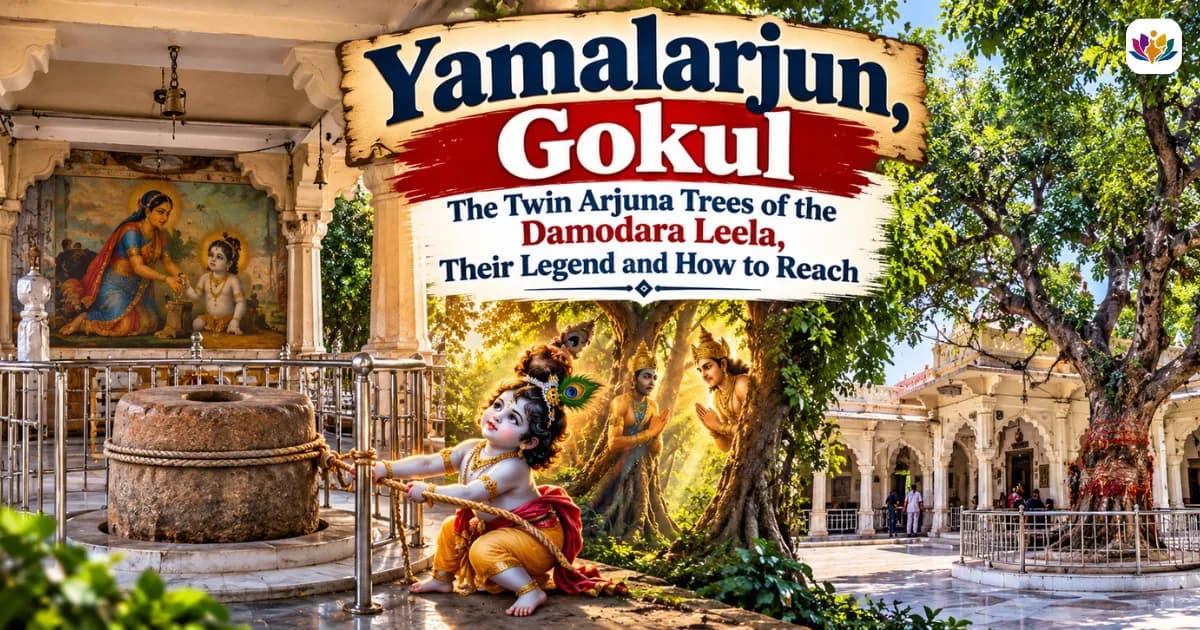
About twelve kilometres downriver lies Gokul, my own home, where the infant Krishna was raised in secret. Its shrines are tender rather than grand. At Chaurasi Khamba in Mahavan, the eighty-four pillared hall revered as the home of Nanda, he was raised through infancy. At Raman Reti, devotees still touch the soft sand where he played. At Brahmand Ghat, Yashoda saw the whole universe in his mouth. And at Chintaharan Mahadev, Shiva appeared as the remover of her worry. No visit to Mathura is complete without them.
8. Dauji Temple at Baldeo: Krishna’s brother
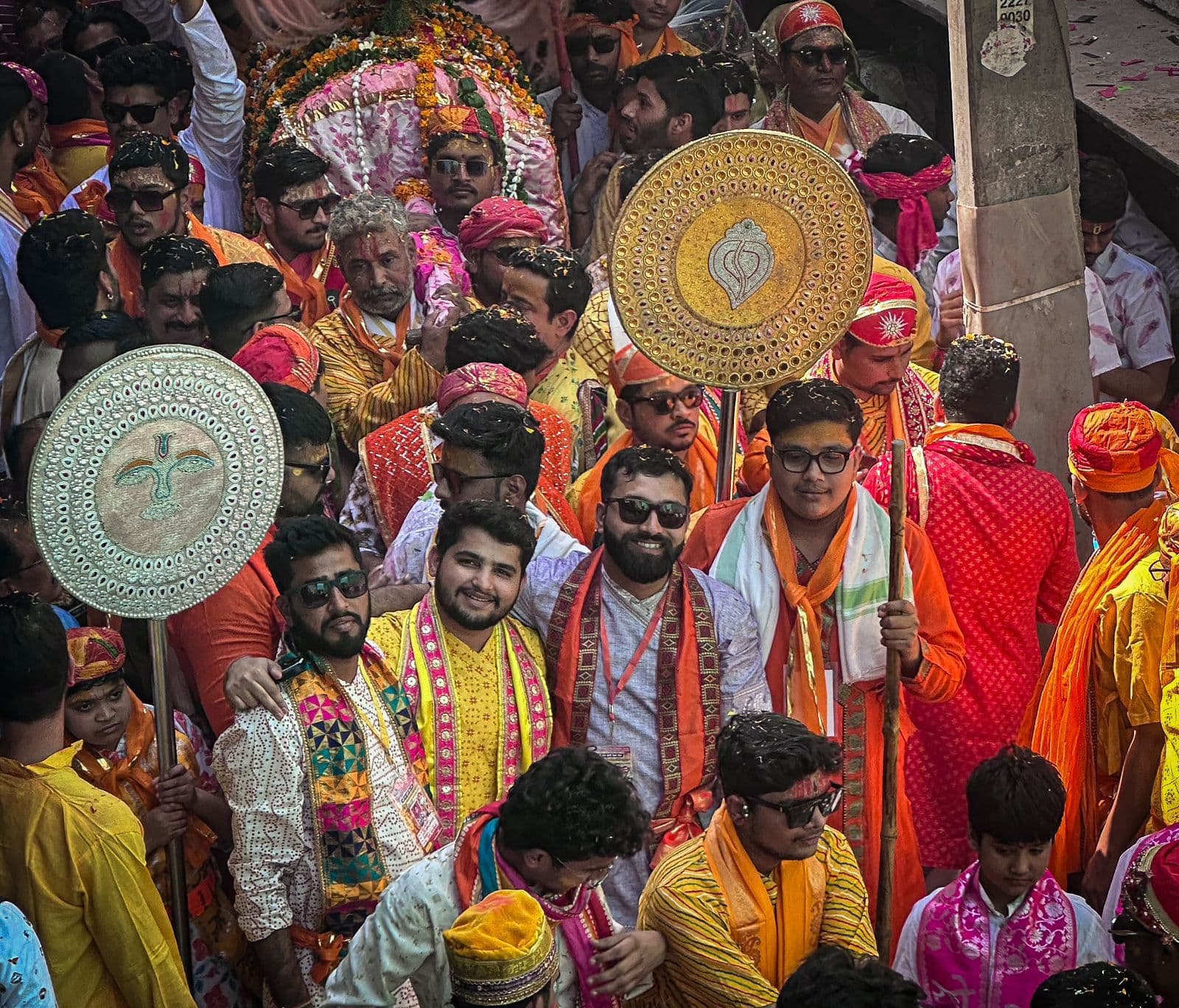
About twenty kilometres from Mathura stands the Dauji Maharaj Temple at Baldeo, the great temple of Balarama, Krishna’s elder brother, lovingly called Dauji. Its black stone deity, around seven feet tall, is held to be the largest Balarama image in Braj, and he is worshipped alongside his consort Revati. The temple is most famous for the Huranga, the boisterous colour play held the day after Holi. It is the one temple in this guide where Krishna is not the presiding deity, and it is deeply loved for that.
Mathura temple timings and locations
This is the question I am asked most, so here is the whole set in one place. Nearly every temple in Mathura opens early, closes for a few hours around midday and opens again in the evening, and several change their hours between summer and winter. Treat the table as a guide, not a guarantee: temple hours shift with the season, with festival days and sometimes at the temple’s own discretion, so reconfirm before you set out.
Darshan timings and locations for the famous temples of Mathura. Timings shift with the season and on festival days, so verify on the day.
Temple | Darshan timings | Where it is |
Krishna Janmabhoomi | 5:00 AM to 12:00 PM, 4:00 PM to 9:00 PM | Deeg Gate Chauraha, Janmabhoomi, Mathura |
Keshav Dev | 5:00 AM to 9:30 PM | Within the Janmabhoomi complex |
Dwarkadhish Temple | 6:30 AM to 10:30 AM, 4:30 PM to 7:00 PM | Pathak Gali, beside Vishram Ghat, Mathura |
Gita Mandir (summer) | 5:00 AM to 12:00 PM, 2:00 PM to 9:00 PM | Gaushala Nagar, Gita Mandir Marg |
Gita Mandir (winter) | 5:30 AM to 12:00 PM, 2:00 PM to 8:30 PM | Gaushala Nagar, Gita Mandir Marg |
Bhuteshwar Mahadev | 5:00 AM to 1:00 PM, 4:30 PM to 10:30 PM | Bhuteshwar, near the Janmabhoomi |
Rangeshwar Mahadev | 5:00 AM to 12:00 PM, 5:00 PM to 10:00 PM | Holi Gate to Tank Chauraha Road, Mathura |
Adi Varaha (summer) | 6:30 AM to 10:30 AM, 4:00 PM to 7:00 PM | Krishna Nagar, near Dwarkadhish |
Adi Varaha (winter) | 6:30 AM to 10:30 AM, 3:30 PM to 6:30 PM | Krishna Nagar, near Dwarkadhish |
Chamunda Devi Temple | 6:30 AM to 12:00 PM, 4:00 PM to 9:00 PM | Masani, Mathura |
Dauji Temple | 8:00 AM to 6:00 PM | Baldeo, about 20 km from Mathura |
Jai Gurudev Mandir | 7:00 AM to 7:00 PM | Madhavpuri, on the Delhi to Agra highway |
Swaminarayan Mandir | 9:00 AM to 7:00 PM | Bangali Ghat, Mathura |
Two honest notes on the table. Dwarkadhish does not simply stay open through the block shown; being a Pushtimarg haveli temple, it gives a series of jhanki darshans, the doors opening and closing several times within those hours, and the schedule differs on festival days, so ask at the gate when you arrive. And Vishram Ghat has no closing hour at all, being an open riverside, though the evening Yamuna aarti time moves with sunset through the year.
The Gokul shrines, Chaurasi Khamba, Raman Reti, Brahmand Ghat and Chintaharan Mahadev, follow the same broad pattern of a morning and an evening session with a long midday break. Each of the guides linked through this article carries its own current hours, which we keep updated.
Planning your temple circuit
A single unhurried day covers the core of Mathura: the Janmabhoomi and Bhuteshwar in the morning, Dwarkadhish and Vishram Ghat around the aarti, with Gita Mandir slotted in between. A second day opens Gokul and Baldeo. Reach each temple early, since most close for a few hours at midday and reopen in the evening; timings shift with the season, so reconfirm on the day, and each guide linked above carries the current hours. Our top places to visit in Mathura page has the wider sightseeing, and a private car from our Mathura Vrindavan taxi service ties the lanes together. For a ready circuit, take a Same Day Mathura Vrindavan Tour or, to include Gokul, a 2 Days Gokul Mathura Vrindavan Tour.
When to visit
The cool months of October to March are the most comfortable. Janmashtami, in the monsoon, is Mathura’s supreme festival, when the Janmabhoomi fills through the night for the midnight birth, magnificent but immensely crowded; note that it falls on two different dates by different traditions, and both are genuine. Holi brings the Huranga at Baldeo. Mahashivratri belongs to the guardian Shivas. Our best time to visit Mathura Vrindavan guide has the seasons in full.
The honest bit
Honest words on Mathura's temples. Entry to every one of them is free; no one should charge you for darshan, and there is no official VIP pass anywhere in Braj, whatever a tout may offer. Phones are not allowed inside the Janmabhoomi and several others, so do not expect to photograph the deities. Priests may press a tilak or a thread on you and then ask for money; a polite, firm no is enough. The Yamuna at the ghats is revered and, honestly, polluted, so take the aarti but do not bathe carelessly. Timings shift with the season and on festival days, so always reconfirm rather than trusting a fixed number online.
Why Experience My India is the right choice
I was born in Gokul Mahaban Bangar, in the Mathura district, so these temples are not a route to me but a neighbourhood. Guiding since 2018, more than 50,000 pilgrims, 4.5 stars across 204 Google reviews, WhatsApp first, 8 AM to 9 PM daily. The value of a local here is exact: knowing which temple is calm at which hour, which of the guardian Shivas is worth your morning, where to leave your phone, and how to reach the ghat before the aarti begins rather than after. We drive the right order, keep the touts away, and quote one clear fare with no charge for free darshan.
Tip from Gurudutt: do the Janmabhoomi first thing in the morning and keep Vishram Ghat for dusk. Between them, the whole story of Mathura unfolds in a single day, from the midnight birth to the ghat where he rested when the tyrant was gone, and the aarti closes it perfectly.
Related guides
Ready to see Mathura’s temples?
Tell me your dates and your group, and I will plan your Mathura temple circuit in the right order and at the right hours, for one clear price. WhatsApp +91 7302265809, any day 8 AM to 9 PM. Packages from Rs 5,999 per person, 4.5 stars from 204 Google reviews. Born in Gokul, Mathura.
Book Your Mathura - Vrindavan Trip Today 📞 +91-7302265809 💬 WhatsApp: +91-7302265809 Packages start from ₹1,999/ person | Rated 4.5★ / 204+ Reviews Explore all: Mathura Vrindavan Tour Packages Jai Shri Krishna 🙏 |
Gurudutt — Born & Raised in Braj Bhoomi
Guiding pilgrims through Mathura & Vrindavan since 2018 · 50,000+ pilgrims served