📌 QUICK ANSWER
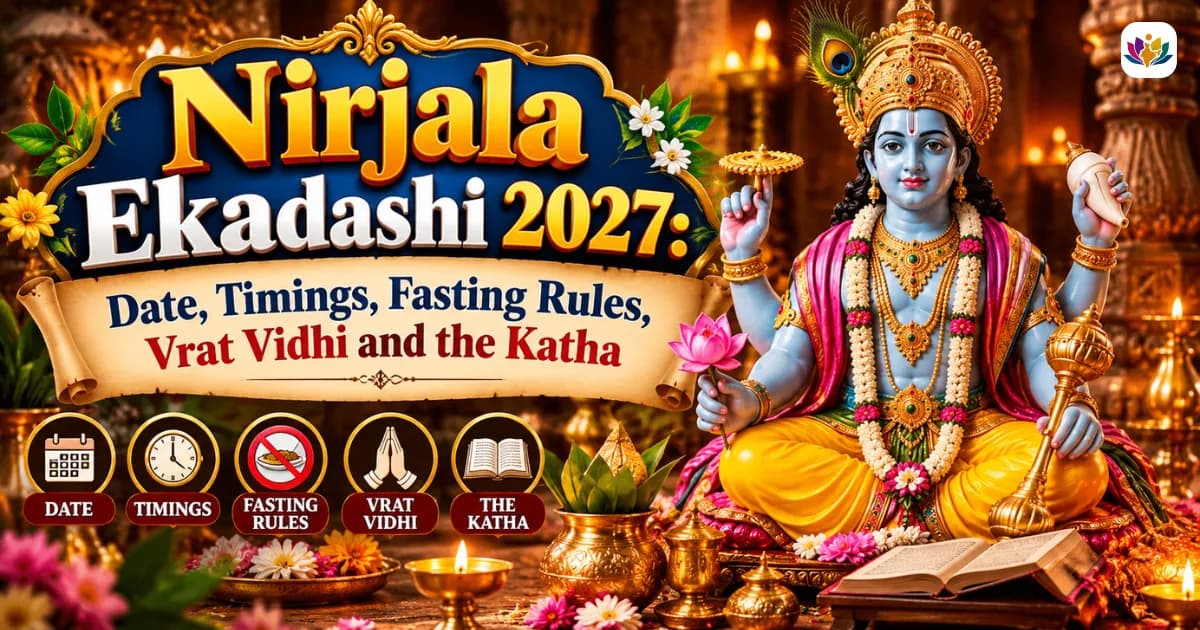
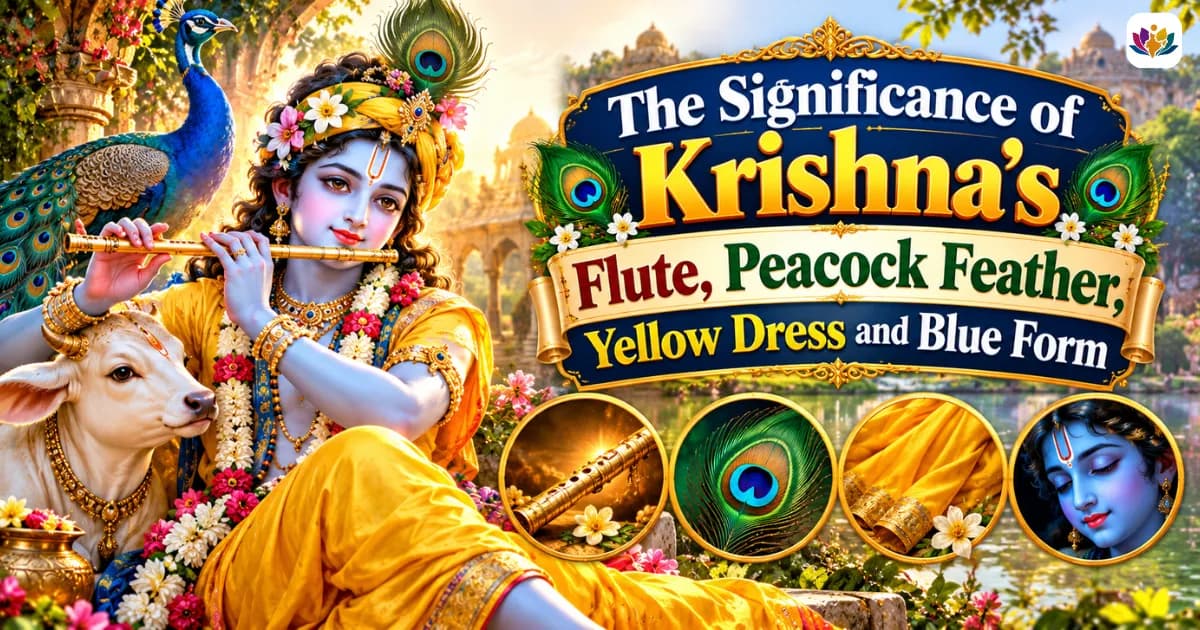
Krishna's flute (bansuri) signifies the ego-less, surrendered devotee, hollow and empty of self, through whom the Lord's own music flows; its call is the divine summons to the soul. His peacock feather shows that he treasures pure love from even the humblest being and holds all the colours of creation. His yellow dress (pitambar) stands for knowledge, the earth and purity, shining like lightning against his dark form. And his blue, dark complexion signifies the infinite and all-pervading, vast and immeasurable as the sky and the sea. To walk the land of the flute-player, call or WhatsApp +91 7302265809.
Every image of Lord Krishna is rich with meaning: the flute at his lips, the peacock feather in his crown, the golden-yellow cloth about his dark-blue form. These are not mere decorations; each is a beautiful symbol, carrying a deep spiritual truth. Why does Krishna play a flute? Why the peacock feather, the yellow dress, the blue skin? Here, from one born in Braj, the land of Krishna, is the significance of each of these beloved symbols of the Lord. Plan your visit with our Mathura Vrindavan tour packages.
Key takeaways
Krishna's flute (bansuri) signifies the ego-less, surrendered devotee through whom God sings.
The flute's music is the divine call that draws the soul to the Lord.
The peacock feather shows Krishna treasures pure devotion from any being and holds all colours.
The yellow dress (pitambar) stands for knowledge, the earth and purity, like lightning on a cloud.
Krishna's blue, dark form signifies the infinite and all-pervading, vast as the sky and sea.
Each symbol is a doorway to a spiritual truth, not mere decoration.
I am Gurudutt, born in Gokul in the Mathura district, in the land where Krishna played his flute among the cows and gopis. Guiding pilgrims since 2018, more than 50,000 of them, I am often asked the meaning of the symbols with which the Lord is shown. Here I explain the significance of his flute, his peacock feather, his yellow dress and his blue form, from the devotional tradition, in the land where he bore them all.
The significance of Krishna's flute (bansuri)
The flute, the bansuri or murli, is Krishna's most beloved emblem and its meaning is among the deepest of all. The bansuri is a simple length of bamboo, hollow and empty within, with no music of its own; it sings only when Krishna raises it to his lips and breathes through it. In this lies its whole teaching: the flute is the perfect devotee, emptied of ego and self-will, hollowed of all 'I' and 'mine', so that the Lord's own breath can flow through it and make divine music. We are each meant to be such a flute: empty yourself of ego and God will sing through your life. The flute asks nothing and keeps nothing; it simply surrenders to the Lord's lips and so is kept always close to him, at his mouth, nearer than any other. Its music, the venu geet, is the divine call that draws the gopis from their homes and draws every soul to God. That Krishna, the Supreme, chooses such a humble instrument shows that God makes his sweetest music through the simple and the surrendered, not the proud and the full. This is why he is adored as Murlidhar, the holder of the flute and Murlimanohar, the one made beautiful by it.
Why Krishna wears a peacock feather (mor pankh)
The peacock feather in Krishna's crown carries its own lovely meaning. By a beloved tradition, when Krishna played his flute in Vrindavan, the peacocks danced in ecstasy at its music and the king of the peacocks, in gratitude and devotion, offered a feather at his feet; Krishna, moved by this pure love from a mere bird, placed it upon his own crown, above all his ornaments. So the peacock feather shows that the Lord treasures sincere devotion and love from any being, however humble and honours it above riches, a tender teaching that it is the heart's love, not status, that he values. The feather's many colours, gathered in its 'eye', are also seen to hold all the hues of creation, so that Krishna, wearing it, contains and crowns the whole rainbow of the cosmos; and the peacock, which dances in joy even in the rains, speaks of devotion and beauty amid all of life's seasons.
The meaning of Krishna's yellow dress (pitambar)
Krishna is almost always shown wearing a garment of golden yellow, the pitambar ('pita' meaning yellow, 'ambar' meaning cloth). Yellow is a deeply auspicious colour in our tradition, associated with knowledge and learning, with the earth and the ripened harvest and with purity and auspiciousness, so the yellow cloth signifies the Lord as the source of wisdom and the sustainer of the world. But its most beautiful meaning is in contrast: Krishna's form is dark, like a deep rain-cloud and against that darkness the golden-yellow cloth shines like lightning across a monsoon sky. The poets of Braj loved this image, the dark cloud (shyam) girded with lightning (the pitambar), at once beautiful and full of the promise of life-giving rain. The yellow upon the dark is the radiance of the divine made visible.
Why Krishna is shown blue (the significance of his colour)
Perhaps the most-asked question is why Krishna is blue. In truth, the scriptures describe his complexion as dark, shyam, like a rain-filled cloud or the deep blue of night; his very name, Krishna, means 'the dark one'. He is shown blue to convey this dark, blue-black beauty and, more deeply, because blue is the colour of the infinite and the immeasurable. The sky is boundless and blue; the ocean is vast and blue; and so the blue of Krishna's form signifies that which is limitless, all-pervading and beyond all measure, the infinite divine itself, taking a form the heart can love. Just as we cannot measure the depth of the sky or the sea, so we cannot measure the Lord; his blue is the colour of the boundless. And the dark rain-cloud he resembles is the bringer of life and relief to a parched world, as Krishna is to the thirsting soul. So his colour is not a mere complexion but a window onto his infinite, life-giving nature.
The symbols of Krishna, in brief
Here is a summary of the four symbols and their meaning.
Symbol | What it signifies |
The flute (bansuri) | The ego-less, surrendered devotee through whom God sings; the divine call to the soul |
The peacock feather | Krishna treasures pure devotion from any being; the feather holds all the colours of creation |
The yellow dress (pitambar) | Knowledge, the earth and purity; lightning shining against his dark, cloud-like form |
The blue, dark form | The infinite and all-pervading, vast as sky and sea; the life-giving rain-cloud |
The symbols of Krishna and their significance, in brief.
Where to feel it: the flute-player's own land
These symbols come alive in Braj, where Krishna bore them. Here he played the flute that called the gopis, in the groves of Vrindavan, remembered at Nidhivan; here he is worshipped as the dark, beautiful Lord at the Banke Bihari temple, where his very name, Bihari, means the one who enjoys these pastimes; here, at the Radha Raman temple and along the Yamuna at Kesi Ghat, his flute, feather, yellow cloth and dark form are adored in daily worship. To stand before the deity of Krishna in his own Braj, flute in hand and feather in crown, is to see these symbols not as ideas but as the living, beautiful Lord.
The honest bit
Honest words from one born in Braj. These meanings of Krishna's flute, feather, dress and colour are drawn from the devotional and poetic tradition of our faith and such symbols are rich and layered, so you will find more than one interpretation of each, all beautiful and sometimes differing in detail between teachers and texts. The explanations here are the most-loved and widely-held ones, offered to open the heart of each symbol, not as the single rigid meaning. The deeper truth is that every detail of the Lord's beautiful form is meant to draw the mind to him and to teach the soul: the flute to surrender, the feather to humble love, the dress to purity, the colour to the infinite. To contemplate them is itself a devotion and to see them worshipped in Braj, their own land, is to understand them with the heart as well as the mind.
Why Experience My India is the right choice
I was born in Gokul in the Mathura district, in the land of the flute-player. Guiding since 2018, more than 50,000 pilgrims, 4.5 stars on Google, WhatsApp first, 8 AM to 9 PM daily. We take you through Braj to the temples where Krishna is worshipped with his flute, feather and yellow cloth, tell you the meaning of his beautiful form on the very ground, walk you into the temple's cars and share the stories and symbols with devotion, with no touts. One clear fare and never a charge for free darshan.
Tip from Gurudutt: when you stand before the deity of Krishna in Braj, do not only look; contemplate. See the flute at his lips and remember that he sings through those who empty themselves of ego. See the peacock feather and remember that he treasures your love however humble you feel. See the yellow cloth bright against his dark form, like lightning on a monsoon cloud and the deep blue of the infinite in his body and let each symbol draw your heart a little nearer. To learn the meaning of his form and then to behold it in his own land of Braj, is to meet Krishna with both understanding and love.
Related guides
Barsana and Nandgaon: the twin villages of Radha and Krishna
Vrindavan and Govardhan: the temple town and the sacred hill
Explore more Braj guides
Plan your visit to the land of Krishna
Tell me your dates and I will plan your journey through Braj, the land of Krishna's flute and his leelas, with a car, a guide born on this soil and your seva arranged, for one clear price. Our Mathura Vrindavan tour packages from Delhi and the NCR and our Mathura tour packages cover the heart of Braj. WhatsApp +91 7302265809, any day 8 AM to 9 PM. Packages from ₹1,999 per person, 4.5 stars on Google. Born in Gokul, Mathura.
Book Your Mathura - Vrindavan Trip Today 📞 +91-7302265809 💬 WhatsApp: +91-7302265809 Packages start from ₹1,999/ person | Rated 4.5★ / 204+ Reviews Explore all: Mathura Vrindavan Tour Packages Jai Shri Krishna 🙏 |
Gurudutt — Born & Raised in Braj Bhoomi
Guiding pilgrims through Mathura & Vrindavan since 2018 · 50,000+ pilgrims served