📌 QUICK ANSWER
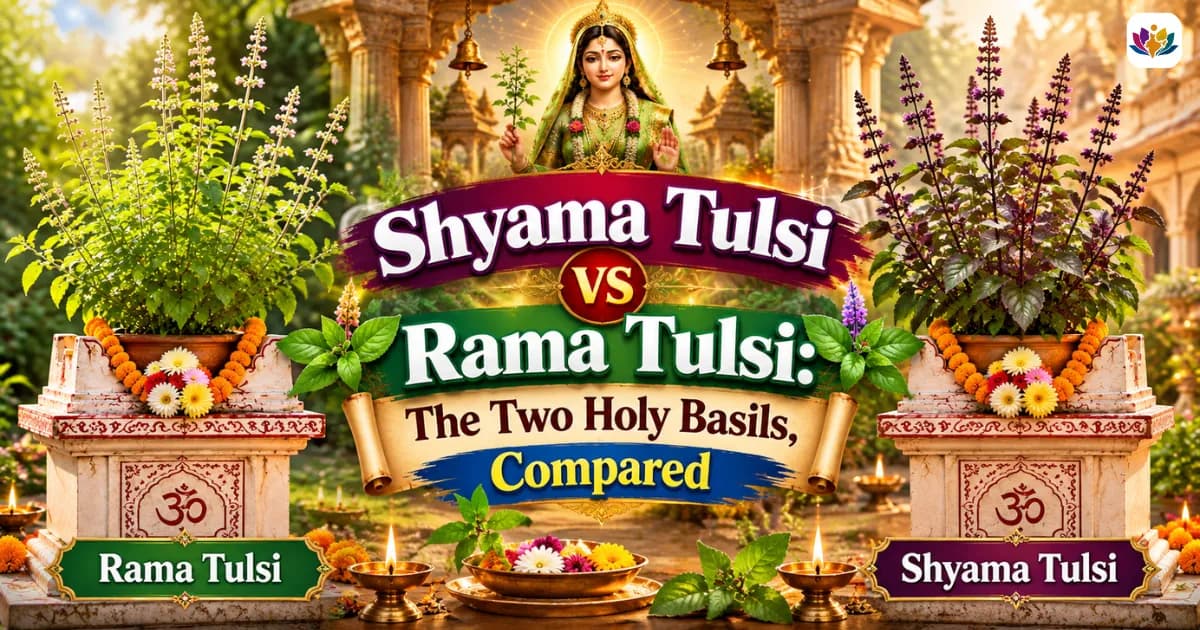
Shyama Tulsi and Rama Tulsi are the two main types of holy basil. Rama Tulsi (green leaf basil) has light green leaves, a milder, sweeter taste and is used for everyday worship and general wellbeing; it is linked to Lakshmi and Vishnu. Shyama Tulsi, also called Krishna Tulsi, has dark green to purple-black leaves, a sharper, peppery taste and is preferred in Ayurveda for stronger remedies; it is named after Krishna for its dark colour. Many homes plant both. To visit Vrindavan, the sacred forest of Tulsi, call or WhatsApp +91 7302265809.
Tulsi, the holy basil, is the most sacred plant in Hindu life, worshipped as a goddess and dear above all to Lord Krishna. There are two main types and people often wonder about the difference: Shyama Tulsi and Rama Tulsi. They differ in the colour of their leaves, their taste and their traditional uses and each carries its own spiritual meaning. Here, from one born in Braj, the land named after Tulsi herself, is a clear comparison of Shyama Tulsi and Rama Tulsi. Plan your visit with our Mathura Vrindavan tour packages.
Key takeaways
Shyama Tulsi and Rama Tulsi are the two main types of the holy basil plant.
Rama Tulsi has light green leaves and a milder, sweeter taste.
Shyama Tulsi (Krishna Tulsi) has dark green to purple-black leaves and a sharper, peppery taste.
Rama Tulsi is used for everyday worship; Shyama Tulsi is preferred in Ayurveda for stronger remedies.
Rama Tulsi is linked to Lakshmi and Vishnu; Shyama Tulsi is named after Krishna for its dark colour.
Many households plant both together, for spiritual and wellbeing benefits alike.
I am Gurudutt, born in Gokul in the Mathura district. There is no plant more sacred to us in Braj than Tulsi, for Vrindavan itself is named after Vrinda, another name for Tulsi, the great devotee of the Lord and Tulsi grows in every temple and courtyard here, offered to Krishna who loves her above all leaves. Guiding pilgrims since 2018, more than 50,000 of them, I am glad to explain the two holy basils, Shyama and Rama and their meaning in the land of Tulsi.
Shyama Tulsi vs Rama Tulsi: at a glance
Here is the comparison, side by side, before the detail below.
Feature | Rama Tulsi | Shyama Tulsi |
Also known as | Green leaf basil | Krishna Tulsi |
Leaves | Light green | Dark green, often deep purple or black |
Stems | Green | Dark purple |
Flowers | Light purple or white | Dark |
Taste | Milder, sweeter | Sharper, crisp, peppery and pungent |
Main use | Everyday worship, general wellbeing | Ayurvedic remedies (throat, cough, skin) |
Linked to | Lakshmi and Vishnu | Krishna (dark like his complexion) |
Brings | Peace and prosperity | Spiritual and wellbeing benefits |
Shyama Tulsi vs Rama Tulsi at a glance. The detail follows below.
Appearance: how to tell them apart
The easiest way to tell the two apart is by colour. Rama Tulsi has light green leaves and green stems, with light purple or white flowers, a bright, fresh-looking plant. Shyama Tulsi, by contrast, has darker leaves, deep green that often turns purple or almost black, paired with dark purple stems. It is this dark, almost dusky colour that gives Shyama Tulsi its name, for 'Shyama' means dark and it is likened to the dark, blue-black complexion of Lord Krishna himself.
Taste and flavour
The two also differ in taste. Rama Tulsi has a milder, sweeter flavour, which is why it is the gentler, everyday Tulsi. Shyama Tulsi has a sharper, crisp, peppery and more pungent taste, stronger on the tongue, which reflects its more potent character and its stronger use in traditional remedies.
Uses and benefits
Both Tulsis are revered and both are used, but a little differently. Rama Tulsi, the milder green basil, is the one most often grown for everyday worship and kept in the home for general wellbeing; it is the common, gentle, daily Tulsi. Shyama Tulsi, the darker Krishna Tulsi, is traditionally preferred in Ayurveda for stronger medicinal use, being used in remedies for throat and respiratory complaints, coughs and skin conditions. (These are traditional uses; for any health concern, please consult a qualified practitioner rather than self-treating.) Many households, wanting the best of both, plant the two varieties side by side.
Spiritual significance
Beyond their appearance and use, each Tulsi carries a spiritual meaning. Rama Tulsi is associated with Goddess Lakshmi and Lord Vishnu and is held to bring peace and prosperity to the home where it is worshipped. Shyama Tulsi is named after Lord Krishna, for its dark purple colour matches the traditional description of his beautiful dark complexion; it is especially dear to his devotees. Both are forms of the sacred Tulsi, the goddess Vrinda, beloved of the Lord and both are deeply auspicious, which is why so many homes keep both, for spiritual blessing and for wellbeing alike.
Tulsi and Vrindavan: the forest of Tulsi
Nowhere is Tulsi more sacred than in Vrindavan, for the very name Vrindavan means 'the forest (van) of Vrinda', Vrinda being another name for Tulsi, personified as a supreme devotee of the Lord. Tulsi is offered to Krishna above every other leaf, worn as beads (the Tulsi mala or kanthi) by his devotees and grown in every temple and home of Braj. The old Radha Raman temple and the temples of the Gaudiya tradition and the great ISKCON, all honour Tulsi in daily worship and the beloved Banke Bihari is offered her leaves. To visit Vrindavan is to walk in the forest of Tulsi herself.
Tulsi Vivah: the marriage of Tulsi to the Lord
The deep bond between Tulsi and the Lord is celebrated each year at Tulsi Vivah, the ceremonial marriage of the Tulsi plant to Lord Vishnu (in the form of the Shaligram or Krishna), held in the month of Kartik, which marks the start of the Hindu wedding season. In Vrindavan and across Braj it is observed with great devotion and beauty. For the festival, see our guide to Tulsi Vivah in Vrindavan and the Mathura Vrindavan festivals calendar.
Which Tulsi should you keep?
For everyday worship and a gentle, auspicious home plant, Rama Tulsi (the mild green basil).
For stronger traditional Ayurvedic use, Shyama Tulsi (Krishna Tulsi), the darker, pungent one.
For devotees of Krishna especially, Shyama (Krishna) Tulsi holds a special dearness.
Many keep both together, for spiritual blessing and for wellbeing alike.
Whichever you keep, worship and water it with devotion; Tulsi is honoured as a goddess.
For any health use, consult a qualified Ayurvedic practitioner rather than self-treating.
The honest bit
Honest words from one born in Braj. Both Shyama and Rama Tulsi are forms of the one sacred holy basil and the differences, in colour, taste and traditional use, are real but gentle; neither is 'better' and both are deeply auspicious. On the health side, Tulsi has long been valued in Ayurveda and Shyama Tulsi especially for throat and respiratory remedies, but these are traditional uses, not medical prescriptions, so please see a qualified practitioner for any real complaint. And remember, above all, that in our tradition Tulsi is not merely a herb but a goddess, the devotee Vrinda, beloved of Krishna; so whichever you keep, keep it with reverence. To see Tulsi honoured as she is in Vrindavan, her own forest, is to understand why she is the holiest of plants.
Why Experience My India is the right choice
I was born in Gokul in the Mathura district, in the land named after Tulsi herself. Guiding since 2018, more than 50,000 pilgrims, 4.5 stars on Google, WhatsApp first, 8 AM to 9 PM daily. We take you through Vrindavan, the forest of Tulsi, to the temples where she is worshipped with Krishna, help you obtain a genuine Tulsi mala or plant if you wish, tell you the stories and meaning on the ground and arrange your seva, with no touts. One clear fare and never a charge for free darshan.
Tip from Gurudutt: if you love Tulsi, there is no place like Vrindavan to feel her sanctity, for this is literally her forest, the van of Vrinda. Come and see Tulsi growing in every temple courtyard, her leaves offered to Krishna at every altar, her beads worn by every devotee; take a genuine Tulsi mala from here, grown in Braj, to wear or to keep; and if you can, come at Tulsi Vivah to see her married to the Lord. To hold a Tulsi leaf from Vrindavan, knowing she is the goddess Vrinda, beloved of Krishna, is to carry a little of the holiest of plants, from the holiest of places, home with you.
Related guides
Explore more Braj guides
Plan your visit to Vrindavan, the forest of Tulsi
Tell me your dates and I will plan your journey through Vrindavan and Braj, the land of Tulsi and Krishna, with a car, a guide born on this soil and your seva arranged, for one clear price. Our Mathura Vrindavan tour packages from Delhi and the NCR and our Mathura tour packages cover the heart of Braj. WhatsApp +91 7302265809, any day 8 AM to 9 PM. Packages from ₹1,999 per person, 4.5 stars on Google. Born in Gokul, Mathura.
Book Your Mathura - Vrindavan Trip Today 📞 +91-7302265809 💬 WhatsApp: +91-7302265809 Packages start from ₹1,999/ person | Rated 4.5★ / 204+ Reviews Explore all: Mathura Vrindavan Tour Packages Jai Shri Krishna 🙏 |
Gurudutt — Born & Raised in Braj Bhoomi
Guiding pilgrims through Mathura & Vrindavan since 2018 · 50,000+ pilgrims served