📌 QUICK ANSWER
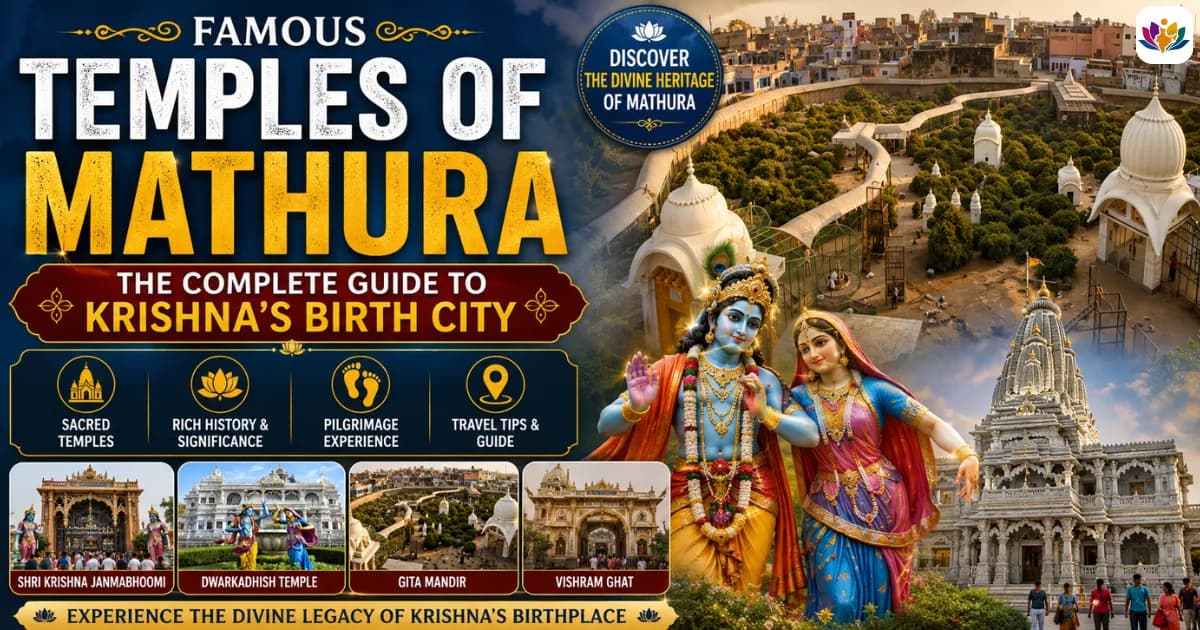
The most famous temples in Vrindavan are Banke Bihari, the town’s most beloved shrine; Prem Mandir, the marble temple lit up at night; ISKCON Krishna Balaram, with its dawn Mangala Aarti; and the seven Goswami temples, led by Radha Raman, whose deity self-manifested in 1542. Vrindavan is said to hold thousands of temples in all. Entry to every one of them is free, and most open early, close for a few hours at midday and reopen in the evening. Two unhurried days cover the great ones. To see them with a Braj-born guide, call or WhatsApp +91 7302265809.
Key takeaways
Banke Bihari is the heart of Vrindavan; darshan comes in glimpses.
Prem Mandir is the great modern marvel, finest after dark.
ISKCON Krishna Balaram holds a genuine daily Mangala Aarti at dawn.
The seven Goswami temples are the ancient devotional core of the town.
Radha Raman has kept a sacred fire burning since 1542.
Entry is free everywhere, with a long midday closure at most temples.
I am Gurudutt, born in Gokul in the Mathura district, guiding pilgrims through Braj since 2018: more than 50,000 of them. Vrindavan is said to hold thousands of temples, and no guide can list them all, nor should it. What matters is knowing which ones to give your hours to, and why each is loved. Some are ancient and half hidden down lanes; some are vast marble marvels; some are groves rather than buildings. This guide sets them out honestly, with the timings pilgrims always ask for. Plan your temple circuit with our Mathura Vrindavan Tour Package, message us on WhatsApp at +91 7302265809, any day from 8 AM to 9 PM.
The famous temples of Vrindavan at a glance
The most famous temples in Vrindavan and when each is at its best.
Temple | Known for | Best time to go |
Banke Bihari | The beloved deity and jhanki darshan | Early morning, weekdays |
Prem Mandir | White marble and the evening light show | After dark |
ISKCON Krishna Balaram | Kirtan and the dawn Mangala Aarti | Early morning |
Radha Raman | Self-manifested deity, fire burning since 1542 | Morning session |
Radha Vallabh | Radha held supreme; no separate idol | Evening |
Radha Damodar | Goswami samadhis and the Govardhan Shila | Morning |
Govind Dev Ji | Red sandstone grandeur of 1590 | Midday darshan |
Rangji Mandir | South Indian Dravidian style and gopuram | Morning |
Madan Mohan | The oldest temple, hilltop by the Yamuna | Late afternoon |
Nidhivan | The sacred grove of the nightly raas belief | Before dusk |
Banke Bihari: the heart of Vrindavan
If you visit only one temple, visit Banke Bihari. The deity was manifested by the saint Swami Haridas from the grove of Nidhivan, and the present temple dates to 1864. Worship follows the gentle Haridasi tradition, and it is unlike anywhere else in India: there is no bell and no conch, and the curtain is drawn across the deity and opened again every few minutes, so that darshan comes in glimpses. Tradition holds that a long, unbroken gaze upon Bihariji would overwhelm the devotee entirely. The crowd surges each time the curtain parts, and that shared gasp is something you never forget. Go on a weekday at the morning opening; phones are not allowed inside.
Prem Mandir: the marble marvel
Vrindavan’s most photographed temple, Prem Mandir was built by Jagadguru Shri Kripalu Ji Maharaj and inaugurated in February 2012. It is carved from white Italian marble, its outer walls covered with sculpted scenes of Krishna’s leelas, set in wide gardens with fountains. By day it is beautiful; after dark, when the marble is washed in changing colour and the musical fountain show runs, it is the single loveliest sight in the town. Entry and the light show are both completely free. It is easy underfoot, so it suits families and elderly pilgrims better than the old lanes.
ISKCON Krishna Balaram Mandir
Established in 1975 by Srila Prabhupada, founder of ISKCON, the Krishna Balaram Mandir is the most international temple in Braj, with continuous kirtan, a white marble shrine and Prabhupada’s samadhi in the grounds. Its deities are Krishna and Balaram, Radha Shyamsundar and Gaura Nitai. Unlike Banke Bihari, ISKCON does hold a genuine daily Mangala Aarti before dawn, and for many pilgrims that early hour, with the chanting rising in the half dark, is the most moving of the whole trip. The gardens are calm, and prasad is served.
The seven Goswami temples: the devotional core
This is the part most temple lists skim, and it is the one that rewards a pilgrim most. In the sixteenth century, Chaitanya Mahaprabhu sent his foremost followers, the Goswamis, to Vrindavan to recover the lost holy places of Krishna’s leelas and establish worship there. The temples they founded are known together as the seven Goswami temples, and walking all seven is a cherished circuit.
The seven Goswami temples of Vrindavan, the devotional core of the town.
Temple | Founded by | What makes it special |
Radha Raman | Gopala Bhatta Goswami | Deity self-manifested from a shaligram in 1542 |
Radha Damodar | Jiva Goswami | Govardhan Shila and the Goswami samadhis |
Radha Madan Mohan | Sanatana Goswami | The oldest temple, on the hill by the Yamuna |
Radha Govind Dev | Rupa Goswami | Red sandstone grandeur, built 1590 |
Radha Gopinath | Madhu Pandita Goswami | Deity recovered from the Yamuna sands |
Radha Shyamsundar | Shyamananda Pandita | Modest outside, deeply devotional within |
Radha Gokulananda | Lokanatha Goswami | Founded by the seventh Goswami of Vrindavan |
Radha Raman is the one I send every serious pilgrim to. Its deity, in the tradition, self-manifested from a shaligram shila in the hands of Gopala Bhatta Goswami in 1542, and has never been moved or replaced. A sacred fire lit in that same year has been kept burning without break ever since, and the temple kitchen still cooks upon it. There is no separate idol of Radha; a crown beside Krishna marks her presence, as at Radha Vallabh.
Radha Damodar in Loi Bazaar, founded by Jiva Goswami, holds the Govardhan Shila that Krishna gave to Sanatana Goswami, four circuits of which are held to equal one full Govardhan parikrama, a gift to elderly pilgrims who cannot walk the hill. The samadhis of Rupa and Jiva Goswami are here, and the room where Srila Prabhupada wrote before founding ISKCON. See our Radha Damodar guide.
An honest note on the deities. Several of the original Goswami deities are no longer in Vrindavan. Under Aurangzeb they were carried to Rajasthan for safety: Madan Mohan’s original went to Karauli, and Govind Dev’s and Gopinath’s to Jaipur, where they are worshipped to this day. What you see in Vrindavan is a pratibhu murti, a representative deity held in the tradition to carry the same potency. Any guide who tells you the original Govind Dev still stands in Vrindavan is mistaken, and I would rather you heard it from me.
The great architectural temples
Govind Dev Ji. Built in 1590 by Raja Man Singh of Amber, Govind Dev Ji is Vrindavan’s architectural set piece, a vast red sandstone temple originally of seven storeys, reduced to three after the upper floors were razed under Aurangzeb. Even so it is majestic, and unlike any other temple in Braj.
Rangji Mandir. The largest temple in Vrindavan and the only one in South Indian Dravidian style, with a towering gopuram, built between 1845 and 1851. Its spring Brahmotsav chariot festival is a great fair. See our Rangji Mandir guide.
Madan Mohan. The oldest temple in the town, raised around 1580 under Sanatana Goswami on a hill by the Yamuna near Kaliya Ghat; the climb is worth it for the river view. See our Madan Mohan guide.
Shahji Temple. Built in 1876 by the Lucknow jeweller brothers Shah Kundan Lal and Shah Phundan Lal, famous for its twelve spiral marble pillars and the Basanti Kamra of Belgian chandeliers. See our Shahji Temple guide.
Jaipur Temple. Built by Maharaja Sawai Madho Singh II of Jaipur and completed in 1917, with carved red sandstone and single-rock pillars, and far calmer than the marquee temples. See our Jaipur Temple guide.
Jugal Kishore. One of the four oldest temples of Vrindavan, built in 1627 in red sandstone beside Kesi Ghat. See our Jugal Kishore guide.
Where Radha comes first: Radha Vallabh
Radha Vallabh Temple is the principal seat of the Radha Vallabh Sampradaya, founded in the sixteenth century by Shri Hit Harivansh Mahaprabhu, the tradition that holds Radha as supreme. The old temple, the Hit Mandir, was built in 1585 in a rare Hindu and Mughal red sandstone style and is a protected monument. As at Radha Raman there is no separate idol of Radha, only a crown beside Krishna marking her presence. Its summer Phool Bangla, the flower palace made fresh for the deity, is among the sweetest sights in Vrindavan.
The modern temples
Vrindavan keeps building. Besides Prem Mandir, the Vrindavan Chandrodaya Mandir is an ISKCON Bangalore project planned to become the tallest temple in the world at around 700 feet, still rising in phases. The Pagal Baba Temple is a nine storey white marble tower of 1969, much loved by families for its puppet shows and its view over the town. Vaishno Devi Dham recreates the Jammu shrine with a darshan cave, for devotees who cannot travel to Katra. And the Priyakant Ju temple, better known as the Vrindavan Lotus Temple, opened in 2016 as a 125 foot marble lotus, at its finest when illuminated after dark.
The groves, the Shiva and the Devi shrines
Not every sacred place in Vrindavan is a building. Nidhivan and Seva Kunj are dense groves of low, twisting trees where Swami Haridas meditated and Banke Bihari first appeared, and where, in living belief, Radha and Krishna perform the raas each night; the grove is cleared and locked after the evening aarti and no one remains after dark. Gopeshwar Mahadev is the beloved Shiva temple where, in the tradition, Shiva took the form of a gopi to enter the raas, and is revered as the only Gopi-form Shiva. Katyayani Peeth, a Shakti shrine, recalls the gopis’ prayers to win Krishna and is at its most vivid during Navratri. The Meera Bai Temple honours the saint-poetess who gave up a kingdom for Krishna, and Garud Govind at Chhatikara is famed for its Kalsarp puja.
Vrindavan temple timings
This is the question I am asked more than any other, so here is the whole set together. Nearly every temple opens early, closes for a few hours around midday when the deities rest, and opens again in the late afternoon. Several change their hours between summer and winter. Treat this as a guide rather than a guarantee, because timings shift with the season, with festival days and sometimes at the temple’s own discretion.
Darshan timings for the famous temples in Vrindavan. Timings shift with the season and on festival days, so verify on the day.
Temple | Darshan timings |
Banke Bihari (summer) | 7:45 AM to 12:00 PM, 5:30 PM to 9:30 PM |
Banke Bihari (winter) | 8:45 AM to 1:00 PM, 4:30 PM to 8:30 PM |
Prem Mandir | 8:30 AM to 12:00 PM, 4:30 PM to 8:30 PM |
Prem Mandir light show | About 7:30 PM to 8:00 PM in summer, 7:00 PM to 7:30 PM in winter |
ISKCON Krishna Balaram | From about 4:30 AM, with a midday break, to about 8:30 PM |
Radha Raman | 8:00 AM to 12:30 PM, 6:00 PM to 8:00 PM |
Radha Vallabh | About 5:00 AM to 9:00 PM, with a midday break |
Radha Damodar | 6:30 AM to 12:00 PM, 4:30 PM to 8:30 PM |
Radha Gopinath | 5:00 AM to 1:00 PM, 4:30 PM to 9:00 PM |
Govind Dev Ji | 5:00 AM to 12:30 PM, 4:30 PM to 9:00 PM |
Rangji Mandir | 8:00 AM to 12:00 PM, 4:00 PM to 8:00 PM |
Madan Mohan | 6:00 AM to 12:00 PM, 4:00 PM to 8:00 PM |
Shahji Temple | 8:00 AM to 11:00 AM, 5:00 PM to 8:00 PM |
Nidhivan | 6:00 AM to 7:00 PM, cleared and locked after the evening aarti |
Pagal Baba Temple | 6:00 AM to 8:00 PM |
Vrindavan Lotus Temple | 5:00 AM to 12:30 PM, 4:30 PM to 9:00 PM |
One caution about the tables you will find elsewhere online. Several popular listings give Banke Bihari a Mangala Aarti and give other temples a single unbroken block of hours; both are misleading. Banke Bihari has no daily Mangala Aarti, and the old Goswami temples give a series of darshan sessions within their published hours rather than staying open throughout. At Radha Raman a red or green light at the gate tells you whether the darshan is currently open, which is the most reliable guide of all.
How to plan your temple circuit
Two unhurried days cover the famous temples properly. Give the first morning to Banke Bihari at its opening and the old lanes around it, Radha Raman, Radha Damodar and Shahji, all within walking distance of each other. Keep the midday for rest, when the temples close. Give the evening to Prem Mandir and its lights. On the second day take ISKCON at dawn for the Mangala Aarti, then Govind Dev, Rangji and Madan Mohan, ending at Kesi Ghat for the Yamuna aarti at dusk. Our places to visit in Vrindavan guide have wider sightseeing, and the full set of guides sits on our temples of Mathura and Vrindavan hub. A private car from our Mathura Vrindavan taxi service saves hours in the lanes; for a ready circuit take a Same Day Mathura Vrindavan Tour or a 3 Days Mathura Vrindavan Pilgrimage Tour.
When to visit
October to March is the comfortable season, and Kartik in autumn the most devotional. Radha Ashtami, celebrating Radha’s appearance, is Vrindavan’s own great day, when the temples are decorated at their most lavish. Janmashtami fills them through the midnight hour, and falls on two different dates by different traditions, both genuine. Holi here is famous and chaotic in the best way. Festival crowds are immense, so book early. Our best time to visit Mathura Vrindavan guide sets out the seasons.
The honest bit
Honest words about Vrindavan's temples, because a great deal of nonsense is sold to pilgrims here. Entry and darshan are free at every temple in the town. There is no official VIP darshan pass for Banke Bihari, and anyone selling one is deceiving you; foreign visitors are targeted most. Banke Bihari has no daily Mangala Aarti, only rare festival days, while ISKCON, Radha Vallabh and the Lotus Temple genuinely do hold one. Nidhivan's nightly raas is a cherished living belief, not a documented fact, and I always say so. Several original Goswami deities now reside in Rajasthan, with a pratibhu worshipped here. Phones are barred inside many temples. And the Yamuna, for all its holiness, is honestly polluted, so take the aarti but do not bathe carelessly.
Our VIP darshan in Vrindavan guide explains the fake-pass trade in full, and is worth reading before you come.
Why Experience My India is the right choice
I was born in Gokul Mahaban Bangar, and Vrindavan’s temples are the lanes I grew up walking on. Guiding since 2018, more than 50,000 pilgrims, 4.5 stars across 204 Google reviews, WhatsApp first, 8 AM to 9 PM daily. What a local gives you here is precision: which temple is calm at which hour, which of the seven Goswami temples to walk to next, when the curtain opens at Bihariji, where to leave your phone, and how to reach the ghat before the aarti rather than after. We drive the right order, keep the touts and their fake passes away, and quote one clear fare with never a charge for free darshan.
Tip from Gurudutt: walk the old temples, do not drive them. Banke Bihari, Radha Raman, Radha Damodar and Shahji sit within a few narrow lanes of one another, and the walk between them, past the sweet shops and the sound of kirtan from open doorways, is half the pilgrimage. Save the car for the temples further out.
Related guides
Ready to see Vrindavan’s temples?
Tell me your dates and your group, and I will plan your Vrindavan temple circuit in the right order and at the right hours, for one clear price. WhatsApp +91 7302265809, any day 8 AM to 9 PM. Packages from Rs 5,999 per person, 4.5 stars from 204 Google reviews. Born in Gokul, Mathura.
Book Your Mathura - Vrindavan Trip Today 📞 +91-7302265809 💬 WhatsApp: +91-7302265809 Packages start from ₹1,999/ person | Rated 4.5★ / 204+ Reviews Explore all: Mathura Vrindavan Tour Packages Jai Shri Krishna 🙏 |
Gurudutt — Born & Raised in Braj Bhoomi
Guiding pilgrims through Mathura & Vrindavan since 2018 · 50,000+ pilgrims served